

Blog
How to Care for a Wooden Dining Table (Cleaning & Protection)

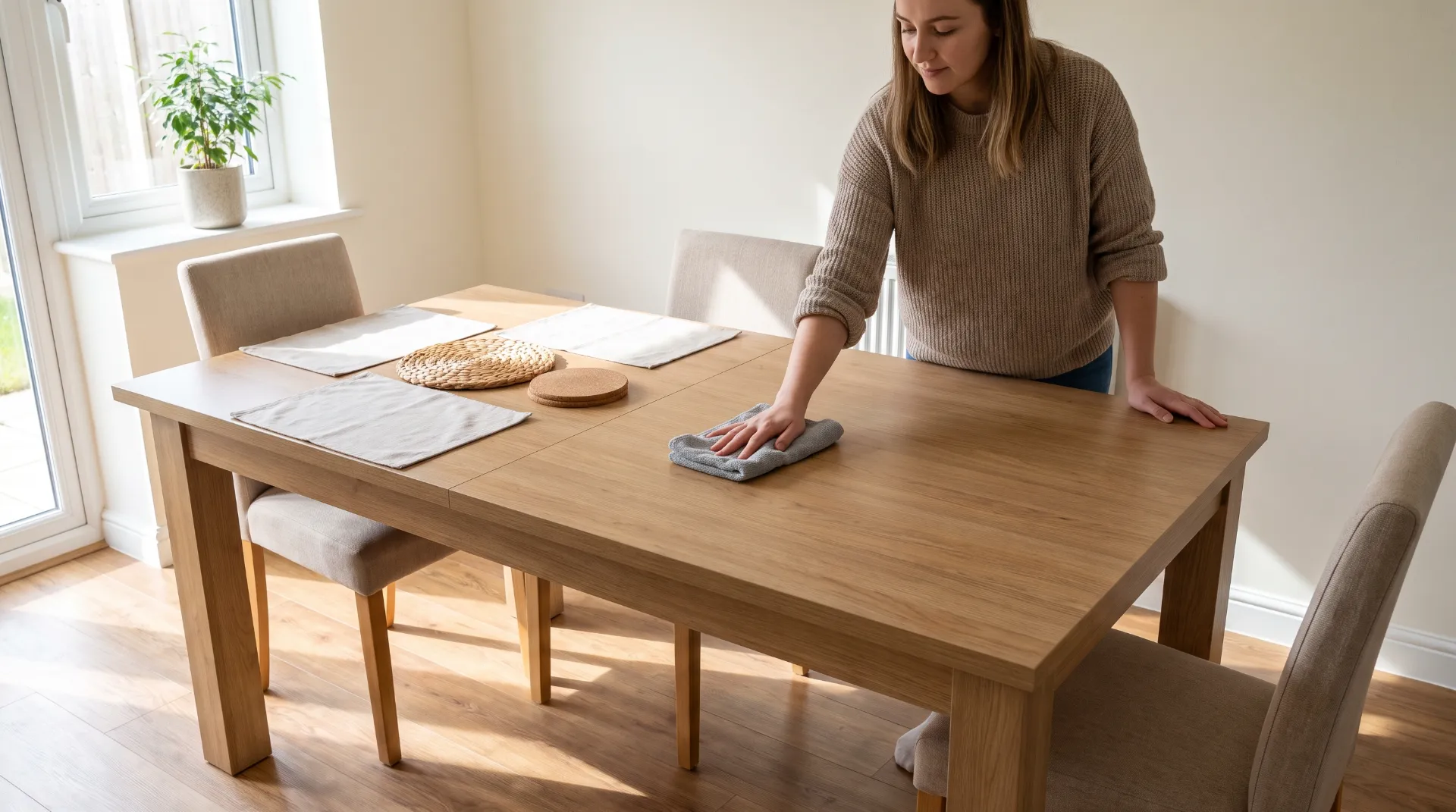
Your dining table works hard. It handles breakfast, homework, hot dishes and the odd spilled drink. A little care each day keeps it looking good for years.
This guide shows you how to care for a wooden dining table in plain, simple steps. You will learn how to clean it, protect it and fix common marks. You will also see how care changes with the finish. At the end, you will find five Kosy Koala tables with prices checked on our site.
If you are still choosing a table, start with our wooden dining table buying guide.
Quick answer: Wipe spills at once. Clean with a soft, damp cloth, then dry the surface. Use mats and trivets under plates, pans and mugs. Keep the table away from radiators and strong sun. Match your care to the finish. Oiled tops need re-oiling. Lacquered tops need gentle cleaning. Wood-effect tops need only a damp cloth.
First, Know What Your Table Is Made Of
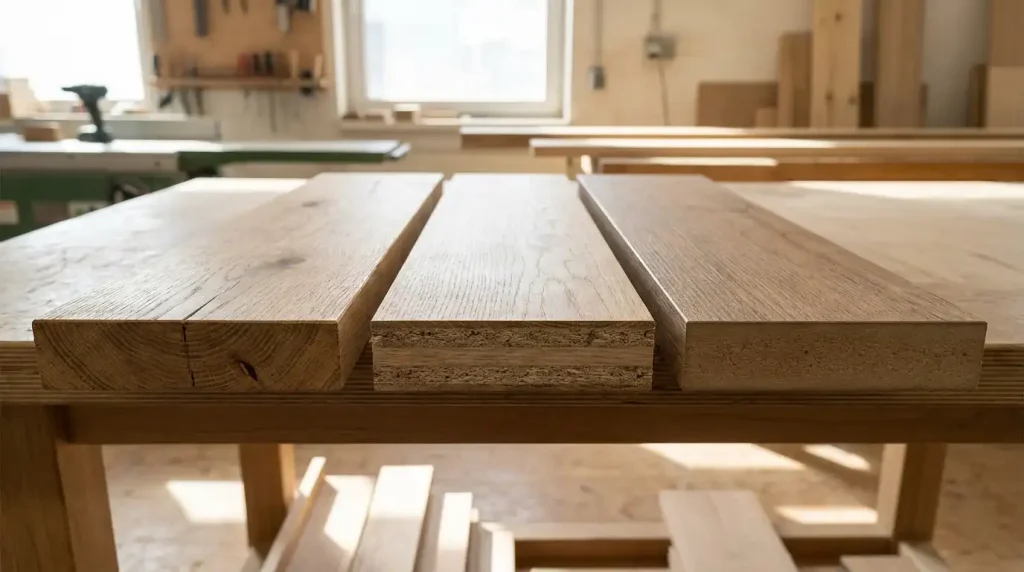
Care starts with the material. “Wooden” can mean three things.
|
Type |
What it is |
Care in short |
| Solid wood | Real timber all the way through |
Can be re-oiled, sanded and refinished |
|
Veneer |
A thin real wood layer on a core board |
Gentle cleaning, very light sanding only |
|
Wood-effect |
A printed wood-grain surface on an engineered board |
Damp cloth only, no oil, wax or sanding |
Our guide to solid wood vs veneer dining tables explains how to tell them apart.
Key note: The tables sold by Kosy Koala in this guide are wood-effect. They use an MDF top with a melamine finish. Their care is simpler than solid wood care. We cover both, because many readers own a mix of tables.
How to Identify Your Finish
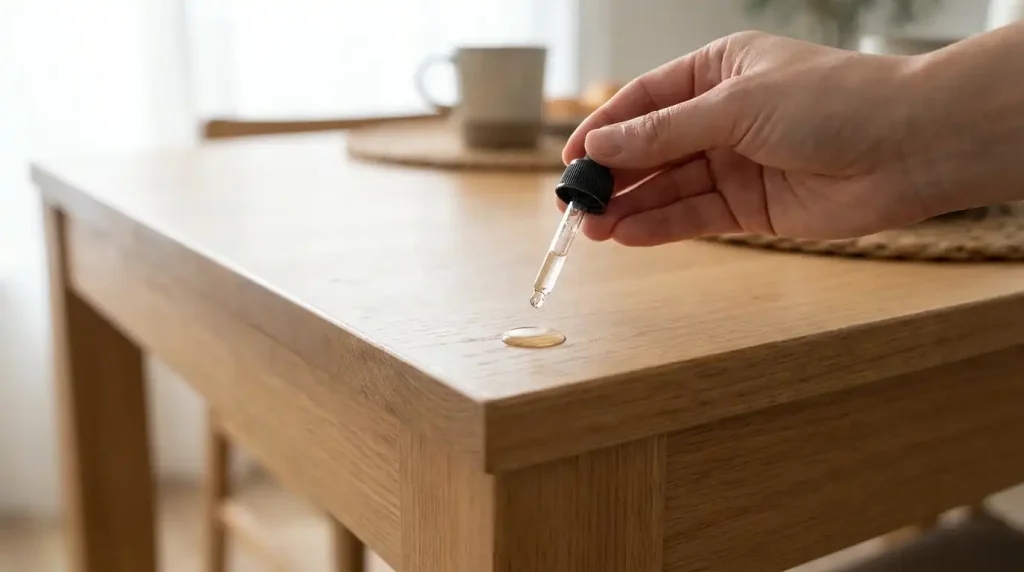
The finish is the outer coat. It decides which products are safe. Many care guides suggest a simple water test.
- Pick a hidden spot, such as the underside of the top.
- Place one small drop of water on it.
- Wait a minute or two, then wipe it away.
If the drop beads up, you likely have a film finish, such as lacquer, varnish or melamine. If it soaks in or darkens the wood, the top is probably oiled or waxed. Check the maker’s care notes too. When in doubt, use the gentlest method.
What Damages a Table Most?
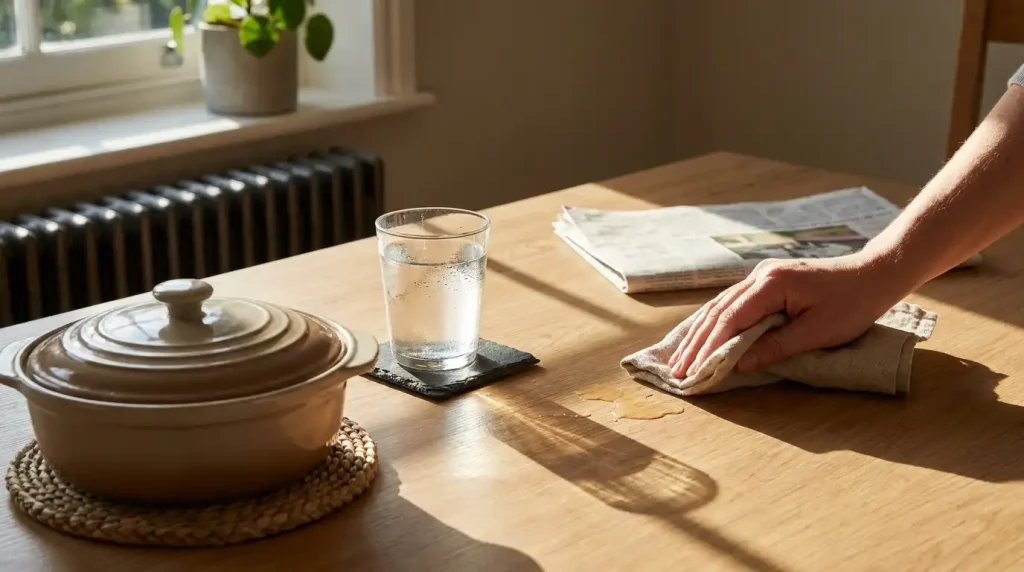
Knowing the risks helps you focus. Most damage comes from a short list.
|
Threat |
What it does |
Best defence |
|
Heat |
Rings, white marks, discoloured surfaces |
Trivets and mats |
|
Water and spills |
Rings, swelling at edges, stains |
Wipe fast, dry the top |
|
Strong sunlight |
Fading and uneven colour |
Blinds, curtains, moving decor |
|
Dry air |
Shrinking and cracks in solid wood |
Keep away from radiators |
|
Harsh cleaners |
Dull, sticky or damaged finish |
Mild soap and water only |
|
Knocks and dragging |
Scratches and dents |
Felt pads, lifting items |
Daily and Weekly Cleaning
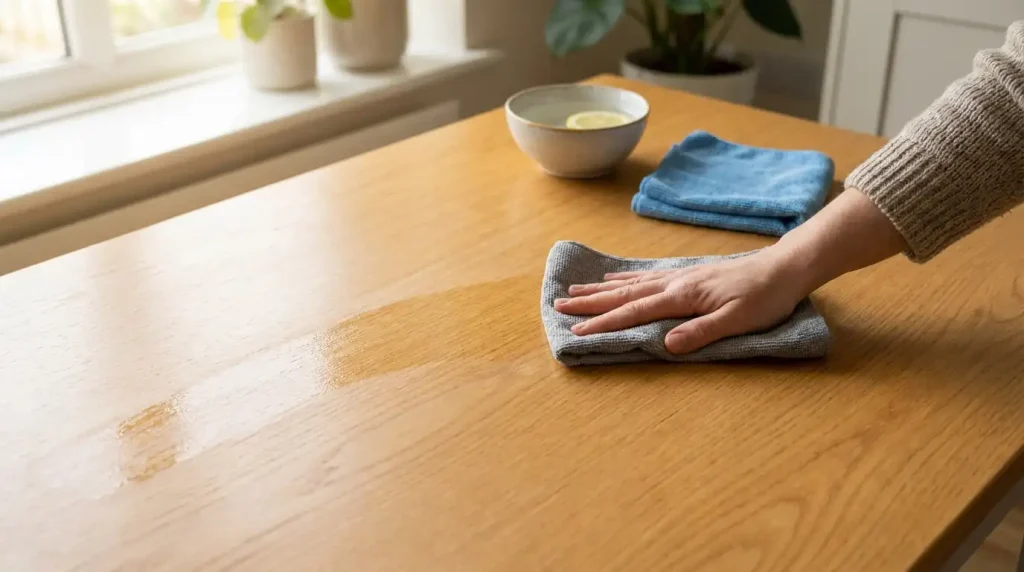
Good habits beat strong products. This simple routine works for most tables.
Every day
- Clear the table after meals.
- Wipe the top with a soft, slightly damp cloth.
- Dry it with a clean cloth. Do not leave water on the surface.
Every week
- Dust with a soft, lint-free cloth.
- Wipe sticky spots with warm water and a few drops of mild washing-up liquid.
- Wring the cloth out well. Then rinse the cloth and wipe again with plain water.
- Dry the top straight away.
What to avoid
- Ammonia, bleach and vinegar
- Citrus cleaners
- Silicone sprays
- Rough sponges and scouring pads
- Soaking wet cloths
Some spray polishes can leave a greasy film on matt or oiled tops. If you want to try a product, test it on a hidden spot first.
A Simple Deep Clean, Step by Step
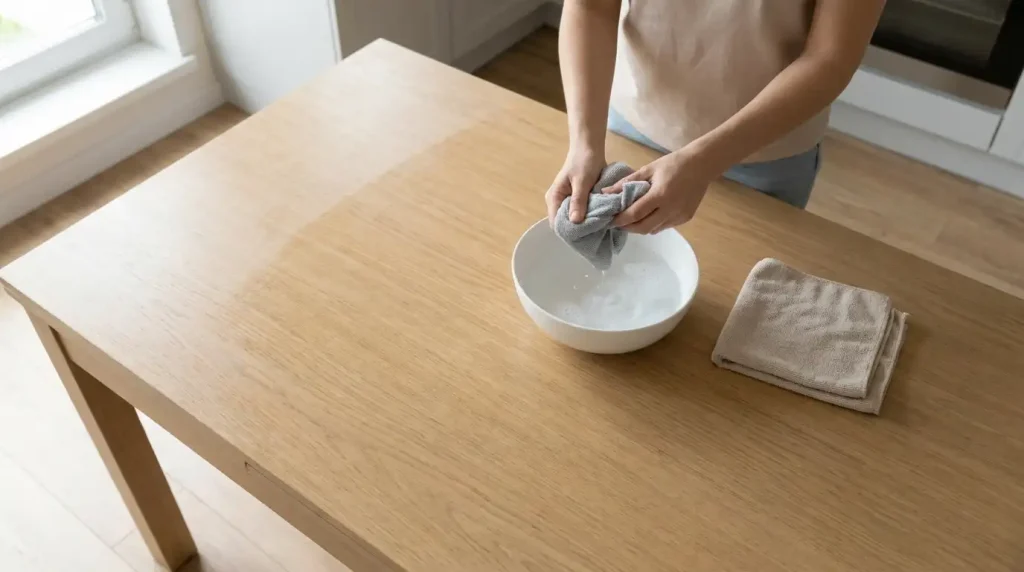
Do this when the table feels sticky or looks dull.
- Clear the table and shake out any cloths.
- Dust the top with a dry, soft cloth.
- Mix warm water with a few drops of mild washing-up liquid.
- Wring a soft cloth until it is only slightly damp.
- Wipe along the grain in long, even strokes.
- Wipe again with a cloth wet only with plain water.
- Dry the top at once with a clean, dry cloth.
Work on one section at a time. This keeps water from sitting on the surface. Do not forget the edges and the table legs.
Care by Finish
|
Finish |
How it looks | Everyday care |
Extra care |
|
Oiled |
Natural, matt, grain shows | Damp cloth, then dry | Re-oil in thin coats when the top looks dry |
|
Waxed |
Soft, silky feel | Dust and damp wipe |
Re-wax from time to time |
|
Lacquered or varnished |
Hard clear film | Gentle damp wipe |
Avoid heat and harsh cleaners |
|
Painted |
Solid colour | Soft damp cloth |
Touch up chips |
|
Melamine wood-effect |
Printed grain, wipes clean | Soft damp cloth |
No oil, wax or sanding |
Oiled tops are often re-oiled two or three times a year. Follow your maker’s advice. Apply a thin coat with a soft cloth. Wipe off any extra after the oil has soaked in. Then let the top rest before use.
How to Care for a Wooden Dining Table Every Day
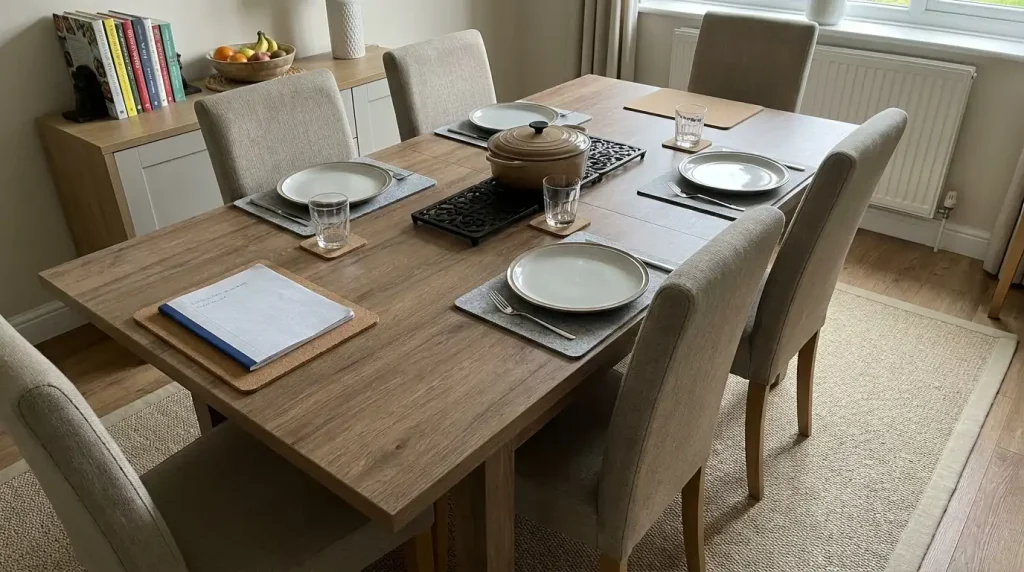
Protection is easier than repair. A few habits do most of the work.
- Use trivets under hot pans and dishes. Heat is the biggest threat to any finish.
- Use coasters under glasses and mugs. They stop rings.
- Use placemats at mealtimes. Felt-backed ones also stop scratches.
- Add a runner or tablecloth for messy meals or craft time.
- Put a mat under homework. Pen pressure can leave marks.
- Lift, do not drag. This goes for vases, bowls and chairs.
- Add felt pads under ornaments and chair legs.
A rug under the table helps too. It should be large enough that the chair legs stay on it when pulled out. This cuts floor scratches and chair-leg knocks on table legs.
Heat, Sun and Central Heating
Your room matters as much as your cloth.
Radiators. Do not place a table right beside one. Dry heat can make solid wood shrink or crack. It can also discolour a laminate surface over time.
Sunlight. Strong sun can fade colour. The care notes on our product pages say to keep the furniture out of direct sunlight. Use blinds or curtains in bright rooms.
Humidity. Very dry air is hard on solid timber. Some makers suggest keeping indoor humidity near 40 to 45 per cent. A small humidity meter is cheap and easy to use.
Hot dishes. Never place a hot pan straight onto any top. Use a trivet every time.
How to Remove Common Marks
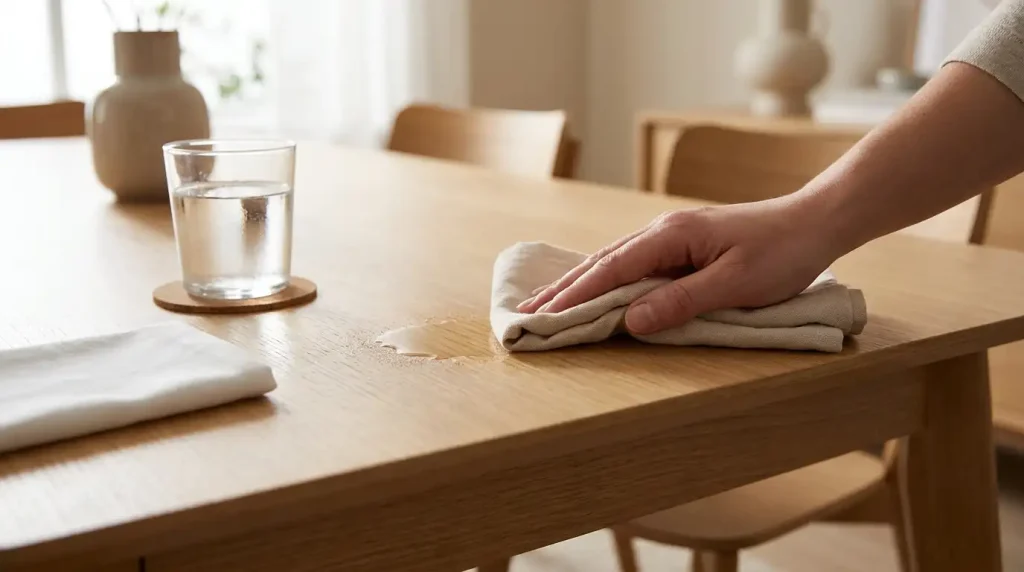
Act fast. Test any fix on a hidden spot first. If the mark does not shift, stop and ask a professional.
|
Mark |
What to try |
Watch out for |
|
Fresh spill |
Blot, working from the edge inward. Then dry the top |
Do not rub it in |
|
Sticky food or jam |
Soft cloth, warm water and a drop of mild soap |
Wring the cloth well |
|
Grease |
Blot, then wipe with mild soapy water and dry |
Avoid strong degreasers |
|
Candle wax |
Let it harden. Lift gently with a plastic card |
Never use a metal blade |
|
White water ring |
Buff gently along the grain with a dry cloth |
A deep ring may need refinishing |
|
Heat ring |
On oiled tops, re-oiling can soften light marks |
Hard marks may need a refinish |
|
Light scratch |
Wax stick or touch-up marker in a matching shade |
Do not use a darker shade |
|
Shallow dent |
Solid wood only. Damp cloth with brief gentle warmth |
Stop if the finish clouds |
|
Wine or ink |
Blot at once |
Dried stains need a professional |
Do not use heat tools unless you know your finish. A hot iron or steam can scorch a top.
Wood-Effect Tables: Special Care
Wood-effect tables are easy to live with. They also have limits.
- Skip oil, wax and polish. These are for real timber. On a sealed surface they can smear.
- Do not sand. The wood grain is printed on the surface. Sanding removes it.
- Protect the edges. The core is an engineered board. Standing water at an edge can cause swelling. Wipe spills away fast.
- Mind the heat. Long contact with heat can discolour the surface.
- Fix chips gently. A touch-up marker in a matching tone can hide small chips. Deep chips usually stay.
The care notes on our product pages say to wipe regularly with a soft, damp cloth. They advise avoiding harsh chemicals and abrasive materials. They also say to keep the table away from direct sunlight and heat sources.
Do Not Forget the Chairs and Legs
A clean table next to dusty chairs looks odd. Care for the whole set.
- Velvet chairs: Vacuum gently and spot clean with a mild solution. Our product care notes recommend this.
- Faux leather: Wipe with a soft damp cloth. See our guide on faux leather vs fabric dining chairs for more.
- Legs and fixings: Check screws every few months. Tighten them by hand. A loose leg adds wear to the whole frame.
- Floor protection: Check rubber caps or felt pads. Replace them when they wear down.
A Basic Care Kit
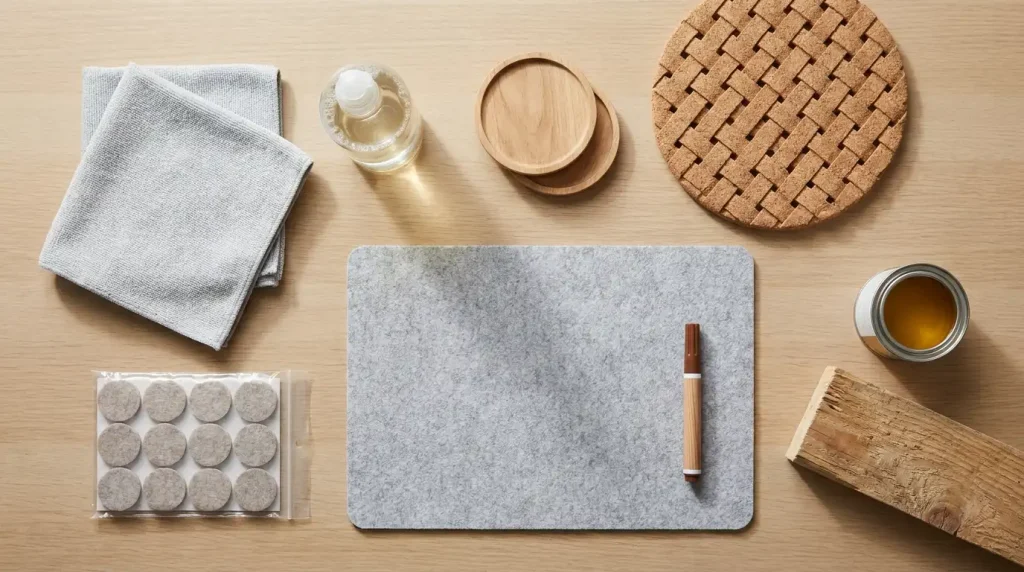
You do not need a cupboard full of products. A small kit covers most tables.
- Two or three soft microfibre or lint-free cloths
- Mild washing-up liquid
- Trivets, coasters and felt-backed placemats
- Felt pads for chairs and ornaments
- A touch-up marker or wax stick in a matching shade
- Wood oil or wax, only if your table is oiled or waxed and your maker recommends it
Check your maker’s advice before buying any oil or wax. The right product depends on the wood and the finish.
Moving, Storing and Rearranging
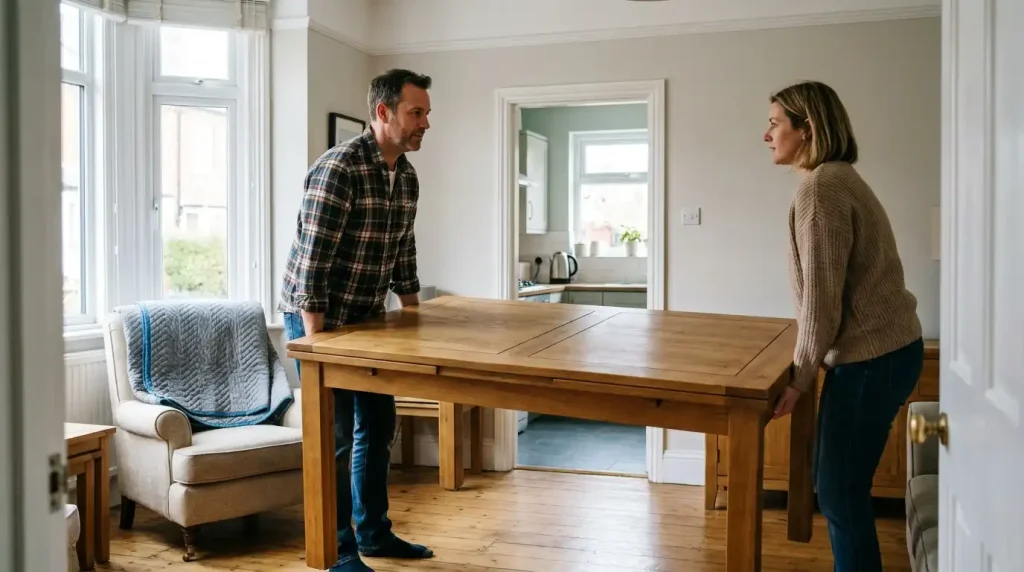
Tables get damaged when they move. Lift, do not drag. Take off any loose items first. If you must tilt a table, ask a second person to help. Keep legs padded with a soft blanket in transit.
Store a table in a dry room. Damp air can harm the board core and the finish. Do not stack heavy items on top of it. If you rearrange the room, check that the new spot is away from radiators and strong sun.
A Simple Care Calendar
|
How often |
What to do |
|
After every meal |
Wipe, dry and clear the top |
|
Weekly |
Dust and wipe sticky spots |
|
Monthly |
Check screws, feet and edges |
|
Twice a year |
Re-oil if the top is oiled, and check for fading or dryness |
|
When needed |
Touch up chips and fix marks |
When to Call a Professional
Some damage is beyond a home fix. Call a refinisher if you see:
- Deep, dark water marks
- Large areas of peeling or lifting finish
- Cracks in the top
- A wobbly frame that screws do not fix
Solid wood can often be sanded back and refinished. Veneer can take only very light sanding. Wood-effect cannot be refinished at all. For those, replacing the top or table may be the practical route.
A Worked Example
The Patel family has an oiled solid wood table. They use placemats and trivets. They wipe the top after meals and dry it. Twice a year, they re-oil it in thin coats. A mug once left a ring. They buffed it lightly and re-oiled the area. The mark faded.
Tom and Lena have a wood-effect table in a small flat. They wipe it with a damp cloth each evening. They keep it away from the radiator. When a pan left a mark, they were glad of the trivet they usually used. They now keep one on the table at all times.
Common Mistakes to Avoid
- Using too much water on a cloth.
- Using spray polish on an oiled or matt top.
- Placing hot dishes straight onto the surface.
- Dragging chairs or ornaments across the top.
- Leaving the table beside a radiator.
- Sanding a veneer or wood-effect top.
- Skipping the hidden-spot test.
Quick Checklist
- Work out your finish with a water drop test.
- Wipe spills straight away and dry the top.
- Use trivets, coasters and placemats.
- Keep the table away from radiators and strong sun.
- Re-oil an oiled top when it looks dry.
- Check screws and floor pads.
- Read the care notes on your product page.
Seasonal Tips for UK Homes
Winter. Heating dries the air. Keep tables away from radiators. Wipe away damp from windowsills and condensation that could drip onto a table nearby.
Summer. Low sun can fade a top fast. Close blinds at midday. Move any rug or runner now and then so the colour ages evenly.
Festive season. Tables get extra use for hosting. Use a heat-proof runner, felt-backed placemats and trivets for serving dishes. Wipe and dry the top before you put it back into daily use.
Frequently Asked Questions
How often should I clean a wooden dining table?
Wipe it after meals. Dust it weekly. Give it a slightly deeper clean with mild soapy water when it feels sticky.
What is the best cleaner for a wooden dining table?
Warm water with a few drops of mild washing-up liquid is enough for most tables. Wring the cloth out well. Then dry the surface.
Can I use furniture polish on my table?
Use it with care. Some sprays leave a greasy film on matt or oiled tops. Test on a hidden spot first. Wood-effect tables do not need polish.
How do I get rid of a white ring on a wooden table?
Buff it gently along the grain with a soft, dry cloth. On an oiled top, re-oiling can help. If the mark stays, ask a professional.
How often should I oil a wooden dining table?
Many makers suggest two or three times a year for oiled tops. Follow your own maker’s advice. Do not oil lacquered or wood-effect tops.
How do I protect a wooden dining table from heat?
Use trivets and mats every time. Keep the table away from radiators. Never put a hot pan straight onto the top.
Can I use vinegar or bleach on a wooden table?
No. They can dull or damage the finish. Stick with mild soap and water.
Can I use cooking oil on my table? It is best not to. Kitchen oils can turn sticky or smell over time. Use an oil made for wood, and only if your table is oiled.
How do I stop chairs scratching the table?
Lift chairs rather than dragging them. Add felt pads to the chair legs. A rug under the table also helps.
How do I care for a wood-effect dining table?
Use a soft, damp cloth, then dry it. Avoid harsh chemicals, abrasive pads, heat and direct sun. Do not oil, wax or sand it.
Care Habits That Keep a Table Looking Good
You do not need special products or lots of time. You need a few steady habits. Wipe, dry, protect and check. Match your routine to the finish. Test before you try a fix.
For the full picture, see our wooden dining table buying guide. If you also own a glass table, our guide to cleaning a glass dining table covers that. When you are ready for a new table, the five picks below are easy to look after.
Five Easy-Care Kosy Koala Wood-Effect Tables and Sets
Every price below was checked directly on our product pages on 14 October 2026. Prices can change, so always confirm the current figure before ordering. All five have a wood-effect finish on an MDF top. None is solid wood. The care notes on each page advise a soft, damp cloth and no harsh chemicals, abrasives, direct sun or heat sources.
Dining Table Beige Wood Kitchen Place for 4 Seats, Dining Table Only (Beige H 75 x L 117 x W 77 cm)
Price: £89.99 (was £94.99). Size: 117 x 77 x 75 cm. Finish: light oak wood grain, melamine laminated.
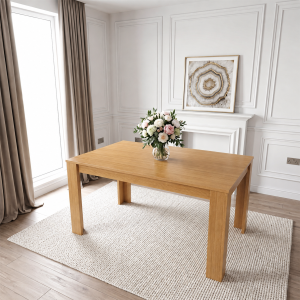
Best for: a simple first table with a wipe-clean surface.
Shop: Dining Table Beige Wood Kitchen Place for 4 Seats (117 cm)
Dining Table Dark Grey Wood Kitchen Place for 6 Seats, Dining Table Only
Price: £109.99 (was £114.99). Size: 140 x 80 x 75 cm. Finish: dark grey with a hint of charcoal.
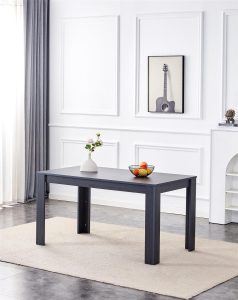
Best for: a roomier table that suits modern rooms.
Shop: Dining Table Dark Grey Wood Kitchen Place for 6 Seats
Dining Table Brown Rustic Wood Effect, Place for 6 Seats for Kitchen, Office
Price: £109.99 (was £114.99). Size: 140 x 80 x 75 cm. Finish: brown rustic wood effect.
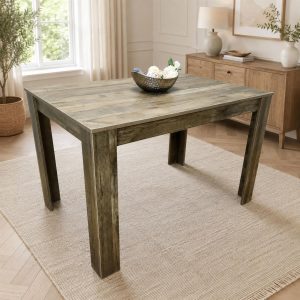
Best for: busy family tables where a warm, mid-tone finish is forgiving.
Shop: Dining Table Brown Rustic Wood Effect, Place for 6 Seats
Dining Set of 4 Oak Effect Dining Table With 4 Green Velvet Chairs Dining Room Furniture
Price: £179.99 (was £199.99). Table: 117 x 77 x 75 cm. Chairs: green velvet on metal legs.
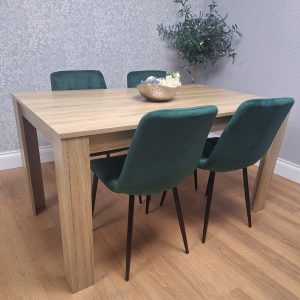
Best for: a ready-made set. The page advises gentle vacuuming or spot cleaning for the velvet.
Shop: Dining Set of 4 Oak Effect Dining Table With 4 Green Velvet Chairs
Dining Table and 4 Chairs White Round Table With 4 Black Velvet Chairs Dining Room Furniture
Price: £174.99 (was £199.99). Table: 90 x 90 x 75 cm, round, with an MDF top and oak-effect wooden legs.
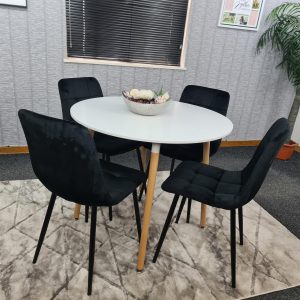
Best for: small spaces. A round top has no corners to catch and is simple to wipe.
Shop: Dining Table and 4 Chairs White Round Table With 4 Black Velvet Chairs
Browse the full range in our wooden dining set collection.
About the author
This article was written by the Kosy Koala team. We design and source furniture for UK homes, with a focus on practical details that actually matter once a piece is in your room. Have a question about any product on this page? Get in touch through our About Us page.


 Dining Tables
 Dining Chairs

 Bed Frames
 Mattresses
 Bunk Beds
 Sofa & Sofa Beds


