

Blog
Wooden Dining Tables: Styles, Finishes & Buying Guide

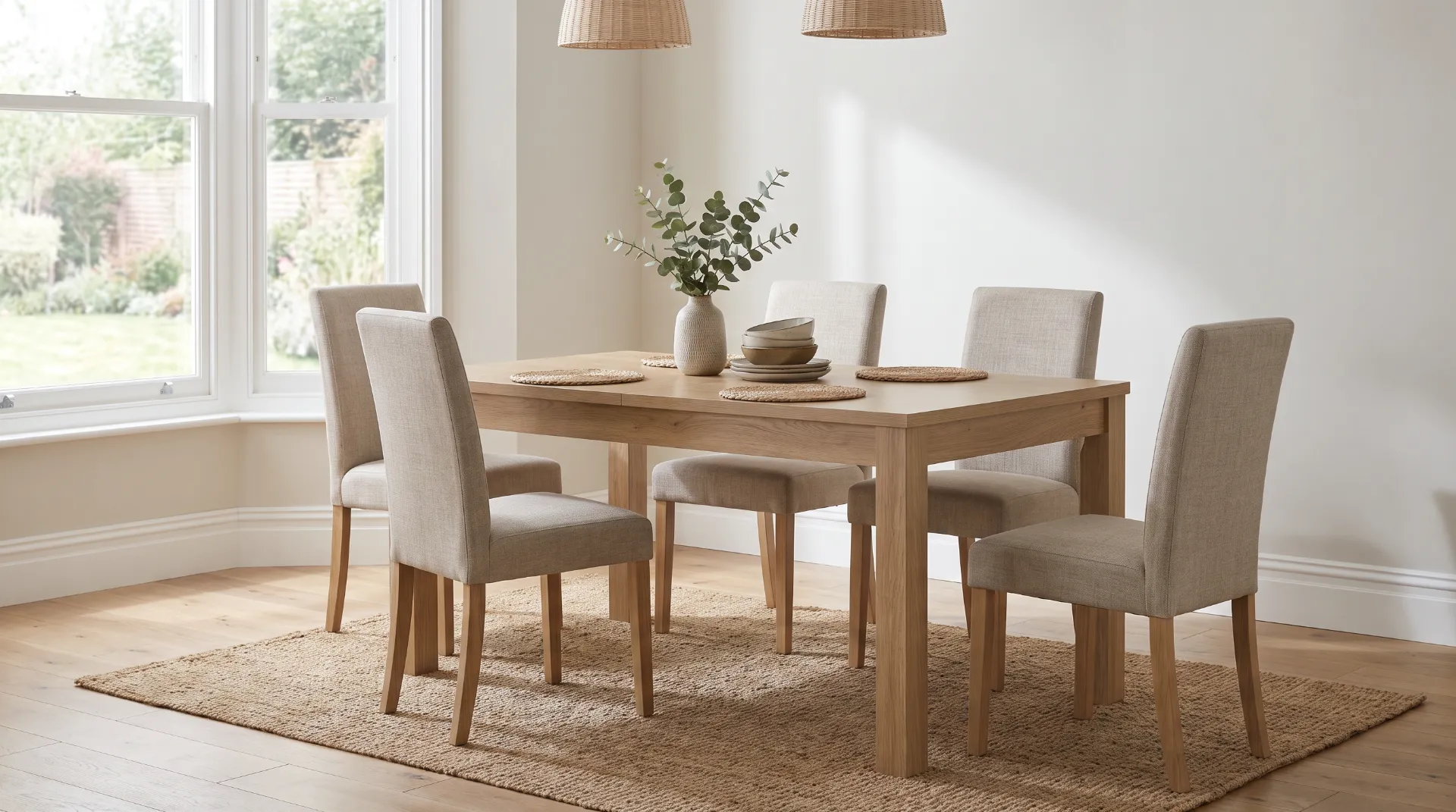
A wooden dining table is the piece your whole room is built around. It hosts Monday homework, Sunday roasts and late-night chats. It also takes daily knocks from hot plates, school bags and elbows. So the choice matters.
The tricky part is the word “wooden”. It can mean very different things. It might be solid oak. It might be a thin layer of real wood over a board. It might be a wood-effect surface that only looks like timber. Price, care and lifespan change with each one.
This guide explains it all in plain English. You will learn about materials, wood types, styles, finishes, shapes and sizes. You will also see common mistakes to avoid. At the end, you will find five Kosy Koala picks with prices checked on our site.
Quick answer: Pick a table that fits your room first, suits your daily life second and matches your budget third. Allow about 70 cm of width per person. Leave about 90 cm behind each chair. Choose solid wood if you want a table for decades and can pay more. Choose wood-effect if you want the look for less, with easy wiping and low upkeep.
What Counts as a Wooden Dining Table?
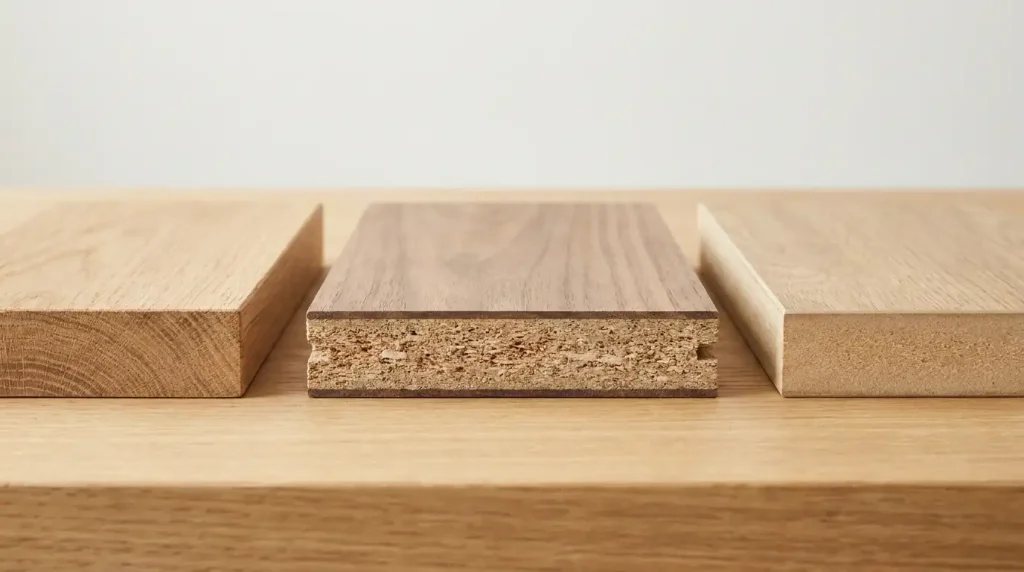
Shops use the word “wooden” for three different builds. Knowing the difference is the most useful thing you can learn before you buy.
|
Build |
What it is | Main strengths |
Main weaknesses |
| Solid wood | Cut from planks of real timber all the way through | Long life, real grain, can be sanded and refinished | Heavy, costs more, can move with humidity |
| Wood veneer | A thin sheet of real wood glued over a board core | Real wood surface, more stable than solid, often cheaper | The thin layer can chip, and repairs are limited |
| Wood-effect | A printed wood-grain layer sealed onto an engineered board such as MDF | Lowest price, wipes clean, no oiling or sanding | Cannot be refinished, and deep chips or heat marks stay |
Wood-effect is often called melamine or laminate. The grain you see is a printed pattern under a hard, sealed surface. That surface is why these tables wipe clean so easily.
MDF stands for medium-density fibreboard. It is made from fine wood fibres pressed together with resin. It is flat, smooth and stable. That makes it a good base for a printed surface.
Solid wood behaves differently. It reacts to the air around it. It swells a little in damp weather and shrinks when the heating is on. Good makers allow for this. Cheap solid tables can still crack or warp if they sit beside a radiator.
Key note: The wooden tables in this guide are wood-effect. They use MDF with a melamine finish. We say so plainly because it matters. If you want a table to last for decades, solid wood is the stronger route. If you want a warm timber look at a fair price, wood-effect does the job well.
Which Build Suits You?
|
If this sounds like you |
Look at |
|
You want one table for decades and can pay more |
Solid wood |
| You want real wood on top, with less movement |
Veneer |
|
You want the lowest price and the easiest wipe-down |
Wood-effect |
|
You may move home or restyle in a few years |
Wood-effect |
|
You have young children and a busy table |
A sealed finish, solid or wood-effect |
How to Tell Solid Wood, Veneer and Wood-Effect Apart
Product names can be vague. These checks take a few minutes.
- Read the material line. “Solid oak” means solid oak. “Oak veneer” means a thin real layer. “Oak effect”, “wood grain finish”, “melamine” and “MDF” mean engineered.
- Look at the edge. On solid wood, the grain runs over the edge and around the corner. On veneer, you may see a thin line or a separate edge strip.
- Check the underside. Solid wood shows the same timber underneath. A board core often looks pale, flat and even.
- Spot the repeat. On wood-effect, the same knot or swirl can appear again and again.
- Feel the weight. Solid wood is much heavier than a board-based top of the same size. A phrase like “oak finish” is not the same as “solid oak”. If a listing does not name the material, ask the seller before you order. Our guide to solid wood vs veneer dining tables goes deeper on this.
Wood Types: Oak, Walnut, Ash, Pine and More
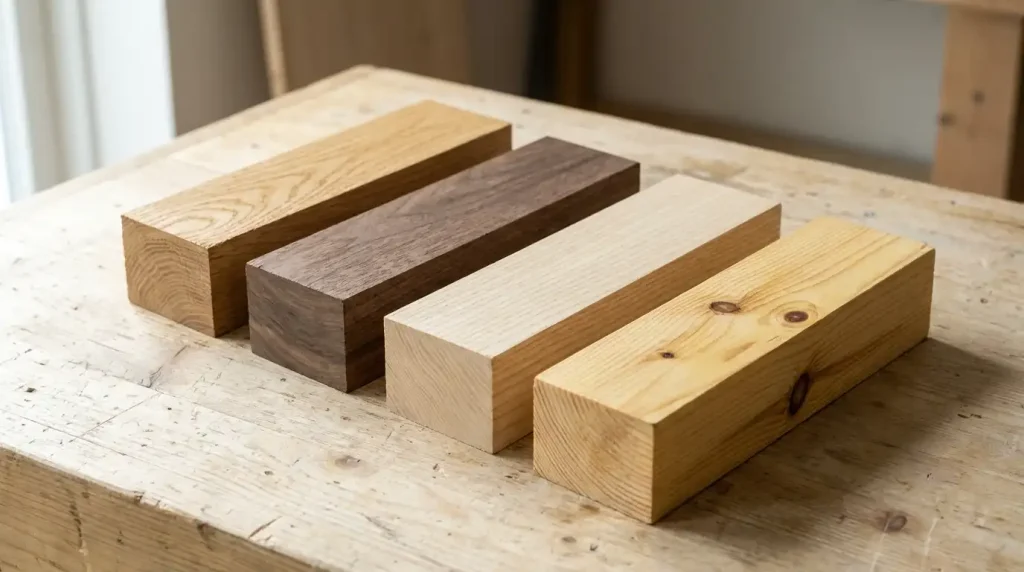
If you are buying solid wood, the species decides how it looks and wears. If you are buying wood-effect, the species name only describes the printed look. “Oak effect” means the surface imitates oak.
|
Wood |
Look | Strength |
Best for |
| Oak | Light to golden brown, bold grain | Hardwood, very hard-wearing | Busy family tables, classic and rustic rooms |
| Walnut | Deep brown, smooth grain | Hardwood, a premium choice | Statement tables, modern and mid-century rooms |
| Ash | Pale cream, straight grain | Hard, strong and slightly flexible | Light, Scandi-style rooms |
| Pine | Pale yellow, often with knots | Softwood, dents more easily | Budget tables, farmhouse looks, painted finishes |
| Acacia | Mixed browns, lively grain | Hardwood, hard-wearing | Rustic rooms with plenty of character |
| Reclaimed timber | Weathered, one of a kind | Varies by source | Anyone who likes marks and history |
In general, oak and walnut cost more than pine. Softwoods like pine mark more easily, but many people like the worn look that follows. If you want a spotless table for years, choose a harder wood or a sealed wood-effect surface.
Wooden Dining Table Styles
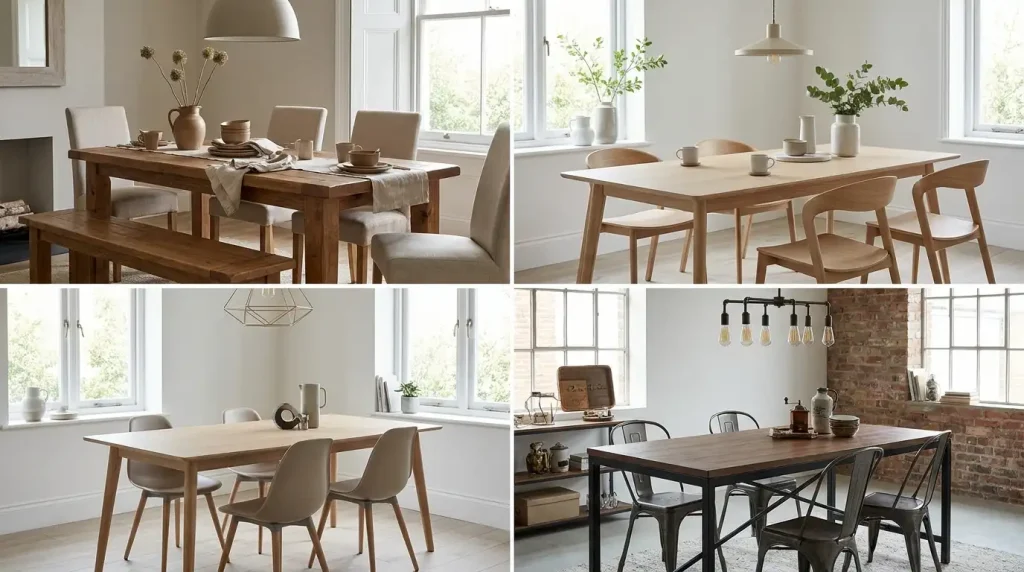
Style is about more than colour. It sets the mood of the whole room. Here are the looks UK homes choose most often.
Rustic and Farmhouse
Think chunky tops, visible grain and warm brown tones. Rustic tables hide everyday wear well. They suit country kitchens, open-plan family rooms and mixed seating.
Scandi
Pale wood, clean lines and slim legs. This look keeps a room bright. It works well in small kitchens with lots of white and soft grey.
Modern and Minimal
Flat tops, sharp edges and simple shapes. Colours stay quiet. Light oak or grey wood tones sit well with velvet chairs.
Industrial
Wood meets metal. Expect black frames, X-shaped legs and a slightly raw finish. It looks good in loft-style rooms and urban flats.
Traditional
Turned legs, richer browns and a more formal shape. It suits dining rooms that are used for special occasions as well as everyday meals.
Mid-Century
Tapered legs, warm tones and gentle curves. Pair it with colourful upholstered chairs for a retro feel.
Tip: Pick your style from the room you already have. If your floor, doors and storage are all pale, a very dark table will feel heavy. If the room is full of black and grey, a warm brown top can soften it.
Which Chairs Go With Which Style?
|
Table style |
Chairs that work |
|
Rustic |
Grey or black velvet, or simple wood |
|
Scandi |
Pale fabric, light grey, soft green |
|
Modern |
Velvet in a bold colour, or faux leather |
|
Industrial |
Black metal frames, dark velvet |
| Traditional |
Rich fabric in deep green, navy or cream |
Velvet is a safe bridge between most styles. It adds softness to a hard wooden top. Pick a colour that already appears somewhere in the room, such as a cushion or a rug.
Table Shapes: Rectangular, Round, Square and Oval
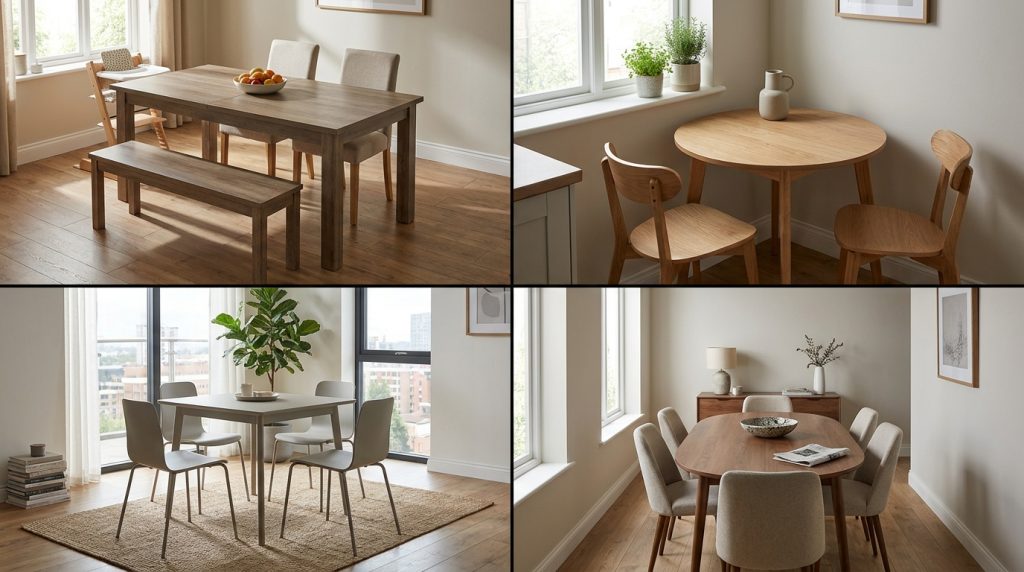
Shape changes how many people fit and how the room flows.
| Shape | Best for |
Watch out for |
|
Rectangular |
Most rooms, benches, larger families | Corners can bump hips in tight walkways |
|
Round |
Small spaces, young children, easy chat |
Lower seat count for the same floor space |
|
Square |
Compact rooms and couples who like to face each other |
Fewer seats than a rectangle |
|
Oval |
Narrow rooms where you want softer edges |
Harder to find, and benches fit less neatly |
A round table has no corners to knock into. That is a real plus with toddlers. A rectangle uses wall space better and takes a bench more easily.
Legs and Bases: What Holds the Top Up
The base affects legroom, style and stability. Sit at a table before you buy if you can. If you cannot, check the leg position in the photos.
- Four corner legs: Simple and stable. The corners can limit where chairs sit.
- Trestle legs: Two end supports with a bar between them. Good for benches and extra legroom along the sides.
- X-frame: Bold and rustic. Crossbars can catch knees, so check the height.
- Hairpin: Slim metal legs with a light, retro look. Best on lighter tops.
- Pedestal: One central base. Ideal for round tables because nobody sits on a leg. If you are torn between two popular looks, read our comparison of X-frame vs hairpin dining table legs.
Wooden Table Finishes Explained
A finish is the outer coat on the surface. It changes the look, the protection and the care you need.
|
Finish |
Look | Protection |
Upkeep |
| Oil | Natural and matt, shows the grain | Soaks in, moderate protection | Re-oil from time to time |
| Wax | Soft and silky | Light protection, weaker against heat and water | Regular re-waxing |
| Lacquer | Clear coat on top, matt to gloss | Good against spills and stains | Wipe clean, deep scratches need a refinish |
| Varnish | Hard, clear film | Durable, helps against fading | Avoid heat and harsh cleaners |
| Paint or stain | Colour change | Depends on the topcoat | Touch up chips |
| Melamine laminate | Printed grain under a hard layer | Wipes clean, resists everyday stains | Cannot be refinished |
Matt, Satin or Gloss?
Matt looks calm and natural. Gloss looks sleek, but it shows fingerprints and light scratches more. Satin sits in the middle. For a family table, matt or satin is usually the easier choice.
The Heat Rule
Every finish dislikes heat. A hot pan can leave a white ring on wood. On wood-effect laminate, long contact with heat can warp or discolour the surface. Use trivets and mats, every time.
Colour Choices That Work
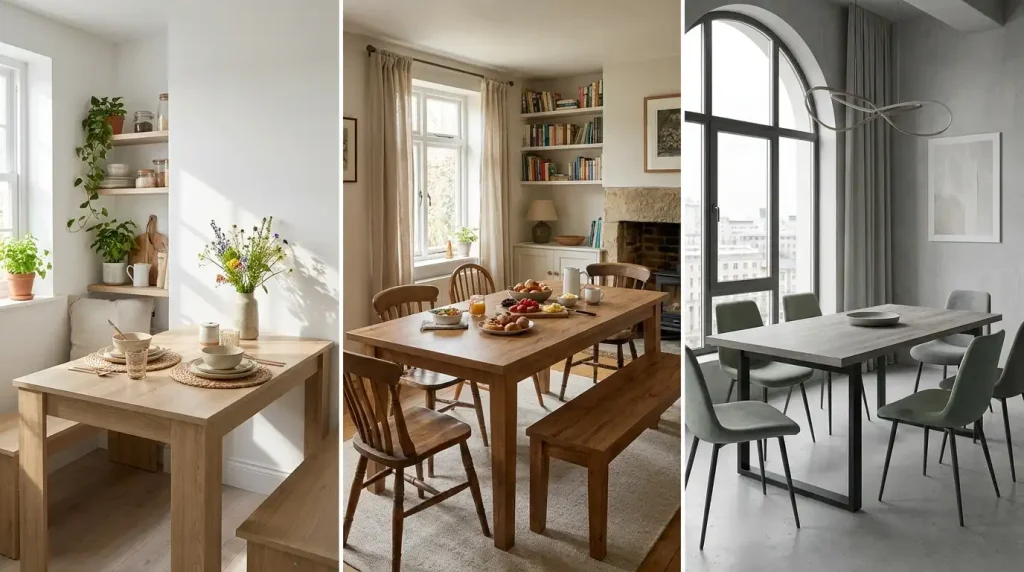
The right colour depends on light, floor and room size.
- Light oak: Opens up small rooms. It pairs well with white, grey and soft green.
- Mid-brown rustic: Warm and forgiving. It hides small marks well.
- Dark brown or charcoal: Dramatic and modern. Dust and crumbs show more.
- Grey wood: Cool and current. It works well with black metal and velvet chairs.
Short on space? Our guide to wooden dining table colours for small kitchens shows which shades make a room feel bigger.
How Big Should Your Wooden Dining Table Be?
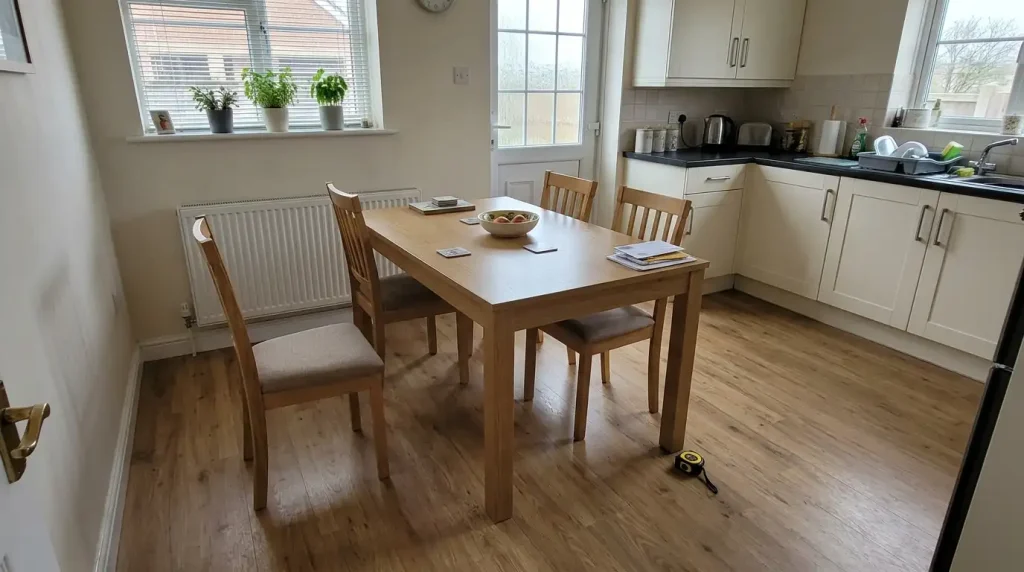
Size is where most buyers go wrong. Measure the room before you fall for a table.
Use these simple rules:
- Allow about 70 cm of width for each person.
- Allow about 90 cm behind each chair so it can pull out.
- Tables are usually around 75 cm high. Dining chair seats are usually around 45 cm high.
- Mark the table size on the floor with tape. Walk around it.
|
Seats |
Typical length | Typical width |
Example from our range |
|
4 |
90 to 120 cm | 75 to 90 cm |
117 x 77 cm or 90 x 90 cm |
|
6 |
About 140 to 160 cm | 80 to 90 cm |
140 x 80 cm |
|
8 |
180 to 220 cm | 90 to 100 cm |
Not in this guide |
Here is a detail many guides skip. A 117 cm table with two people on each long side gives about 58 cm each. That is fine for daily meals. It feels tight for guests. A 140 cm table gives each person about 70 cm. That is a noticeable step up in comfort.
Fixed or Extendable?
Check whether the top is a fixed size. Fixed tables are simpler and often steadier. Extendable tables suit people who host only a few times a year. They add moving parts, so check that the mechanism feels smooth. The tables in this guide are sold at the set sizes listed.
Choosing by Room and Household
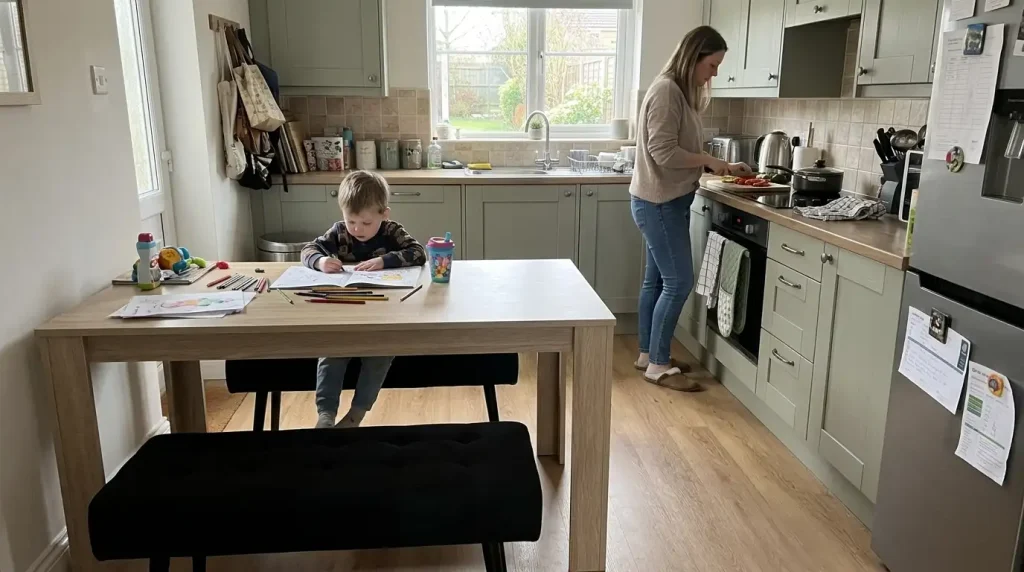
Your home matters as much as the table. Here is how it plays out.
- Small kitchen diner: Go for a 90 to 120 cm top. Light colours help. Benches or a round shape free up space.
- Open-plan living room: The table is part of the view. Pick a finish that matches your sofa and flooring.
- Family with young children: Choose a sealed, wipe-clean top. Round or softly shaped edges are kinder to small heads.
- Couple in a flat: A compact table with two chairs and a bench keeps things flexible.
- Regular hosts: Go bigger. A 140 cm table seats six comfortably, and it still looks good with only two people at it.
Wooden or Glass: Which Should You Pick?
Wood feels warmer. It hides fingerprints better and copes well with busy households. Glass makes a small room feel lighter and wipes clean fast. If you cannot decide, read our full comparison of glass vs wooden dining tables.
Chairs or Benches?
Chairs are better for long meals because they have backs. Benches tuck fully under the table and fit children easily. They also save space.
You do not have to choose one. A common setup is a bench on one long side and chairs on the other. Our oak-effect set with two black velvet benches is built for this kind of tight space.
Styling Your Wooden Dining Table
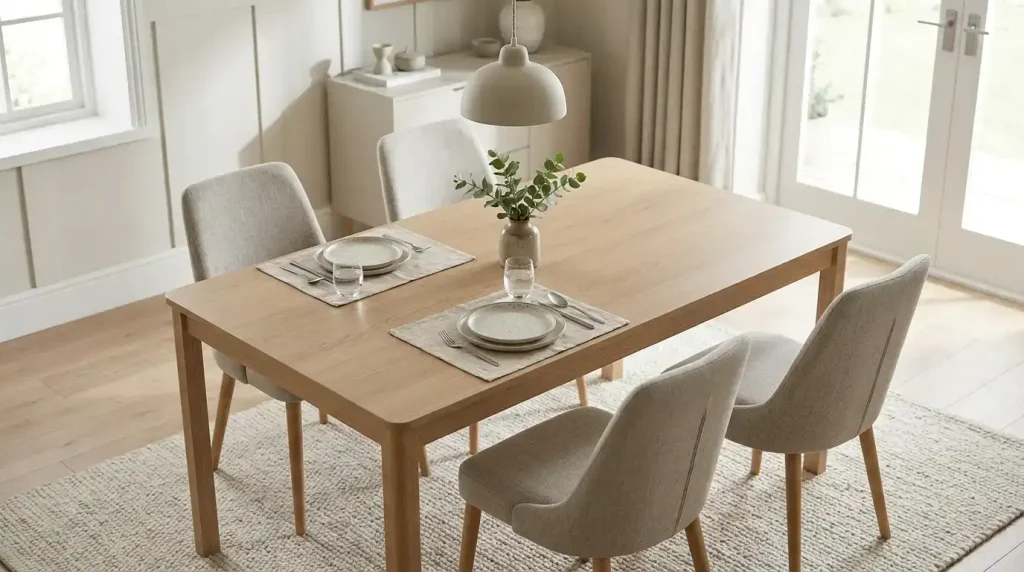
A good table needs little styling. The wood does the work.
- Add a runner or placemats. They protect the top and add colour.
- Keep the centre simple. A bowl, a small vase or a candle is enough. Leave room for serving dishes.
- Hang a light above it. A pendant lamp lowers the ceiling feel and makes meals cosier.
- Use a rug if you have space. It should be large enough that the chair legs stay on it when pulled out.
Delivery and Assembly: What to Expect
Many tables arrive flat-packed. Open the boxes in the room where the table will live. Check every part against the list before you start.
A table frame usually takes around 30 to 45 minutes to build. Chairs add more time. A second person helps a lot when you turn the table upright. Build the table a few days before any event. That way, a missing part never turns into a last-minute rush.
How to Look After a Wooden Dining Table
Good habits matter more than expensive products.
- Wipe spills straight away with a soft, damp cloth. Then dry the surface.
- Use coasters, mats and trivets.
- Keep the table out of direct sun and away from radiators.
- Skip harsh sprays and rough scouring pads.
- Lift chairs when you move them. Do not drag them.
Solid wood also needs seasonal care. Central heating dries the air, and timber can shrink or crack. Wood-effect tables are simpler. The product care notes on our pages recommend a damp cloth, with no direct sunlight and no heat. For a full routine, see our guide on how to care for a wooden dining table.
What Does a Wooden Dining Table Cost?
Solid wood is a bigger investment. It can last for decades, and it can be refinished. Wood-effect tables cost less up front and need less upkeep, but they are not meant to be sanded back.
Here is what we can say with checked figures. On 12 October 2026, our wood-effect tables sold on their own were priced from £89.99 to £109.99. Table-and-chair or table-and-bench sets in this guide ranged from £174.99 to £199.99.
When you compare prices, check these points:
- Is it the table only, or a set with chairs?
- What is the top made from?
- Does it arrive flat-packed, and how long will it take to build?
- What warranty and returns come with it?
The product pages we checked list a 12-month warranty and 30-day returns. Buyers pay return postage. Always read the terms on the page before you order.
Wood-Effect Tables: The Honest Pros and Cons
Wood-effect gets a mixed press. Some of it is fair. Here is a straight view.
What it does well
- It costs less than solid wood or veneer.
- The sealed surface wipes clean in seconds.
- It never needs oiling, waxing or sanding.
- The colour and grain look the same from table to table, so matching is easy.
Where it falls short
- It cannot be sanded back. A deep chip or heat mark usually stays.
- Standing water at the edges can harm the board underneath.
- It has no real grain, so it will not feel like timber to the touch.
- It is not an heirloom piece.
For many households, those trade-offs are fine. You get a good-looking table that handles daily life. Just treat it kindly. Wipe spills fast, use mats for hot dishes and keep it away from radiators.
Two Worked Examples
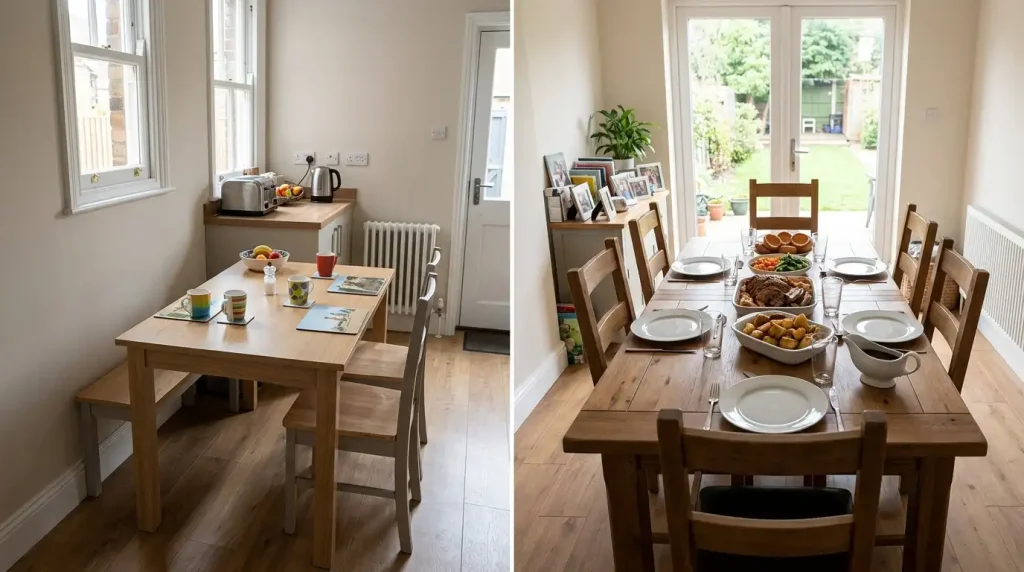
A small kitchen diner. A couple with a toddler has a narrow room. They measure 2.4 metres across. A 117 x 77 cm table leaves a good gap on each side. They choose a light oak-effect top and two benches, so the benches slide under when the room is a play space.
A family of five who host on Sundays. They need space for six. They pick a 140 x 80 cm table in a mid-brown rustic finish. The darker tone hides crumbs and small marks. They use placemats for hot dishes and keep a runner for the centre.
Common Mistakes to Avoid
- Buying on looks alone and never measuring the room.
- Assuming “wooden” means solid wood.
- Forgetting the 90 cm pull-out space behind chairs.
- Placing hot dishes straight onto the surface.
- Choosing a table that is too long for the walkway.
- Ignoring leg position, then finding knees hit a crossbar.
- Picking a dark colour for a small, dim room.
Quick Checklist Before You Buy
- Measure the room and tape out the table size.
- Check the exact material, not only the colour name.
- Count your seats and allow 70 cm each.
- Choose a finish that matches how you live.
- Check leg style and legroom.
- Read the care notes, warranty and returns terms.
- Check the price on the product page on the day you order.
Quick Glossary
- Hardwood: Timber from broadleaf trees, such as oak or walnut. Usually harder wearing.
- Softwood: Timber from conifers, such as pine. Easier to dent.
- Veneer: A thin slice of real wood glued to a board.
- MDF: A board made from wood fibres and resin.
- Melamine: A hard, sealed resin surface, often printed with a wood-grain pattern.
- Trestle: A table base with two end supports.
- Flat-pack: Furniture delivered in pieces for you to build.
Frequently Asked Questions
What is the best wood for a dining table?
Oak is the most popular all-round choice. It is hard-wearing and easy to match with other furniture. Walnut looks richer but costs more. Pine is cheaper but marks more easily.
How can I tell if a dining table is solid wood?
Read the material line first. Then check the edge for grain that wraps around the corner. Look underneath for the same timber, not a pale board. Solid wood is also much heavier.
Are wood-effect dining tables worth buying?
Yes, if you want the look at a lower price and easy cleaning. They suit busy homes. They cannot be sanded or refinished, so treat them with care around heat.
What size wooden dining table do I need for six people?
Aim for about 140 cm long and 80 cm wide. That gives about 70 cm per person. Leave 90 cm of space behind each chair.
Is a wooden dining table better than a glass one?
It depends on your home. Wood is warmer and hides fingerprints. Glass makes small rooms feel lighter. Both have trade-offs, which our glass vs wooden guide covers.
Can I put hot dishes on a wooden dining table?
Not directly. Use a trivet or mat. Heat can leave rings on wood and can damage a laminate surface.
What finish is best for a family dining table?
A tougher sealed finish is the easiest. Lacquer and melamine both resist everyday spills well. Oil looks lovely but needs more care.
How do I stop scratches on a wooden dining table?
Use placemats. Add felt pads under ornaments. Lift chairs rather than dragging them. Keep keys, bags and sharp items off the surface.
Do wooden dining tables need assembly?
Many tables are sold flat-packed, including the ones in this guide. Instructions come in the box. Allow a quiet block of time and a second pair of hands for the top.
Choosing a Table That Fits Your Home and Your Habits
The best wooden dining table is not the most expensive one. It is the one that suits your room, your family and your budget. Start with measurements. Then decide how much care you want to give. After that, pick the style, colour and finish you will enjoy every day.
Want to go deeper? Our guides on solid wood vs veneer and caring for a wooden dining table are good next reads. When you are ready to shop, start with the five picks below.
Five Kosy Koala Wooden-Look Dining Tables and Sets
Every price below was checked directly on our product pages on 12 October 2026. Prices can change, so always confirm the current figure before ordering. All five use a wood-effect surface with an MDF and melamine top.
Dining Table Beige Wood Kitchen Place for 4 Seats, Dining Table Only (Beige H 75 x L 117 x W 77 cm)
Price: £89.99 (was £94.99). Size: 117 x 77 x 75 cm.
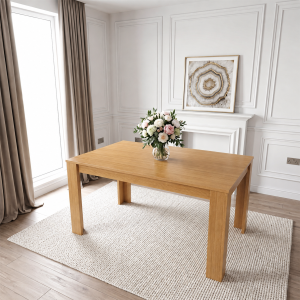
Finish: light oak wood grain. Best for: small kitchens and anyone who already owns chairs. This is the most affordable table on our list, with a wipe-clean surface and flat-pack assembly.
Shop: Dining Table Beige Wood Kitchen Place for 4 Seats (117 cm)
Dining Table Brown Rustic Wood Effect, Place for 6 Seats for Kitchen, Office
Price: £109.99 (was £114.99). Size: 140 x 80 x 75 cm. Finish: brown rustic wood effect.
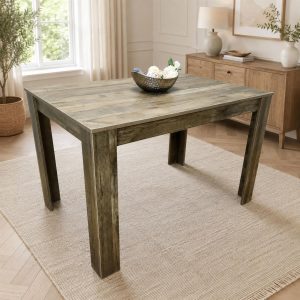
Best for: family tables and shared spaces. It gives about 70 cm per person for six.
Shop: Dining Table Brown Rustic Wood Effect, Place for 6 Seats
Dining Table and 2 Benches Oak Effect Table With 2 Black Velvet Benches
Price: £174.99 (was £199.99). Table: 117 x 77 x 75 cm. Benches: 90 x 36 x 47 cm each.
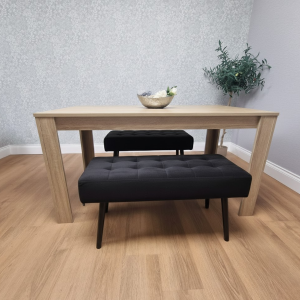
Best for: tight spaces and young families. The benches tuck under the table when you need floor space.
Shop: Dining Table and 2 Benches Oak Effect Table With 2 Black Velvet Benches
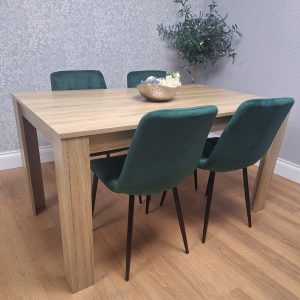
Dining Set of 4 Oak Effect Dining Table With 4 Green Velvet Chairs
Price: £179.99 (was £199.99). Table: 117 x 77 x 75 cm. Chairs: 87 cm high, with a 45 cm seat height.
Next Day Delivery – 14
Best for: a pop of colour. The green velvet chairs sit well against light oak.
Shop: Dining Set of 4 Oak Effect Dining Table With 4 Green Velvet Chairs
Dining Table and 4 Chairs, Rustic Effect Wood Table With 4 Grey Velvet Chairs
Price: £199.99 (was £219.99). Table: 140 x 80 x 75 cm.
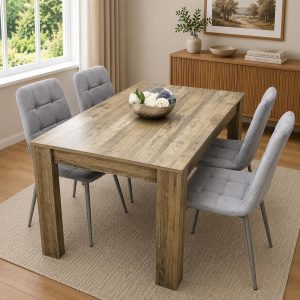
Chairs: grey velvet on metal legs. Best for: a roomier four-seater. The longer top gives everyone more elbow room.
Shop: Dining Table and 4 Chairs, Rustic Effect Wood Table With 4 Grey Velvet Chairs
Browse the full range in our wooden dining set collection.
About the author
This article was written by the Kosy Koala team. We design and source furniture for UK homes, with a focus on practical details that actually matter once a piece is in your room. Have a question about any product on this page? Get in touch through our About Us page.


 Dining Tables
 Dining Chairs

 Bed Frames
 Mattresses
 Bunk Beds
 Sofa & Sofa Beds


