

Blog
How to Clean and Maintain a Glass Dining Table


A glass dining table looks brilliant when it’s clean. It looks tired fast when it’s not. Fingerprints, dust and water spots show up on glass more than on any other table material. That’s the trade-off for the light, open look glass gives a room.
This guide focuses on the cleaning routine itself, not on whether glass is the right choice for you in the first place. If you’re still weighing that up, our glass vs wooden dining table guide covers that decision in full. This article answers a narrower question: how do you actually keep a glass table looking its best, day after day.
Quick answer: wipe your table daily with a soft, dry cloth to remove dust and fingerprints. Once a week, clean it properly with warm water and washing-up liquid, or a proper glass cleaner, then buff dry with a lint-free cloth or newspaper. Avoid ammonia-based sprays, bleach, and anything abrasive. A full weekly clean takes about five to ten minutes.
What You’ll Need
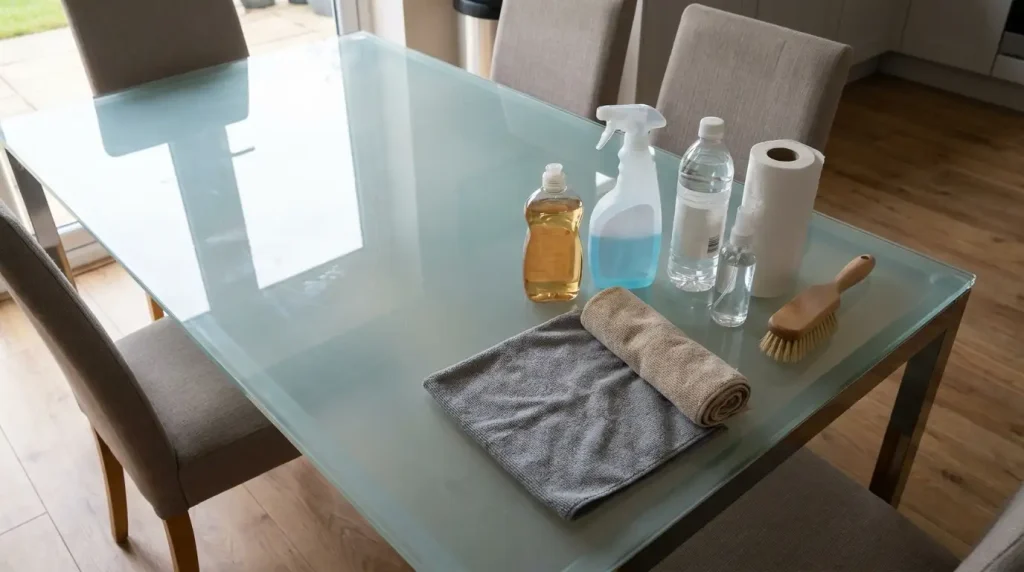
You don’t need a cupboard full of products. Most of this is probably already in your kitchen.
- A microfibre cloth or two, one for washing, one for drying
- Washing-up liquid, or a proper glass cleaner
- White vinegar, useful for streaks and light limescale
- Newspaper or kitchen roll, for the final buff
- A soft-bristled brush or cotton bud, for corners and joints
A pack of microfibre cloths costs very little from a supermarket. One bottle of washing-up liquid lasts for months of table cleaning. This is one reason glass tables are cheap to maintain, even though they need slightly more frequent attention than wood.
Why Glass Needs a Different Routine Than Wood
It’s tempting to assume any dining table just needs “a wipe now and then.” In practice, glass shows marks that a wood or wood-effect table simply hides. There’s nowhere for dust or a fingerprint to disappear against a glass surface.
This isn’t a flaw in the material. It’s the same transparency that makes a small dining room feel more open. The trade-off is fair. Glass rewards a slightly more regular routine than wood does. Each individual clean still only takes a few minutes.
Cleaning the Frame, Not Just the Glass
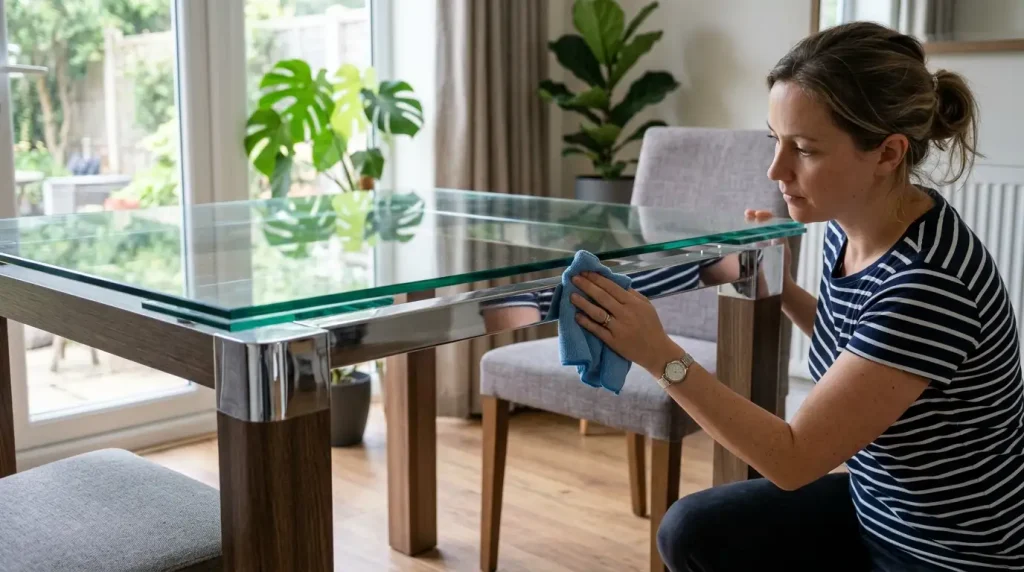
Most glass dining tables sit on a metal, chrome or wood-effect frame. This needs a different approach to the glass itself.
Metal and chrome frames wipe clean with a soft, slightly damp cloth. Avoid anything abrasive here too. A scratched chrome frame loses its shine permanently. Dry it afterwards with a separate cloth.
Wood or wood-effect frames need a dry or barely damp cloth. Standing moisture can make the finish lift or discolour over time. Always dry any moisture off straight away, especially where the frame meets the glass.
Cleaning Time Breakdown
Rather than one single routine, it helps to split cleaning into three levels, each suited to a different job.
| Task | How often |
Typical time |
| Quick daily wipe |
After meals |
Under 1 minute |
| Full weekly clean |
Once a week |
5 to 10 minutes |
| Deep clean | Every 4 to 8 weeks, or when the glass looks dull | 15 to 20 minutes |
A household with young children, or one that hosts often, may find the weekly clean works better every four or five days. A strict seven-day gap can let marks build up too much in a busy house. The deep clean is only needed when the glass looks foggy rather than clear. It doesn’t need a fixed schedule.
Signs you need a deep clean now:
- The surface looks slightly foggy even right after a normal clean
- Faint ring marks don’t wipe away with your usual method
- The glass feels slightly sticky, even when it looks clean
- It’s been more than two months since your last deep clean
Quick Wipe vs Full Clean: The Real Difference
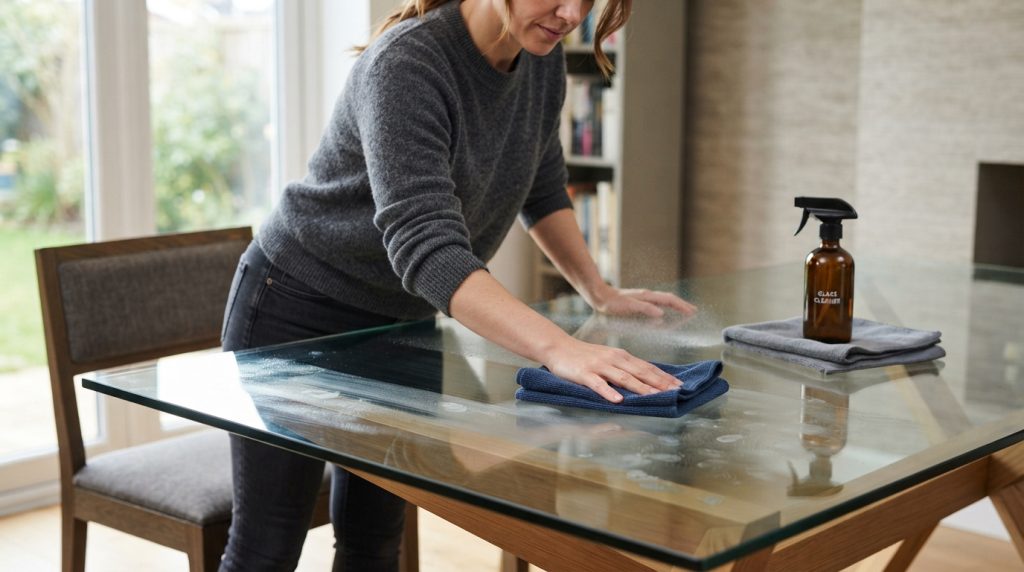
A quick daily wipe and a proper weekly clean aren’t the same job done at different speeds. They actually solve different problems.
A quick wipe with a dry cloth removes loose dust, crumbs and fresh fingerprints. It takes seconds. It stops marks from building up between proper cleans. It won’t shift a dried spill or a greasy mark. It won’t stop general streaking either. It doesn’t use any cleaning solution.
A full clean uses a proper solution. Warm water and washing-up liquid, or a glass cleaner, followed by a dry buff. This is the stage that actually lifts grease, fingerprints and general grime. It leaves the glass genuinely streak-free rather than just dust-free. Skipping this in favour of daily wipes alone is the most common reason a glass table starts looking dull within a few weeks.
Cloth and Product Choice Matters
The tool you clean with changes the result almost as much as the method does. Here’s a quick comparison.
|
Cloth or material |
Good for |
Watch out for |
|
Microfibre cloth |
Daily wiping and drying, no lint | Wash it often, or it smears grease around |
|
Newspaper |
Buffing out streaks after cleaning | Ink can mark a very pale table frame |
| Cotton cloth | General wiping, soft and cheap |
Can leave small bits of lint |
| Paper towel | Quick spot cleaning only |
Often leaves lint on a full clean |
A microfibre cloth is the best all-round choice. Keep two on hand, one for washing and one for drying. This alone stops most streaks before they start.
If you’d rather use a shop-bought glass cleaner, check the label for “ammonia-free.” Ammonia-based formulas are the ones most likely to leave a cloudy film over time. Avoid anything labelled as a multi-surface polish too. These are made for wood or plastic, and they can leave a greasy residue on glass.
Key note: always check what your cloth is made of before you start. A rough or textured cloth can leave fine scratches on glass over time, even if it feels soft to the touch.
Where the Table Sits Changes What It Needs
Table position genuinely affects how often cleaning is needed, and this is easy to overlook.
A table near a window gets more direct sunlight. This shows up every fingerprint and streak far more clearly than a dimly lit room does. This doesn’t mean the table is dirtier. It just means the light is doing a better job of showing you what’s already there.
A table close to the kitchen also picks up a fine film of cooking grease from the air over time, particularly from frying. This is one of the main causes of that dull, cloudy look people notice after a few months. It’s worth a slightly more frequent wipe if your dining table sits near your cooker.
There’s also a genuinely UK-specific issue worth knowing: hard water. Large parts of the UK have hard water. This includes the South East, the Midlands and much of the East of England. Hard water carries more dissolved minerals than soft water. When this dries on glass rather than being buffed off, it leaves faint white or chalky marks behind. Buffing the glass dry straight after cleaning is the simplest fix. Don’t let it air dry. If marks have already built up, a vinegar and water mix cuts through them well.
Common Stains and Quick Fixes
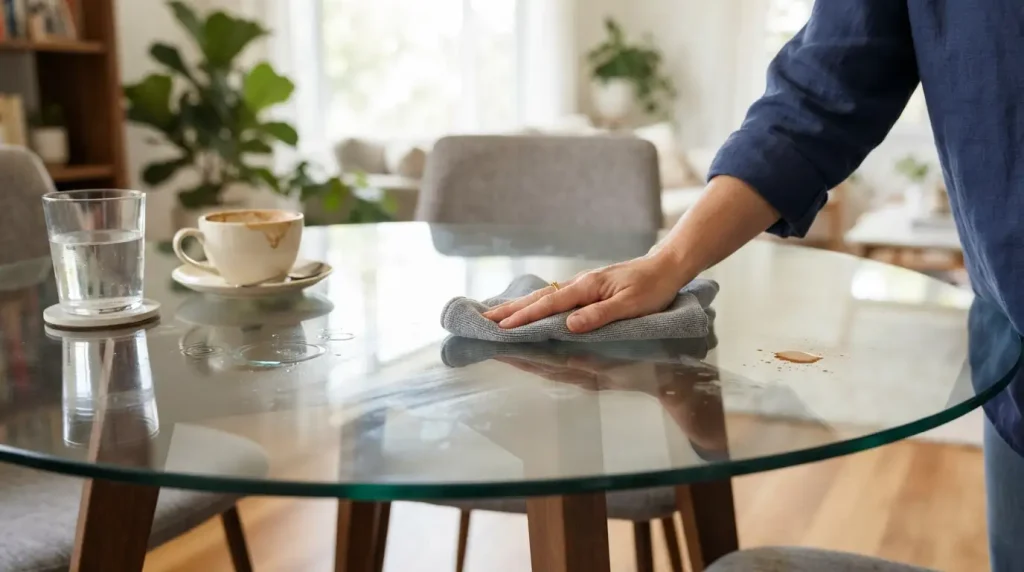
A few specific marks come up often enough to deserve their own quick answer.
- Wine or juice: blot straight away. Don’t wipe, or you’ll spread the stain. Clean as normal once dry
- Tea and coffee rings: warm soapy water lifts most marks. Let it sit a minute on a stubborn one
- Oil and grease: washing-up liquid is built for exactly this job. It’s designed to cut through grease
- Candle wax: let it harden fully first. Then lift gently with a plastic scraper before cleaning normally
- Limescale or water spots: a vinegar and water mix, left for a minute before wiping
Key note: always test a new or stronger product on a small, hidden part of the glass first, especially on a tinted or coated finish.
What Slows Cleaning Down
- Skipping the dry dust first, which drags grit across wet glass and can cause tiny scratches
- Wiping in circles rather than straight lines, since this tends to leave swirl marks that catch the light
- Letting the glass air dry, the main cause of both streaks and hard water marks
- Using ammonia-based cleaners, bleach, furniture polish or abrasive sponges, all of which dull or scratch glass over repeated use
- Leaving spills to dry before wiping them up, since a dried mark takes far more effort than a fresh one
What Actually Helps
- Use coasters and placemats, since direct contact from mugs and hot dishes causes most marks in the first place
- Wipe spills up straight away, rather than leaving them until the next clean
- Lift, rather than drag, plates and serving dishes, since dragging crockery is one of the most common causes of fine scratches
- Keep two microfibre cloths on hand, one for washing, one for drying and buffing
- Buff the glass dry immediately after cleaning, the single biggest factor in avoiding streaks and hard water marks
Chair material matters here too. Faux leather and easy-clean fabrics near the table edge are kinder to a glass surface than fabrics that shed fibres, and they’re simpler to keep clean alongside the table itself.
Don’t Forget the Chairs and Floor
A clean table next to dusty chairs doesn’t look finished. It’s worth folding both into the same routine.
Faux leather chairs wipe clean with a damp cloth in seconds, much like the table itself. Fabric or velvet chairs need a light vacuum instead. This lifts crumbs and dust from the seams that a cloth alone won’t reach.
The floor under a dining table collects more crumbs than almost anywhere else in the room. A quick sweep after meals, alongside your table wipe, stops crumbs being trodden through the house.
Getting Ready for a Big Meal or a Houseful of Guests
Christmas dinner, a birthday, or any big gathering puts more pressure on a glass table than a normal weeknight. A full clean the day before means you’re not rushing on the day itself. Keep a stack of coasters and a spare cloth nearby during the meal, since more hands around the table means more chances of a spill.
Afterwards, don’t leave the clean-up until the next morning. Food and wine left overnight take far more effort to shift than a spill wiped up the same evening, even a quick, rushed wipe.
A Worked Example
Consider a young couple in a flat. Their dining area shares space with the living room. They wipe the table daily after meals, taking under a minute each time. They do a proper clean every Sunday, roughly seven minutes including the buff. Once every couple of months, they notice slight dullness. A quick baking soda deep clean sorts this, adding another fifteen minutes. Total weekly time comes to well under fifteen minutes. The table consistently looks clear rather than dull.
Now consider a family of four with young children, eating together most evenings. Their daily wipe happens more like twice a day. Their full clean tends to land every four or five days rather than a strict week, given the extra spills and fingerprints. Even with this more frequent routine, each individual clean still only takes a few minutes. The method itself doesn’t change with how often you do it.
Neither household is doing anything unusual. They’ve simply matched the frequency of cleaning to their own daily reality. Neither one follows a fixed schedule that doesn’t fit how they actually use the table.
What If the Glass Gets Scratched or Chipped?
Tempered glass is tough, but it isn’t scratch-proof. For very fine surface scratches, a specialist glass polish can sometimes help. These are made for glass, not general furniture polish, so follow the instructions closely.
Deeper scratches and chips are different. These don’t polish out safely at home. A chip near the edge can affect the glass’s strength, since toughening relies on the whole sheet being intact. If you ever see a crack forming, stop using the table and contact the retailer.
The best approach is prevention. Coasters, placemats, and lifting rather than dragging dishes all reduce the chance of a scratch happening in the first place.
Quick Checklist Before You Start
- Clear the table completely.
- Dust with a dry cloth first.
- Apply your cleaning solution and wipe in straight lines.
- Buff dry immediately with a clean cloth or newspaper.
- Wipe the frame and legs separately.
- Check the edges and underside for missed marks.
Frequently Asked Questions
What is the best thing to clean a glass dining table with?
A soft microfibre cloth with warm water and a few drops of washing-up liquid works well for most cleaning. A proper glass cleaner works just as well if you’d rather use one.
How do I get rid of streaks on my glass table?
Streaks usually happen when the glass is left to air dry. Wipe with your cleaning solution, then dry and buff straight away with a clean cloth or newspaper.
Why does my glass table look cloudy?
This is usually hard water marks or leftover cleaning product residue. A deep clean with a baking soda and water paste, then a proper rinse and dry buff, generally clears it.
How often should I clean a glass dining table?
A quick daily wipe plus a proper clean once a week keeps most glass tables looking their best. Busier households may need the full clean slightly more often.
Does cleaning affect tempered glass differently to normal glass?
No. Tempered glass cleans exactly the same way as any other glass. Its strength comes from how it’s manufactured, not a special surface coating.
Can I use vinegar to clean a glass dining table?
Yes. Equal parts water and white vinegar cuts through grease, fingerprints and light limescale well, and it’s a good option if you’d rather avoid chemical cleaners.
Can I use a steam cleaner on a glass dining table?
It’s best to avoid this. Sudden heat on one small area of glass can cause stress marks over time, even on tempered glass. A normal cloth and cleaning solution works just as well and is safer.
Is it realistic to keep a glass table looking new for years?
Yes, with a consistent routine. Daily dusting, a proper weekly clean, and prompt spill wiping are the three habits that matter most over the long term.
Keeping It Looking Its Best
A glass dining table takes very little real effort to maintain once you know the right method. Dust it daily, clean it properly once a week, and buff it dry every single time. Avoid harsh chemicals and abrasive cloths, and use coasters to stop marks before they start. Do this consistently, and a glass table looks as good after years of family meals as it did on the day it arrived.
Glass Dining Tables Worth Considering
Every price below was checked directly on our site before this guide was published. Prices can change, so always confirm the current figure on the product page before ordering.
Black Glass Dining Table Set With 4 Black Chairs
Price: £179.99. Table: tempered black glass. Chairs: faux leather, wipeable finish.

Best Budget Option: An accessible route into a genuine tempered glass table, paired with easy-clean chairs suited to daily family use.
Shop: Black Glass Dining Table Set With 4 Black Chairs
Black Glass Dining Table Set With 6 Black Faux Leather Chairs
Price: £189.99. Table: tempered black glass, 6-seater. Chairs: black faux leather.

Best for Larger Households A full six-seat glass set at a genuinely accessible price, with wipeable chairs that suit a busier daily routine.
Shop: Black Glass Dining Table Set With 6 Black Faux Leather Chairs
Browse the full range in our glass dining sets collection.
About the author
This article was written by the Kosy Koala team. We design and source furniture for UK homes, with a focus on practical details that actually matter once a piece is in your room. Have a question about any product on this page? Get in touch through our About Us page.


 Dining Tables
 Dining Chairs

 Bed Frames
 Mattresses
 Bunk Beds
 Sofa & Sofa Beds


