

Blog
Tempered Glass Dining Tables Explained: What UK Buyers Should Know

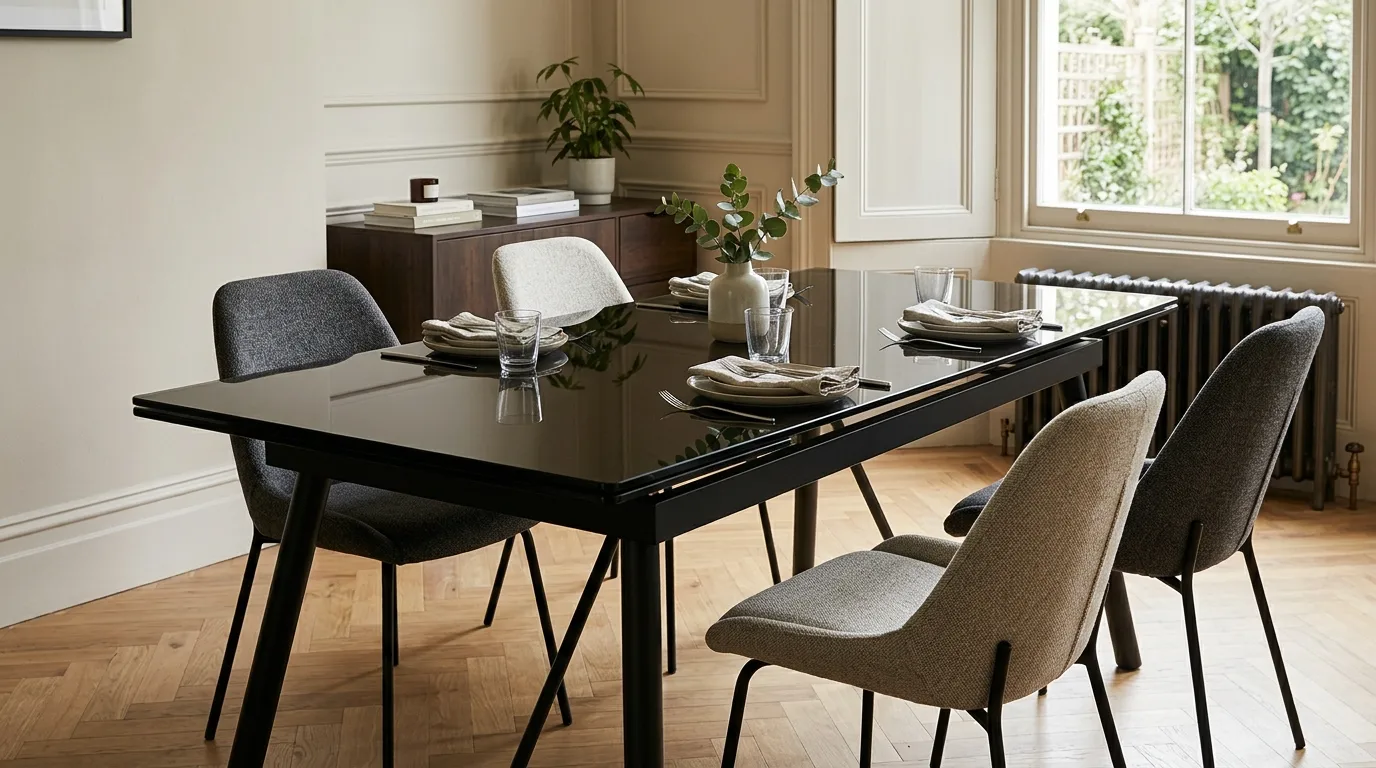
If you’re comparing dining tables, you’ve probably seen the term tempered glass dining table on almost every product listing. It’s worth knowing what it actually means before you buy, since not all glass sold for furniture is made the same way, and the difference genuinely matters for everyday safety and durability.
This guide explains exactly what tempered glass is, how it’s made, what UK standards apply, and what to check on a product page before you commit. If you’re still deciding between materials altogether, our glass vs wooden dining table guide covers that wider decision in full.
Quick answer:
Tempered, or toughened, glass is ordinary glass that’s been heated to a very high temperature and then cooled extremely quickly. This process makes it several times stronger than untreated glass, and if it ever does break, it crumbles into small, blunt granules rather than sharp shards. Genuine tempered glass used in UK dining tables meets BS EN 12150 for the toughening process and BS 7376 for its use in table construction specifically. Most dining tables use glass between 8mm and 12mm thick.
What Is a Tempered Glass Dining Table, Exactly?
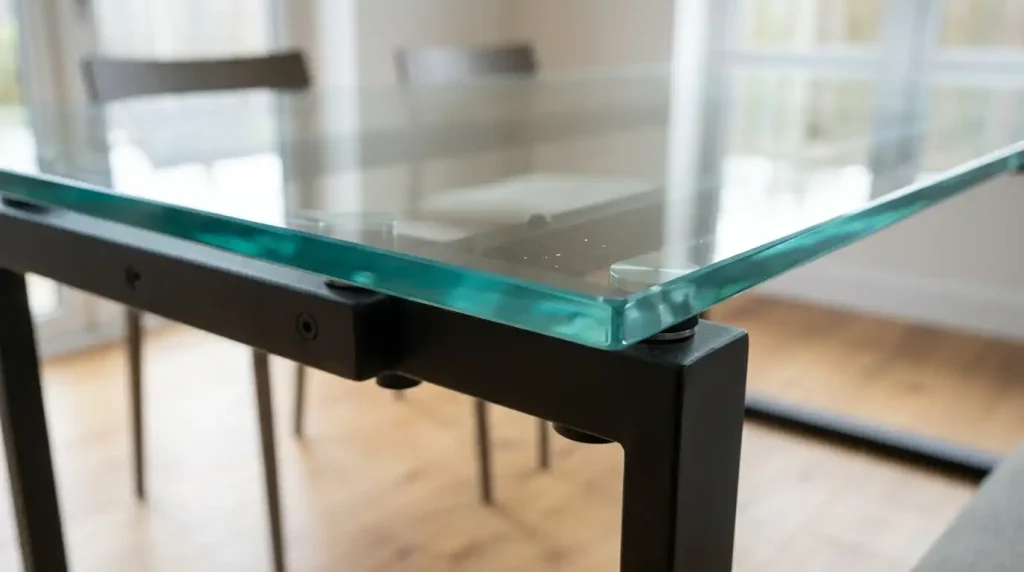
A tempered glass dining table uses a tabletop made from toughened safety glass rather than ordinary, untreated glass. The term “tempered” and “toughened” mean the same thing, and you’ll see both used interchangeably across UK and international product listings.
The key point is that tempered glass isn’t a different type of glass in terms of its raw material. It starts out as standard float glass, the same base material used in windows and mirrors, and becomes tempered through a specific manufacturing process that changes its internal structure. This process is what makes it suitable for a dining table, where daily knocks, hot dishes, and general family use are all part of normal life.
How Tempered Glass Is Actually Made
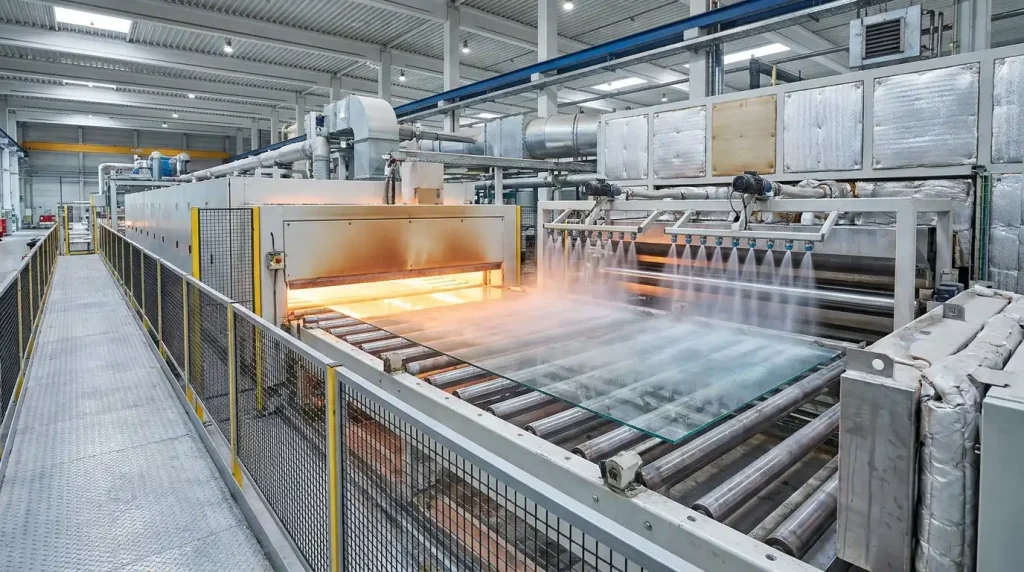
Understanding the manufacturing process helps explain why tempered glass behaves so differently to ordinary glass, and why it costs a little more to produce.
The process starts with a sheet of standard annealed glass, cut and finished to the exact size and shape needed for the table. This sheet is then heated in a furnace to a temperature of around 600 to 700 degrees Celsius, close to its softening point. From here, it’s cooled extremely quickly using jets of cold air across both surfaces, a step known as quenching.
This rapid cooling is the part that actually creates the strength. The outer surfaces of the glass cool and contract faster than the inner layer, which puts the surfaces under permanent compression while the core remains in tension. This internal balance is what gives tempered glass its extra strength compared with ordinary glass of the same thickness, generally around four to five times stronger under normal impact.
To put that in context, a sheet of ordinary annealed glass and a sheet of tempered glass can look completely identical to the naked eye. The difference is entirely internal, locked into the glass during manufacturing, which is exactly why checking a product description matters more than judging a table by appearance alone.
Key note: once glass has been through this process, it can’t be cut, drilled, or reshaped afterwards. Any cutting or edge finishing has to happen before toughening, which is why a tempered glass tabletop always arrives as a finished, fixed size.
Where Else You’ll Find Tempered Glass
It helps to know that dining tables are far from the only place tempered glass is used, since this context explains why the technology is so well understood and widely trusted. The same toughening process is used for car windows, shower screens, glass balustrades, oven doors, and mobile phone screen protectors. In every one of these applications, the same principle applies: a material that needs to be strong in daily use, but genuinely safer than ordinary glass if it’s ever damaged.
This wide, everyday use is part of why tempered glass is considered such a reliable, well-tested choice for a dining table top. It isn’t a new or unproven technology being applied to furniture. It’s a long-established safety glass standard, borrowed from applications where failure genuinely isn’t an option.
Tempered vs Annealed vs Laminated Glass: What’s the Difference?
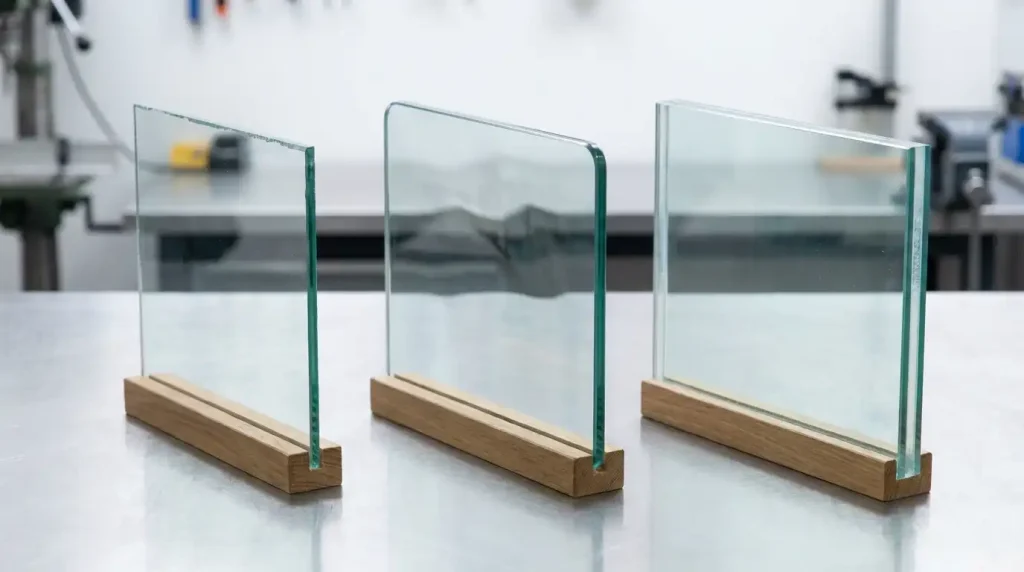
Not all glass sold for furniture is tempered, and it’s worth knowing the difference before you buy, particularly from a less familiar retailer.
| Glass type | Strength | How it breaks | Suitable for dining tables? |
| Annealed (standard) glass | Baseline strength, no special treatment | Breaks into long, sharp shards | No, not for a load-bearing tabletop |
| Tempered (toughened) glass | Around 4 to 5 times stronger than annealed | Crumbles into small, blunt granules | Yes, the standard choice for dining tables |
| Laminated glass | Similar strength to annealed, but held together by an inner layer | Cracks but stays largely in place, held by the interlayer | Sometimes used for extra safety in specific settings, less common for standard dining tables |
Annealed glass has no place on a genuine dining table top, since it offers no meaningful safety margin if it’s struck hard enough to break. Laminated glass is a legitimate safety option in some settings, since its plastic interlayer holds broken pieces together, but tempered glass remains the standard choice for UK dining tables thanks to its strength, cost, and everyday practicality.
Why Tempered Glass Breaks Differently
This is the detail that actually matters most for everyday peace of mind. Because of the internal compression created during manufacturing, tempered glass fails in a completely different way to ordinary glass.
If tempered glass is ever struck hard enough to break, usually from a very severe impact rather than normal daily use, the stored internal stress releases all at once. Rather than cracking into large, jagged pieces the way a window pane might, the entire sheet crumbles into small, blunt granules. This is by design, and it’s the entire reason tempered glass is considered a safety glass in the first place.
Our full guide on is a glass dining table safe for families with children goes further into what this means for households with young children specifically, including shape and stability considerations beyond the glass itself.
What Thickness Should a Dining Table Glass Actually Be?
Thickness is one of the most practical, checkable details on any product listing, and it’s worth understanding rather than skipping over.
Most UK dining table tops use tempered glass between 8mm and 12mm thick. Thinner glass, generally used for smaller side tables or shelving, isn’t intended for a full dining table’s daily use. A properly specified 8mm tempered top, correctly supported by its frame, is genuinely suitable for everyday family dining, and this is the specification used across most accessible-price UK glass dining sets, including our own Black Glass Dining Table Set With 4 Chairs, priced at £199.99.
Key note: thickness alone doesn’t guarantee quality. A well-made 8mm tempered top on a stable frame will outperform a poorly supported thicker one, since the frame’s construction matters just as much as the glass itself.
Why Tempered Glass Costs a Little More
If you’ve compared a glass-topped table against an equivalent wooden one, you may have noticed the glass version often sits at a similar or slightly higher price point. This isn’t simply about appearance. Tempered glass genuinely costs more to produce than untreated glass, generally somewhere between 20 and 40 percent more, because of the extra furnace time, precise temperature control, and rapid cooling equipment the toughening process requires.
This cost difference is worth keeping in mind when comparing two similarly priced tables from different retailers. A genuinely tempered glass top, properly specified and backed by a warranty, reflects real manufacturing cost. A very cheap glass table with no stated specification at all is worth a closer look before assuming it offers the same quality.
The UK Standards Behind Tempered Glass Furniture
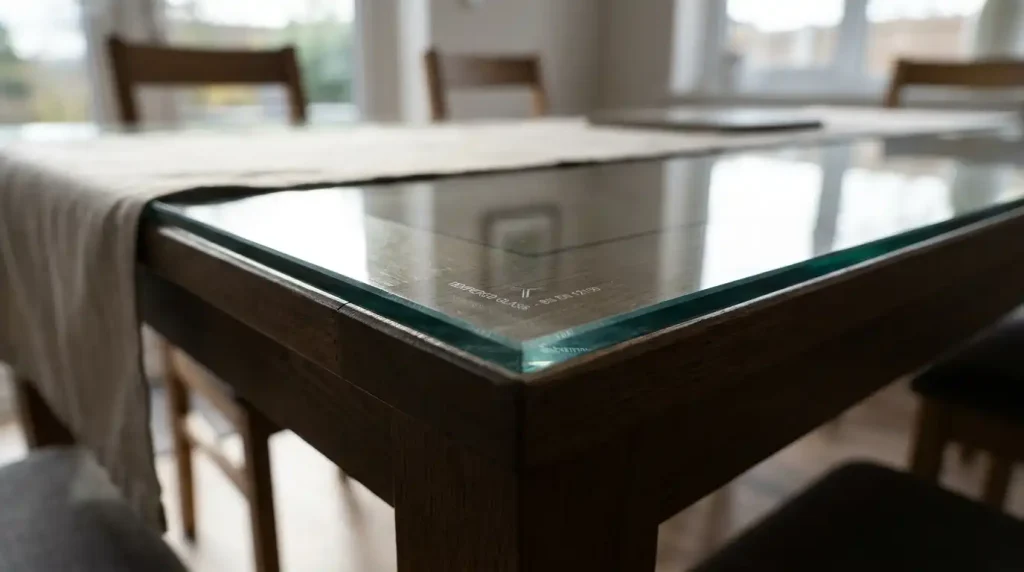
This is worth knowing in a little more detail, since it’s the actual legal and technical basis for calling a product safe in the first place, rather than just a marketing phrase.
In the UK, the General Product Safety Regulations 2005 place a legal duty on manufacturers and retailers to ensure any product supplied to consumers is genuinely safe for its intended use. For glass specifically used in furniture, this is backed by two more specific standards. BS EN 12150 sets out the technical requirements for thermally toughened soda lime silicate safety glass, covering the toughening process itself. BS 7376 covers the inclusion of glass in the construction of tables specifically, addressing how the glass should be supported and used within a finished piece of furniture.
Genuine tempered glass carries a small etched mark confirming compliance, usually positioned discreetly on a corner or edge of the glass. If you’d like the full legal detail behind these regulations, the official General Product Safety Regulations 2006 guidance is publicly available on GOV.UK.
How to Check a Table Is Genuinely Tempered Before You Buy

Buying online means you can’t physically check the glass yourself before committing, so it’s worth knowing what to look for on the page instead.
- Read the product description carefully. A genuine UK retailer will specify “tempered” or “toughened” glass explicitly, usually alongside the thickness in millimetres.
- Check for a stated thickness. Anywhere between 8mm and 12mm is standard for a dining table. A listing with no thickness mentioned at all is worth a direct question to the retailer.
- Look for a warranty or guarantee. A retailer confident in their glass specification will usually back it with a proper warranty, which is a reasonable signal of genuine quality.
- Ask directly if you’re unsure. A legitimate UK retailer should be able to confirm the glass type and standard compliance clearly and quickly, without hesitation.
Our Black Glass Dining Table Set With 4 Gem Pattern Chairs, priced at £179.99, is a good example of a listing that states its tempered glass specification clearly, which is exactly the sort of detail worth looking for wherever you end up buying.
Delivery, Weight, and Handling
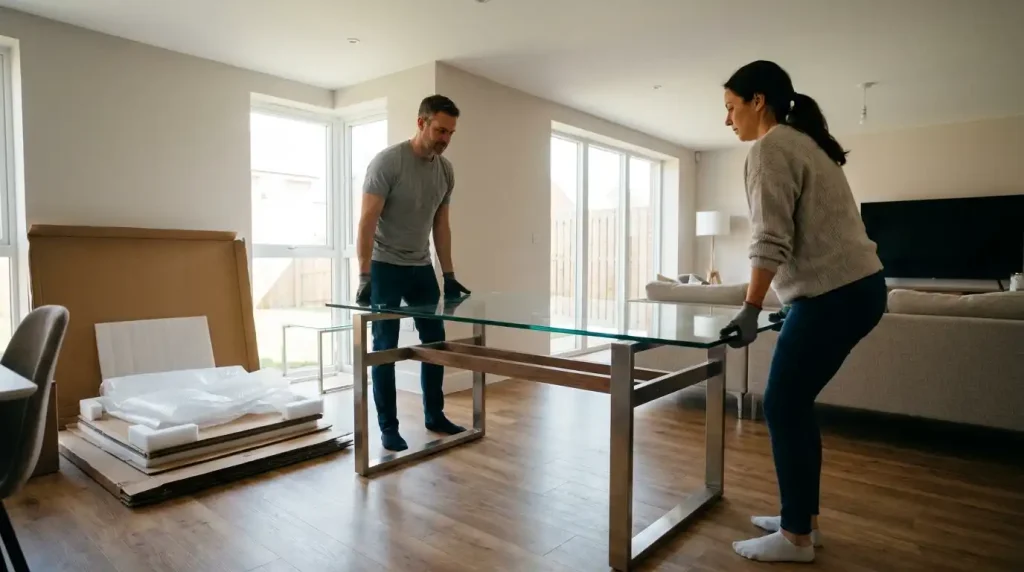
Tempered glass tabletops are noticeably heavier than an equivalent wooden or wood-effect panel of the same size, and this is worth planning for around delivery day. Most retailers pack the glass top separately from the frame, well protected in its own layer of packaging, and this section usually needs two people to lift and position safely during assembly.
It’s worth clearing a flat, stable surface to rest the glass on temporarily while you assemble the frame underneath, rather than leaning it against a wall or propping it at an angle. Once fitted correctly into its frame, the weight that made it awkward to carry becomes an advantage, since a heavier glass top generally feels more stable and less prone to shifting during everyday use.
Can Tempered Glass Be Repaired, Cut, or Resized?
This comes up more often than you’d expect, and the honest answer is no. Once glass has gone through the toughening process, it can’t be cut, drilled, ground down, or reshaped afterwards. Any attempt to do so is likely to cause it to shatter immediately, since cutting disrupts the internal compression that gives it its strength in the first place.
This means a chipped or cracked tempered glass tabletop can’t be repaired in any meaningful way. If a genuine tempered top does become damaged, the sensible option is a full replacement panel made to the same dimensions, rather than any attempt at an on-site repair or resize. This is worth bearing in mind if you’re ever tempted to trim a table down to fit an awkward space; with tempered glass, that adjustment has to happen before you order, not after.
Tempered Glass and Everyday Family Life

Beyond the technical detail, it’s worth knowing how tempered glass actually performs in a normal household, since this is what most buyers really want to know.
Tempered glass handles hot dishes and sudden temperature changes noticeably better than untreated glass, thanks to its improved thermal shock resistance, though a coaster or trivet under anything very hot remains sensible practice regardless. It resists everyday scratching from cutlery and plates reasonably well, and it doesn’t fade or discolour from sunlight over time the way some other surfaces can. Day to day maintenance is straightforward too. Our full guide on how to clean and maintain a glass dining table covers the exact method and products that keep a tempered glass top looking its best.
Common Myths About Tempered Glass
Myth: tempered glass never breaks. It’s significantly stronger than ordinary glass, but it isn’t indestructible. A severe enough impact will still break it, just far more safely than untreated glass would.
Myth: all glass furniture uses tempered glass automatically. This isn’t guaranteed unless the retailer states it explicitly. It’s always worth checking the product description rather than assuming.
Myth: thicker glass is always better. Thickness matters, but a well-supported 8mm top on a stable frame is genuinely suitable for daily dining use. Thickness alone doesn’t compensate for a poorly built frame underneath.
Myth: you can have a chipped tempered glass table repaired. Genuine tempered glass can’t be repaired once damaged. A full replacement panel, made to the original dimensions, is the only real option.
A Worked Example
Consider a buyer comparing two very similarly priced glass dining tables online. One listing states clearly that the top is 8mm tempered glass, meeting BS EN 12150, with a stated warranty period. The other simply describes the table as having a “glass top,” with no thickness, no standard mentioned, and no warranty listed.
On price alone, the two tables look identical. Once the buyer knows what to look for, the difference becomes obvious. The first listing gives a genuine, checkable specification that a reputable UK retailer stands behind. The second leaves too much unconfirmed, and it’s worth a direct question to the seller before ordering, rather than assuming the best.
This is exactly the sort of detail that separates a confident purchase from a hopeful one, and it costs nothing to check before you buy.
Red Flags Worth Watching For
A handful of warning signs are worth knowing before you buy from an unfamiliar retailer, particularly if a listing looks unusually cheap for a glass dining set.
- No mention of “tempered” or “toughened” anywhere in the listing. A genuine UK retailer will state this clearly, since it’s the single most important specification for the product.
- No thickness given at all. Even a basic listing should state the glass thickness in millimetres.
- Stock images that don’t match the described product. This can suggest a listing has been copied from elsewhere without proper verification of what’s actually being sold.
- No returns policy or warranty mentioned. A retailer confident in their product’s quality will generally offer some form of guarantee.
- Reviews that mention the glass arriving already cracked or chipped. A pattern of this happening across multiple reviews suggests a packaging or quality issue worth taking seriously.
None of these signs guarantee a problem on their own, but a listing showing more than one of them is worth a direct question to the retailer before you order.
Key note: it’s also worth checking whether the retailer is UK-based and subject to UK consumer protection law directly, rather than a marketplace listing shipped from overseas with limited recourse if something goes wrong. This doesn’t rule out overseas sellers entirely, but it’s a genuine factor in how easily you could resolve a problem after delivery.
What Happens to Tempered Glass at the End of Its Life?
This is a fair question, and one that genuinely useful guides tend to skip. Tempered glass is fully recyclable through standard glass recycling streams, though most household kerbside collections don’t accept flat glass in the same way they accept bottles and jars, since the recycling process for flat glass differs slightly. A local recycling centre or specialist glass recycler will generally accept a tempered glass tabletop, and this is worth checking with your local council if you’re ever replacing or disposing of one. This is a small but genuinely practical point worth knowing, since a table this durable is likely to outlast several other pieces of furniture in the same room before you need to think about it at all.
Frequently Asked Questions
What is a tempered glass dining table?
It’s a dining table with a top made from toughened safety glass, heat-treated to be several times stronger than ordinary glass, and designed to break into small, blunt pieces rather than sharp shards if it ever fails.
Is tempered glass the same as toughened glass?
Yes, the two terms describe exactly the same manufacturing process and the same finished product. UK listings tend to use “toughened,” while international listings often say “tempered.”
How thick should a tempered glass dining table be?
Most UK dining tables use glass between 8mm and 12mm thick. An 8mm top on a well-built, stable frame is genuinely suitable for everyday family use.
Can you tell if glass is tempered just by looking at it?
Not reliably. Genuine tempered glass carries a small etched mark, usually on a corner or edge, but this can be easy to miss. Checking the product description or asking the retailer directly is more reliable.
What happens if a tempered glass table breaks?
It crumbles into small, blunt granules rather than long, sharp shards. This is the specific safety benefit the toughening process is designed to provide.
Can a chipped tempered glass table be repaired?
No. Once tempered glass is damaged, it can’t be cut, ground, or repaired. A full replacement panel to the same dimensions is the only genuine option.
Does tempered glass scratch easily?
It resists everyday scratching from cutlery and plates reasonably well, though it isn’t scratch proof. Placemats and coasters help avoid marks from harder or sharper objects dragged across the surface.
Why does a glass dining table cost more than a similar wooden one?
Tempered glass is genuinely more expensive to manufacture than untreated glass, generally around 20 to 40 percent more, due to the furnace time and precise cooling process involved. This cost is reflected in the finished price of a properly specified tempered glass table.
Is tempered glass heavier than I’d expect?
Yes, noticeably so compared with an equivalent wood-effect panel. This is worth planning for during delivery and assembly, though it becomes an advantage once fitted, since a heavier top tends to feel more stable in daily use.
Is a tempered glass dining table a good long-term investment?
Generally yes. A properly specified tempered glass top resists everyday wear, scratching and fading better than many other surfaces, and its strength doesn’t degrade over normal years of use. Provided the frame underneath stays sound, a genuine tempered glass table is likely to outlast several other pieces of furniture in the same room.
Five Kosy Koala Tempered Glass Dining Sets Worth Considering
Every price below was checked directly on our site before this guide was published. Prices can change, so always confirm the current figure on the product page before ordering.
Black Glass Dining Table Set With 4 Chairs
Price: £199.99. Table: 8mm tempered black glass. Chairs: black and white faux leather.
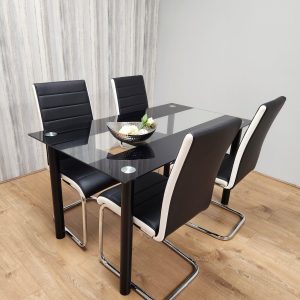
Best Clearly Specified Option A listing that states its tempered glass specification plainly, exactly the sort of detail worth looking for when comparing tables online.
Shop: Black Glass Dining Table Set With 4 Chairs
Black Glass Dining Table Set With 4 Gem Pattern Chairs
Price: £179.99. Table: 8mm tempered black glass. Chairs: black faux leather with gem-pattern stitching.
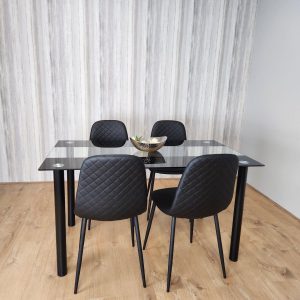
Best Budget Tempered Glass Set A genuinely specified tempered glass top at an accessible price, with a more detailed chair finish than the most basic sets.
Shop: Black Glass Dining Table Set With 4 Gem Pattern Chairs
Black Glass Dining Table Set With 4 Black Velvet Chairs
Price: £179.99. Table: 8mm tempered black glass. Chairs: black velvet.
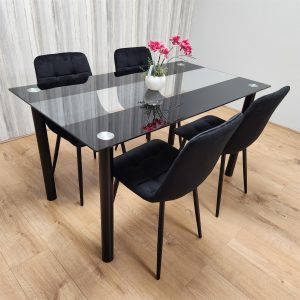
Best for a Softer Look The same genuine tempered glass specification, paired with a softer velvet chair finish for a slightly different overall style.
Shop: Black Glass Dining Table Set With 4 Black Velvet Chairs
Black Clear Glass 4 Gem Pattern Faux Leather Padded White Chairs
Price: £239.99. Table: tempered black glass. Chairs: white faux leather with gem-pattern stitching.
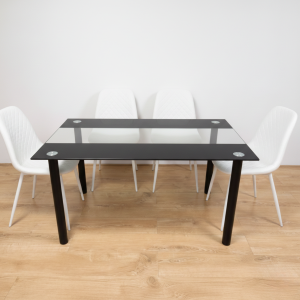
Best for a Brighter Look A lighter chair finish against the same genuine tempered glass top, suited to a brighter dining room.
Shop: Black Clear Glass 4 Gem Pattern Faux Leather Padded White Chairs
Black Clear Glass 4 Faux Leather Padded White Chairs
Price: £214.99. Table: tempered black glass. Chairs: white faux leather, wipeable finish.
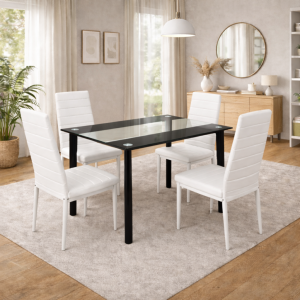
Best for Easy Cleaning Wipeable chairs alongside the same genuine tempered glass specification covered throughout this guide.
Shop: Black Clear Glass 4 Faux Leather Padded White Chairs
Browse the full range in our glass dining sets collection, or see how chair choice affects the overall set in our guide to the best chairs to pair with a glass dining table.
Buying With Confidence
A tempered glass dining table is a genuinely well-engineered piece of furniture, not just a stylish surface. Knowing what the term actually means, checking thickness and standards compliance, and understanding what happens if it’s ever damaged all help you buy with real confidence rather than just trusting a listing at face value.
About the author
This article was written by the Kosy Koala Team. We create practical furniture guides to help UK shoppers understand key buying considerations, compare options and choose furniture that suits their home. Have a question about any product on this page? Get in touch through our About Us page.


 Dining Tables
 Dining Chairs

 Bed Frames
 Mattresses
 Bunk Beds
 Sofa & Sofa Beds


