

Blog
Dressing Table With Mirror: The Complete UK Buying Guide

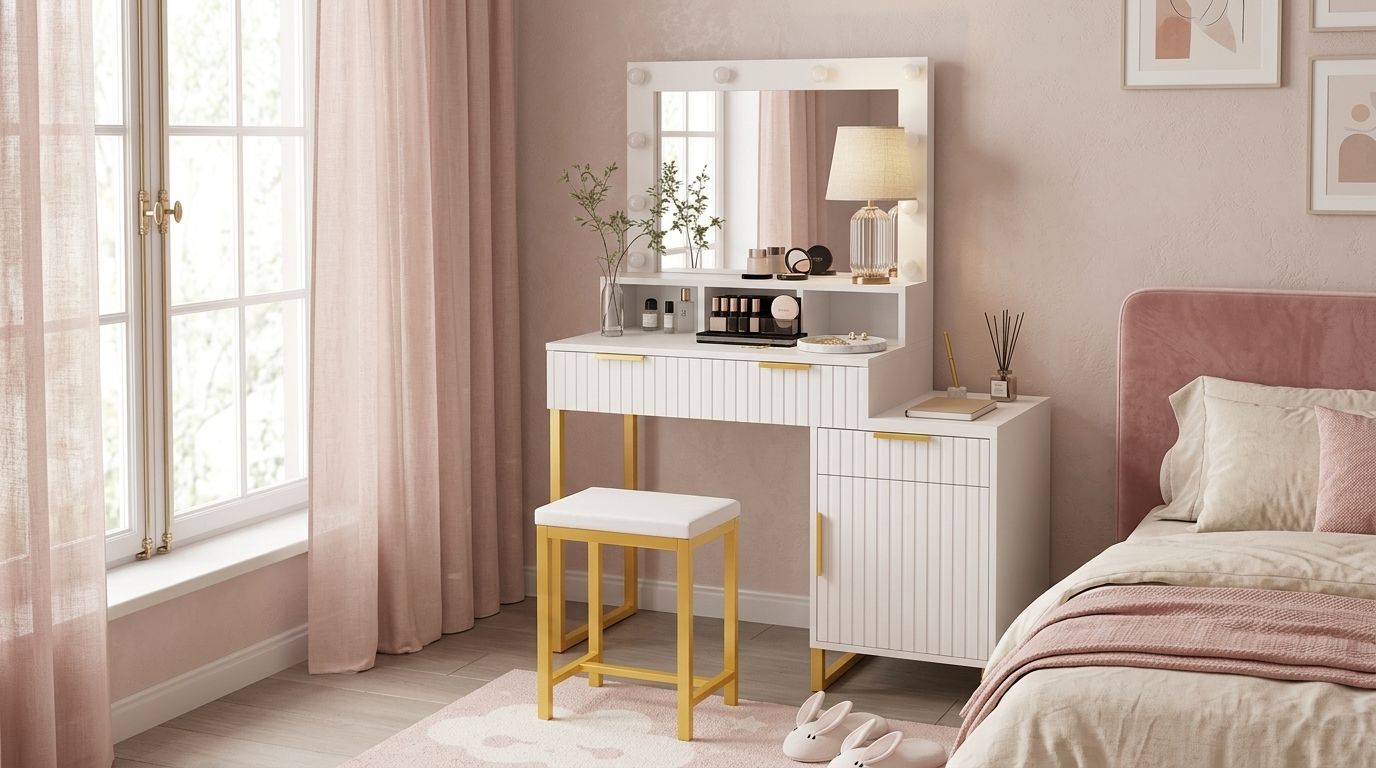
A dressing table with mirror is one of those purchases that looks simple on a product page and turns complicated the moment it lands in your hallway. The wrong mirror height leaves you hunching every morning. The wrong depth means your straighteners overhang the edge. The wrong width means the stool jams against the bed every time you pull it out. None of this is obvious from a photo, and it is exactly why so many people end up buying twice.
This guide walks through every decision that actually matters: how much space you need, which mirror type suits your routine, whether a stool should be included, how much storage is realistic, what height works for your body, and what to expect at each UK price point. By the end, you will know exactly what to look for, and you will be able to shortlist from our dressing table collection with confidence rather than guesswork.
Quick answer: the right dressing table with mirror comes down to five decisions in this order: available floor space (table width plus roughly 90cm of clearance for the stool), mirror type (fixed, flip-up, Hollywood bulb, LED, or freestanding), storage need (count what you use daily before choosing drawer count), tabletop height against your own seated eye level, and finish to match your existing bedroom furniture. Get those five right and almost any style will work for you.
What Counts as a Dressing Table With Mirror
A dressing table with mirror is a table built specifically for getting ready, with the mirror integrated into the design rather than bought and hung separately. That integration is the whole point of the category. The mirror is fixed at a height that suits seated use, the table depth is calculated around arm’s reach rather than general desk use, and storage is arranged around cosmetics, jewellery and hair tools rather than paperwork or laptops.
This is different from simply pushing a desk against a wall and hanging a mirror above it. A proper dressing table accounts for three things a generic desk does not: seated eye-level mirror placement, a surface shallow enough that you are not leaning forward to reach products, and drawer or shelf divisions sized for small items rather than files and folders.
It is also worth being clear early on about a distinction that trips a lot of buyers up: dressing table and vanity desk are often used interchangeably in UK retail, but they are not always identical products. A dressing table traditionally centres on the mirror and seated routine, while a vanity desk sometimes leans closer to a hybrid workspace with a mirror added on. If your main use is makeup, hair and jewellery, look for products explicitly built around the mirror rather than a desk with a mirror bolted on as an accessory.
How Much Floor Space You Actually Need
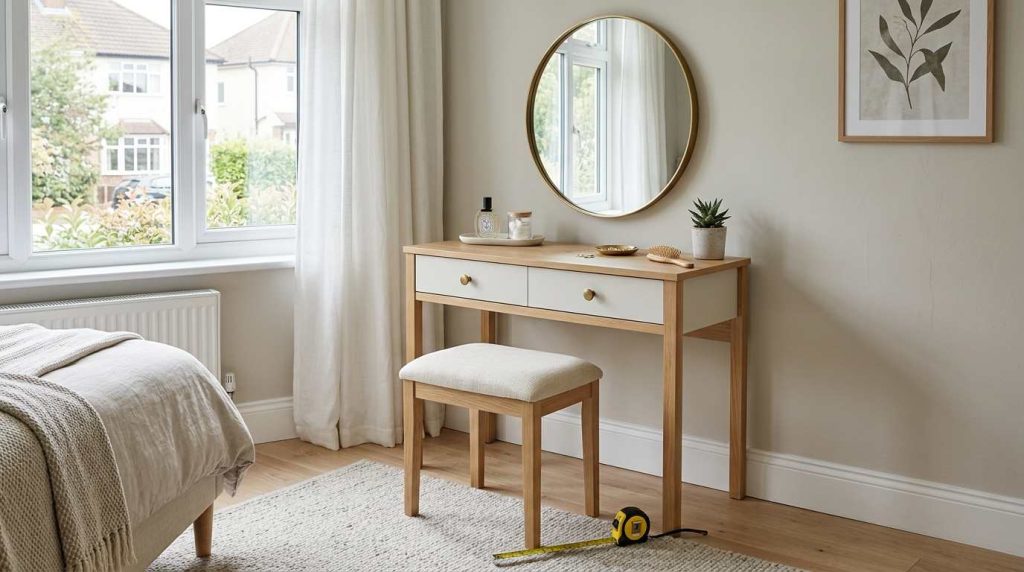
This is where most buying mistakes happen, and it happens for a predictable reason: people measure the table and forget the stool.
The rule that avoids the problem: table width, plus roughly 90cm of clear floor in front of it. That 90cm is not padding. It covers the stool itself, the legroom to sit down and stand up without knocking your knees, and enough clearance that the stool does not block a door or wardrobe when it is pulled out.
| Table width | Total floor depth needed (table plus stool clearance) |
| 60cm | 150cm |
| 70cm | 160cm |
| 80cm | 170cm |
| 90cm and above | 180cm+ |
For most UK bedrooms, a table between 60cm and 90cm wide is the practical range. UK bedrooms tend to run smaller than buyers expect on paper. Under the government’s own Nationally Described Space Standard, a single bedroom only needs to be 7.5 square metres and a double 11.5 square metres, and a large share of existing housing stock was built to standards below even that. Once you have a bed, a wardrobe and a chest of drawers in an 11.5 square metre double room, the space left for a dressing table is often narrower than people plan for on a floor sketch.
Before you shop, do this in five minutes:
- Measure the wall space where the table will sit, side to side.
- Measure out from that wall to where you want the stool to end up when fully pulled out, not just tucked under.
- Check nothing else swings into that space: wardrobe doors, a bedroom door, a radiator.
- Note the ceiling height if the wall slopes, since taller mirrored units and tri-fold mirrors need more headroom than a flat wall mirror.
- Measure the doorway and staircase width the table needs to travel through on delivery day, particularly for larger corner units.
One positioning tip that rarely gets mentioned: avoid placing the table directly opposite a window. The mirror reflects the window and creates glare that makes it genuinely difficult to use during daylight hours. A wall perpendicular to the window, rather than facing it, gives you natural light on your face without a wash of glare across the mirror itself.
If your room genuinely cannot take a standard-width table, a corner dressing table uses a dead corner that most other furniture cannot occupy, often giving you more drawer and shelf space than a straight-wall table of the same footprint.
Which Mirror Type Actually Suits Your Routine
The mirror is the functional core of the piece, and it is the decision most likely to affect how much you actually use the table once the novelty wears off. Below are the formats you will see across UK retail, and who each one genuinely suits.
| Mirror type | Best suited to | Watch out for |
| Fixed standing mirror | Daily users who want the mirror always ready, no mechanism to fiddle with | Adds visual height to the piece; not ideal under a sloped ceiling |
| Flip-up lid mirror | Small bedrooms, renters, anyone who wants the table to disappear into a flat surface when closed | Mirror angle is fixed by the hinge, less flexible than a freestanding tilt mirror |
| Tri-fold Hollywood mirror | Full makeup and hair routines, seeing the sides and back of your head | Takes up more width and depth than a single flat mirror |
| LED mirror (colour temperature adjustable) | North-facing rooms or bedrooms with inconsistent natural light | Requires a nearby socket or battery compartment; check which before buying |
| Round or oval freestanding mirror | Minimalist, design-led bedrooms; pairs well with faux marble or glass tops | Rarely comes with a stool included, so budget for one separately |
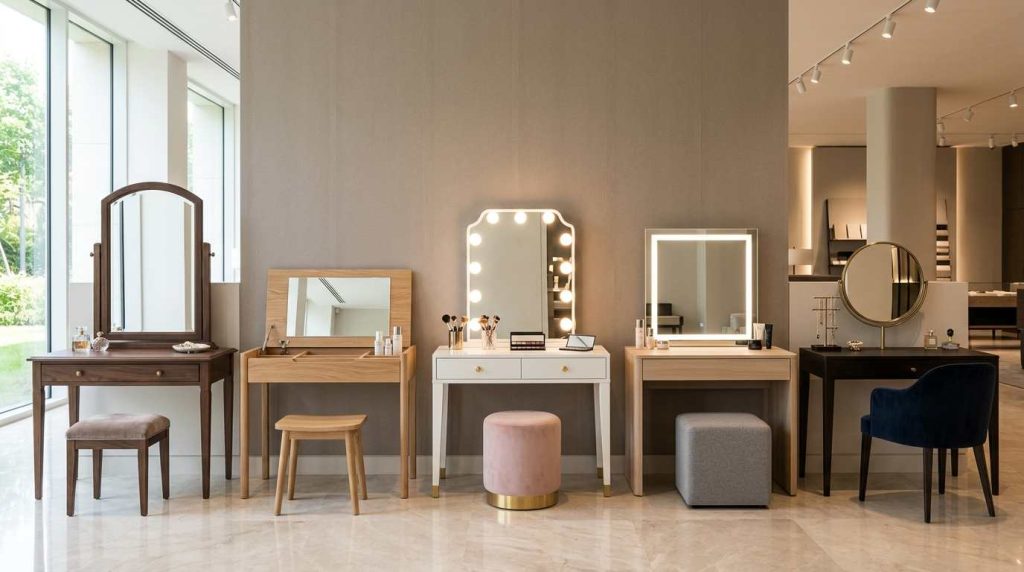
Fixed mirrors sit above the table surface at a set height, always visible and ready with nothing to open or adjust. They suit anyone who uses the table daily and does not want a step between sitting down and being able to see themselves clearly.
Flip-up lid mirrors fold flat when not in use, so the table becomes a completely usable flat surface with no mirror visible and no glare catching the light. This is the strongest option for small UK bedrooms where a permanently visible mirror would dominate the room visually, and it doubles as a desk when closed.
Tri-fold Hollywood mirrors, sometimes called triple panel mirrors, give you a centre view plus two angled side panels, so you can see the sides and back of your hair without twisting or reaching for a hand mirror. Our corner dressing table with a three-way folding mirror uses this format, which is genuinely useful if you style your hair regularly rather than just applying makeup.
LED mirrors solve a problem that has nothing to do with mirror shape: inconsistent light. A north-facing bedroom, a room with one small window, or simply getting ready before sunrise in winter all mean natural light cannot be relied on to judge how makeup actually looks once you step outside. A built-in LED ring or edge strip with adjustable colour temperature, typically switching between a cool white for daylight simulation and a warm white for evening tones, removes that guesswork. Our Hollywood-style mirror set with adjustable LED bulbs uses a touch-button control so you can shift the tone without hunting for a separate dimmer switch.
Round and oval freestanding mirrors are the design-led choice, usually paired with a faux marble or glass top and a slim metal frame. They suit contemporary, minimalist bedrooms where the goal is a light visual footprint rather than maximum function. The trade-off is that these sets rarely include a stool, and the mirror is fixed rather than adjustable, so check both before assuming it matches your routine.
A note that applies to every format above: check whether the mirror is fixed or adjustable before buying if you plan to use the table standing as well as seated, since a mirror set for a seated eye line can be uncomfortably low if you also want to check a full outfit while standing.
Table With a Stool, or Table Alone
For most buyers, a set that includes the stool is the more practical purchase, for one reason that is easy to overlook: a stool sold with a dressing table is designed to the correct seated height for that specific table. Source them separately, and you have to independently match seat height, upholstery colour and overall proportions, and get all three right.
That said, buying the table alone makes sense in a few situations:
- You already own a chair at the right seated height, such as a vanity stool from a previous set.
- You prefer a more substantial upholstered accent chair over a small padded stool.
- Floor space is tight enough that you want to reuse an existing dining or bedroom chair rather than store a dedicated stool.
If you do buy the table alone, check the tabletop height against a stool or chair you already own before ordering. Most UK dressing tables sit at 74 to 79cm tabletop height, paired with a stool seat height of around 44 to 50cm, which places your forearms at a comfortable working level with the mirror roughly at eye level once seated. A mismatch of even 5 to 8cm is enough to make the table uncomfortable for daily use.
Sets that already pair a matching mirror, table and stool, such as our Hollywood-style dressing table set with a cushioned stool, remove this guesswork entirely, since the proportions are calculated together at the design stage rather than assembled from separate purchases.
How Much Storage You Genuinely Need
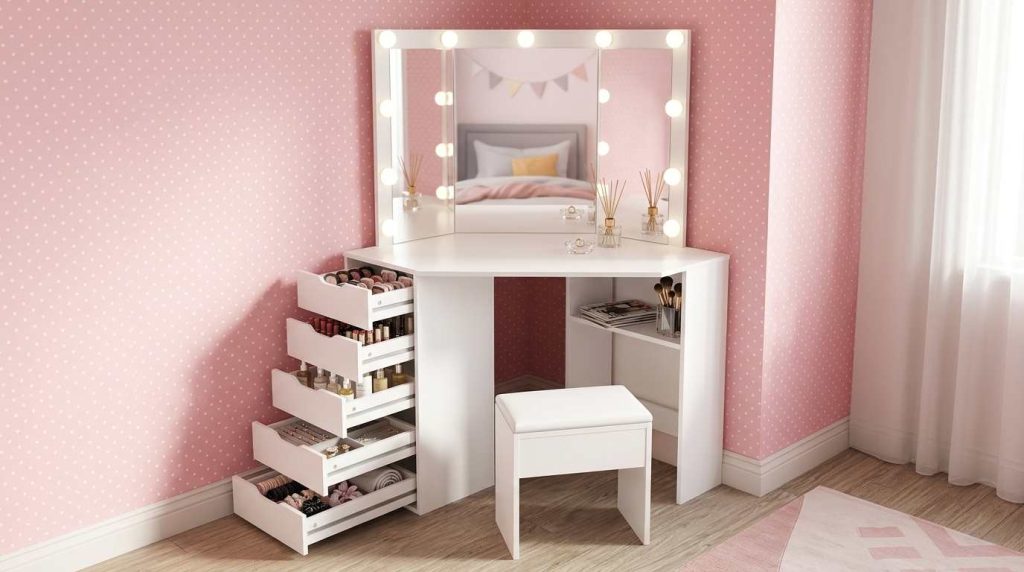
The right amount of storage depends on what you already own, not what you intend to own eventually. Before you shop, count the products you use every single morning. If that count is 15 items or more, a single drawer will be full within the first week.
There are two broad approaches, and most tables use a mix of the two:
Drawers conceal contents and keep the surface looking clean. They suit anyone who prefers an uncluttered bedroom aesthetic and does not want products visible day to day. Look for at least two to four drawers if you keep a full makeup collection, skincare, and jewellery separately organised.
Open shelves keep frequently used items visible and immediately reachable, with no opening or closing required. They suit curated collections where the display itself is part of the appeal, but they show clutter instantly if the collection is not kept tidy.
A few storage details worth checking before buying, since they rarely show up clearly in product photos:
- Drawer depth, since a shallow top drawer is often unsuitable for anything taller than lipsticks and brushes.
- Dedicated compartments, such as a ring slot or divided tray, which matter if jewellery organisation is a priority rather than an afterthought.
- Side cabinets, which some Hollywood-style sets include in addition to standard drawers, are useful for hairdryers, straighteners and larger tools that do not fit a shallow drawer.
If storage genuinely matters more than mirror style, a table with more drawers and a simpler mirror will usually serve you better long term than a striking mirror with minimal storage underneath it. Browse the full dressing table range filtered by drawer count if this is your priority.
Small Bedrooms and Awkward Layouts
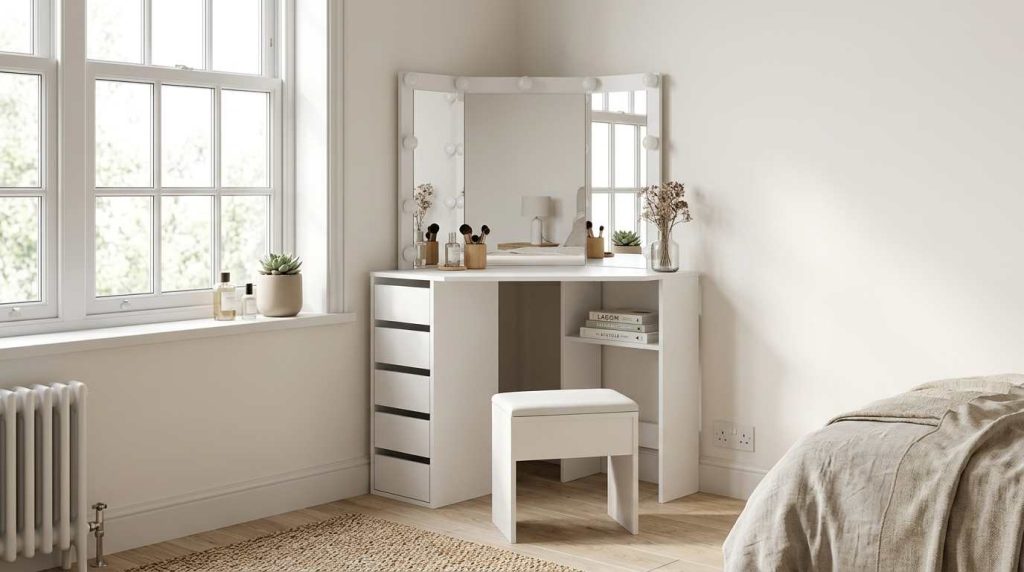
If your bedroom cannot take a standard rectangular table against a flat wall, you have more workable options than most buying guides suggest.
Corner units are the most effective single change for a tight room. They use a section of floor that almost nothing else in a bedroom occupies productively, which means you often gain more usable surface and drawer space than a straight table of the same overall footprint would offer. Our white corner dressing table with a five-drawer and shelf layout is built specifically around this problem, pairing a curved worktop with a three-way folding mirror so you are not sacrificing function for the sake of fitting the space.
Flip-up lid tables solve a different version of the same problem: not a lack of floor space, but a lack of visual space. In a small room, a permanently visible mirror can make the whole space feel smaller and busier. Closing the lid removes the mirror from view entirely and gives you back a flat, usable surface, which matters if the dressing table doubles as a spot for a lamp, books or a laptop outside of your getting-ready routine.
Sloped ceilings rule out tall mirrored units in the section of the room where the ceiling drops. Measure the height at the exact point the table will sit, not the highest point of the room, and check that measurement against the table’s total height including any raised mirror section before ordering.
Narrow alcoves either side of a chimney breast or wardrobe can sometimes fit a slim table better than open wall space can, since the alcove naturally limits how far the stool needs to be pulled out to clear the walkway.
Materials and Finishes
UK dressing tables are typically built from one of a small number of materials, and the material affects durability, weight and price more than most buyers expect.
MDF and painted particle board are the most common construction for the £50 to £150 bracket. High-density options, sometimes marked E1 grade, resist warping better than lower grades and take a smooth painted finish well. This is the practical choice for most bedrooms and the material behind most white and grey dressing tables on the market.
Pine and other solid woods appear more often in corner and traditional-style tables. They add genuine weight and a warmer visual tone, and they typically outlast painted MDF under daily wear, at a moderate price increase.
Faux marble and glass tops paired with steel frames sit at the design-led end of the market, prioritising a light visual footprint over storage capacity. These finishes mark more easily than painted wood, so a coaster or tray for products is worth using if you choose one.
On colour, white remains the most searched and most versatile choice in UK bedrooms, since it works across modern, traditional, Scandi and maximalist schemes without demanding a specific colour palette elsewhere in the room. Grey follows for a slightly more contemporary, less stark option. Black and gold-accented sets, such as our Hollywood-style white and gold set, suit a bolder, more glamorous bedroom scheme and photograph particularly well under bulb lighting.
The one rule that applies regardless of finish: match the dominant tone already in the room, not the tone in the product photo. A warm oak floor next to a cool grey table can look mismatched in person even when both individually look fine in isolation.
Height and Seated Comfort
Ergonomics gets skipped in most buying guides, but it is the difference between a table you use every day and one that quietly becomes a shelf for clutter within a month.
For most UK adults, a tabletop height of 74 to 79cm paired with a stool seat height of 44 to 50cm places your forearms at a comfortable working level while seated, with the mirror centre roughly at eye level. Below 72cm, you end up hunching forward over time, which matters if you spend ten or fifteen minutes at the table daily. Above 80cm, the mirror tends to sit uncomfortably high, forcing you to tilt your head back to see your full face.
Mirror height matters as much as table height. Hang or position the mirror so its centre sits at roughly your own seated eye level. For most people, that places the bottom edge of the mirror around 10 to 15cm above the table surface. If you are notably taller or shorter than average, check the specific mirror height in the product listing rather than assuming standard proportions will work, particularly for fixed mirrors that cannot be repositioned after assembly.
Table depth is the dimension most buyers overlook entirely. Anything under 40cm deep starts to feel cramped once you add a mirror base, a lamp and daily products, since items begin overhanging the front edge. 40cm is a reasonable practical minimum for arranging everyday essentials without constantly nudging things off the surface.
Lighting, Briefly
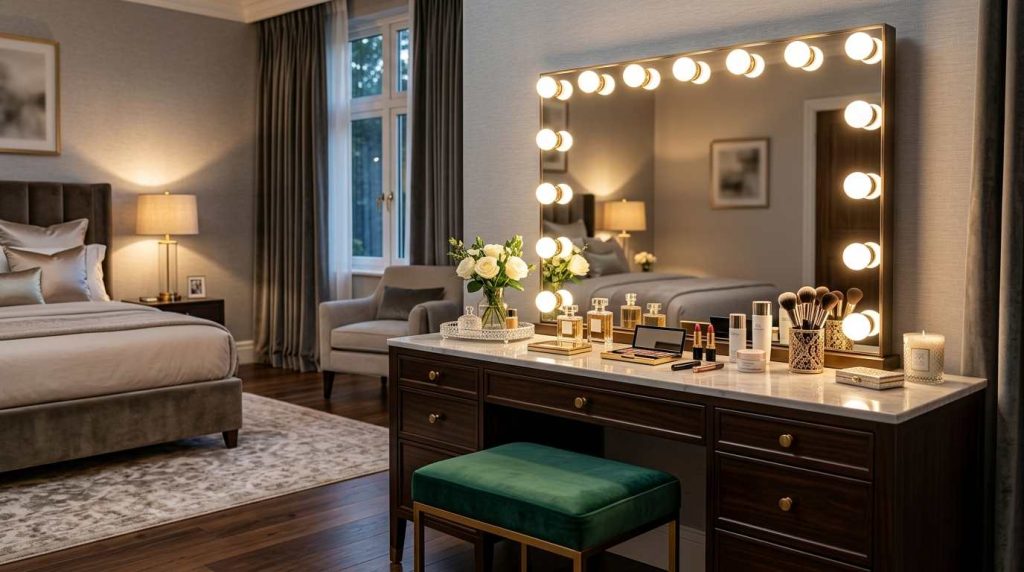
Lighting deserves more detail than a buying guide alone can cover well, so treat this as the essentials rather than the full picture.
The two formats you will see are LED strip or ring lighting with adjustable colour temperature, and Hollywood-style individual bulbs arranged around the mirror frame. LED formats tend to give even, diffused light and lower running costs. Bulb formats cast light from multiple individual points around the frame, which reduces the shadowing under the chin and around the eyes that a single overhead or side light source often creates, a genuine advantage if you apply makeup regularly rather than only occasionally.
Colour temperature control matters more than brightness alone. A mirror that only offers one fixed white tone will not adapt to a north-facing room in winter versus a south-facing room in summer, while a mirror with switchable cool, neutral and warm settings lets you match the light you will actually be under later, whether that is daylight, office lighting or evening lamplight.
Power source is the detail most buyers forget to check before ordering: confirm whether the mirror is mains-powered, requires batteries, or uses a USB connection, and check that a socket or the right cable length reaches your intended wall position before assembly day rather than after.
Safety: Anti-Tip and Stability
This section rarely appears in dressing table buying guides, and it should, particularly for households with children, pets, or simply a table that will see drawers opened and closed heavily every day.
Tall mirrored furniture, including dressing tables with an upright mirror section, carries a genuine tip risk if it is not secured, especially when a drawer is pulled fully open and used, deliberately or not, as a step or handhold. RoSPA, the Royal Society for the Prevention of Accidents, is direct about this: unsecured furniture, particularly tall or top-heavy pieces, should be anchored to the wall, since it can pull over more easily than its weight alone suggests.
Practical steps that take a few minutes at assembly:
- Use the anti-tip bracket or strap included with most flat-pack dressing tables, rather than treating it as optional.
- Fix the anchor point into a solid part of the wall, ideally a stud, rather than relying on a plasterboard fixing alone.
- Avoid loading the top of a mirror unit with additional weight, such as stacked boxes or a second mirror, beyond what the design intends.
- Check that any Hollywood bulb or LED wiring is routed away from where a chair or stool will be pulled in and out daily, to avoid repeated strain on the cable.
None of this should put you off buying a dressing table. It simply takes the same five minutes that most people already spend anchoring a chest of drawers or a wardrobe, and it is worth doing at the same time as assembly rather than as an afterthought later.
What to Expect at Each UK Price Point
UK dressing tables span a wide range, and price correlates fairly closely with a small number of concrete features rather than brand name alone.
| Price band | What you typically get |
| Under £80 | Basic MDF construction, single fixed or flip-up mirror, one to two drawers, no lighting, stool sometimes excluded |
| £80 to £150 | Better MDF or particle board, LED or bulb mirror lighting becomes common, matching stool usually included, two to four drawers |
| £150 to £300 | Solid wood elements, tri-fold or Hollywood mirrors, additional side cabinets or open shelving, more considered hardware and finishes |
| £300+ | Designer or bespoke pieces, premium materials such as marble or high-end veneer, often commissioned rather than off-the-shelf |
For most buyers, the £80 to £150 bracket delivers the best balance of genuine daily usability, mirror lighting, and included storage without paying a significant premium for materials or finishes that will not meaningfully change day-to-day use. Spending beyond that range makes more sense when a specific material, such as solid wood or marble, is a firm requirement rather than a nice-to-have.
Matching Style to Your Bedroom
Hollywood glamour leans on bulb-lit mirrors, gold or brass hardware, and a tufted or velvet stool. It suits bedrooms that already carry some richness in colour or texture elsewhere, rather than a minimalist scheme where the table would look out of place against everything around it.
Scandi and natural interiors pair better with pale or natural wood tones, simple flip-up or fixed mirrors, and minimal hardware detailing. Avoid heavily ornamented mirror frames here, since they tend to fight against the simplicity the rest of the scheme is built on.
Modern minimalist bedrooms suit round or oval freestanding mirrors, faux marble or glass tops, and slim metal frames over bulky drawer units. This is the pairing to choose if the goal is a light visual footprint rather than maximum storage.
Traditional and period-style rooms, particularly those with picture rails and original cornicing, generally suit a table with more visible wood grain and classic proportions over a starkly modern glass and steel combination, which can look at odds with the architecture around it.
Organising the Table Once It Arrives
A dressing table stays useful for years, or it becomes a cluttered surface within weeks, largely based on how it is set up in the first few days rather than the table itself. A few habits worth building in from day one:
- Assign every drawer a category before you fill it, rather than putting items away in whatever order you unpack them.
- Keep only genuinely daily items on the open surface. Everything else belongs in a drawer, even if that means a slightly emptier-looking tabletop than the product photo suggested.
- Use small dividers or trays inside deeper drawers, since a single open drawer without dividers tends to become a single junk drawer within a month regardless of how much space it offers.
- Wipe the mirror and surface weekly rather than only when visibly dirty, particularly with a bulb-lit mirror, since dust accumulates faster around warm bulbs than around an unlit frame.
Common Buying Mistakes to Avoid
- Measuring the table but not the stool clearance, leading to a stool that blocks a door or wardrobe when pulled out.
- Choosing a mirror style based on the photo rather than the room’s natural light, resulting in glare from a window the buyer did not account for.
- Assuming all sets include a stool, when several mirror styles, particularly round freestanding designs, do not.
- Ignoring drawer depth, ending up with a top drawer too shallow for anything beyond flat items.
- Skipping the anti-tip anchor at assembly, treating it as optional hardware rather than a genuine safety step.
- Buying on colour alone, without checking whether the tabletop height and mirror height actually suit the buyer’s own height and seated posture.
A Quick Decision Framework
If you are still deciding between two or three options, run through this order rather than starting with colour or style:
- Does it physically fit? Confirm table width plus roughly 90cm of stool clearance against your measured wall space.
- Does the mirror suit your light? North-facing or low-light rooms favour LED; well-lit rooms can use a fixed or flip-up mirror without lighting.
- Does it include the stool, and is the height right? If not, confirm you have a seat at the correct height before ordering.
- Is the storage realistic for what you already own? Count daily-use items first, then match drawer and shelf count to that number.
- Does the finish match your existing furniture, not just the product photo?
Any table that clears all five checks is very likely to still be in daily use a year from now, which is the real test a photo alone cannot answer.
Frequently Asked Questions
What is the standard height of a dressing table with mirror?
Most UK dressing tables sit at a tabletop height of 74 to 79cm, paired with a stool seat height of 44 to 50cm. This places the arms at a comfortable working level and the mirror roughly at seated eye level for most adults.
Do I need a wall socket near my dressing table for LED lighting?
Only if the mirror is mains-powered. Many LED and bulb mirrors run on battery packs or USB power banks, so check the specific product listing rather than assuming a nearby socket is required.
Can a dressing table with a mirror be used without drilling into the wall?
Yes, the vast majority of freestanding dressing tables, including flip-up and Hollywood styles, need no wall fixing to use day to day. The anti-tip strap included with most sets is a safety anchor, not a requirement for the table to stand or function.
Is a dressing table with mirror suitable for a child’s bedroom?
Standard adult dressing tables, typically 74 to 79cm tabletop height, are usually too tall for children under ten to use comfortably without a height-adjusted stool. Look for dedicated children’s vanity ranges sized specifically for younger users instead.
What is the difference between a dressing table and a vanity desk?
In UK retail, the terms are frequently used interchangeably, but a true dressing table is designed around the mirror and a seated getting-ready routine, while a vanity desk sometimes prioritises desk functionality with a mirror added as a secondary feature. If your main use is makeup, hair and jewellery rather than general desk work, look for products explicitly built around the mirror first.
How much floor space does a dressing table with a stool actually need?
As a working rule, allow the table’s width plus roughly 90cm of clear floor in front of it, which covers the stool and enough legroom to sit and stand comfortably without the stool blocking a door or wardrobe.
Should I choose drawers or open shelves for storage?
Drawers suit anyone who prefers an uncluttered surface and wants products out of sight. Open shelves suit a curated collection where visibility and quick access matter more than a tidy top. Most practical tables use a mix of both.
Is a corner dressing table a good option for a small bedroom?
Yes, corner units make use of floor space that most other bedroom furniture cannot occupy productively, often delivering more drawer and shelf space than a straight table of a similar overall footprint.
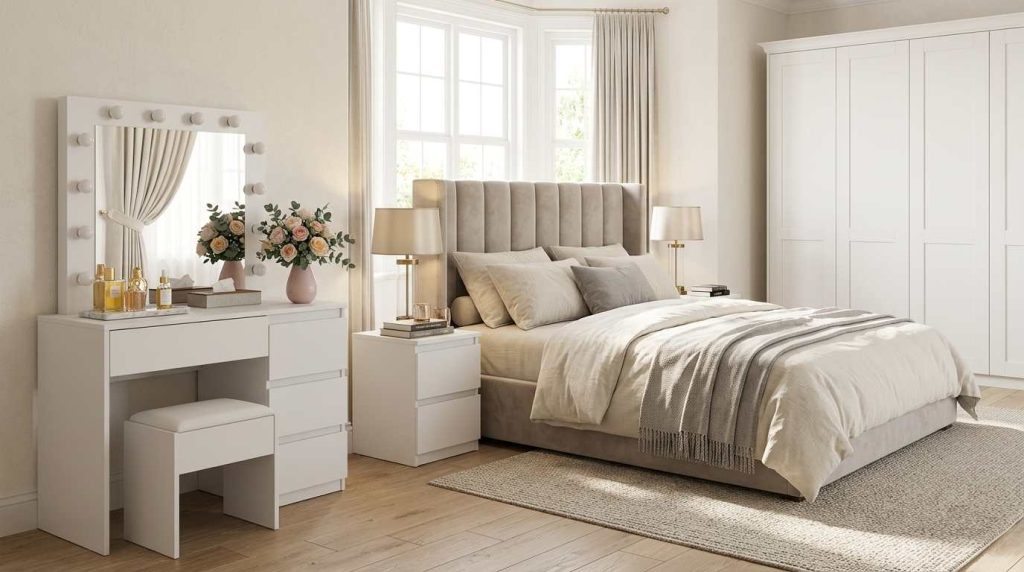
Top 5 Dressing Tables With Mirror at Kosy Koala
Based on everything covered above- floor space, mirror type, stool fit, storage and finish- these five pull from our own range to cover the situations most UK buyers are actually shopping for: an all-rounder, a small-bedroom fix, a full hair-and-makeup setup, a low-light fix, and a statement piece.
Hollywood Dressing Table With Mirror and Stool, Stone Grey
Best Overall Mirror type: Hollywood bulb-lit Drawers: 1 large, 3 small Dimensions: Table L94 x W42 x H140cm, stool L40 x W24 x H40cm Finish: Stone grey effect
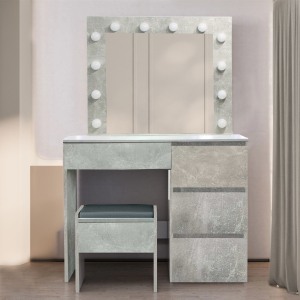
This is the set that answers most of the checklist in this guide at once: a Hollywood bulb mirror for even, shadow-free light, a genuinely useful drawer split for daily products versus overflow storage, and a matching stool built to the table’s own seated height rather than sourced separately. The stone grey finish sits comfortably in both contemporary and softer transitional bedrooms, which is why it is the set we point most buyers toward first.
Shop: Hollywood Dressing Table With Mirror and Stool, Stone Grey
Corner Dressing Table With Mirror, Drawers and Storage Shelf
Best for Small Bedrooms Mirror type: 3-way folding, LED, brightness adjustable Drawers: 5, plus storage shelf Dimensions: Table L114 x W61 x H140cm, stool L40 x W26 x H38cm Finish: Pine wood
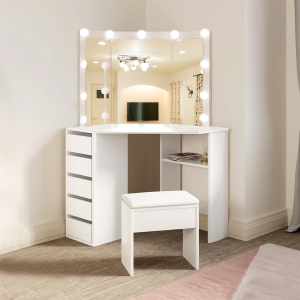
If your bedroom cannot fit a standard straight-wall table, this is the pick that makes the corner earn its keep. The 3-way folding mirror covers the side and back views a flat mirror cannot, the touch-adjustable LED brightness handles rooms with inconsistent natural light, and five drawers plus a shelf give you more realistic storage than most straight tables of a similar footprint manage. Solid pine construction also means it carries more weight and daily wear than painted MDF equivalents.
Shop: Corner Dressing Table With Mirror, Drawers and Storage Shelf
White Corner Dressing Table With 3 Mirrors and Stool
Best for Full Hair and Makeup Routines Mirror type: 3 angled mirrors (1 large centre, 2 side panels) Drawers: 5, plus 3 storage shelves Dimensions: Worktop W111 x D53cm, total height 141cm Finish: White, E1-grade particle board with solid wood legs
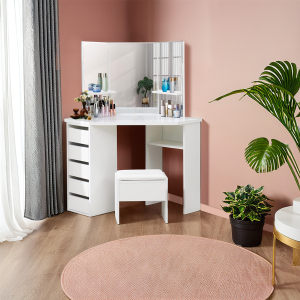
Built for anyone who styles hair as often as they do makeup, the three angled mirrors let you check every side of your head at once without moving the table or reaching for a hand mirror. The curved corner worktop and five drawers plus three shelves give this the highest total storage of the corner options in our range, while the white finish keeps a fairly large footprint from visually overwhelming the room.
Shop: White Corner Dressing Table With 3 Mirrors and Stool
White Dressing Table With LED Mirror, Drawers and Stool
Best for Low-Light Bedrooms Mirror type: LED, adjustable via touch button Drawers: 4 Dimensions: Table L94 x W42 x H140cm, stool L40 x W24 x H40cm Finish: White
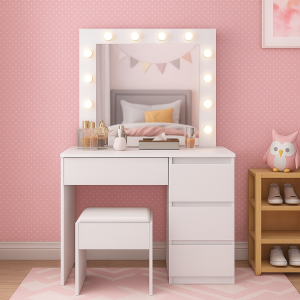
The pick to reach for if your bedroom faces north or simply does not get consistent daylight. The touch-button LED mirror switches tone without a separate dimmer, four drawers cover a fuller product collection than most entry-level tables, and the white finish keeps it flexible across most existing bedroom colour schemes rather than locking you into one look.
Shop: White Dressing Table With LED Mirror, Drawers and Stool
White and Gold Hollywood Dressing Table Set
Best Statement Piece Mirror type: Hollywood bulb-lit, 3 colour tones Drawers: 2, plus open cubbies and side cabinet Dimensions: Table W100 x D40 x H140cm, stool W40 x D26 x H45cm Finish: White with gold hardware and legs
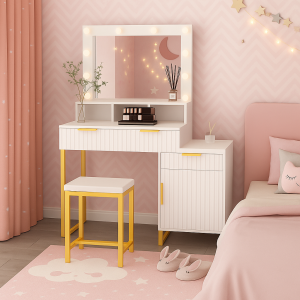
The set to choose when the dressing table is meant to be a visible feature of the room rather than a quiet corner piece. Gold legs and handles lift the whole design, the side cabinet gives you closed storage for hairdryers and larger tools that a shallow drawer cannot hold, and the three-tone bulb mirror covers daylight, general use and evening lighting from one switch. Best suited to bedrooms that already carry some richness in colour or texture elsewhere, rather than a strictly minimalist scheme.
Shop: White and Gold Hollywood Dressing Table Set
Browse our full Dressing Table Collection and filter by mirror type, drawer count and finish to find the perfect dressing table for your bedroom.
Recommended Supporting Articles
- Best Dressing Table for a Small Bedroom
- LED Mirror Dressing Tables Explained: Bulbs, Brightness & Power
- Dressing Table With Stool: What to Check Before You Buy
- Corner Dressing Tables: Ideas for Awkward Bedroom Spaces
- How to Organise a Dressing Table (Storage Tips That Work)
- Dressing Table vs Vanity Desk: Is There Really a Difference?
About the author
This article was written by the Kosy Koala team. We design and source bedroom furniture for UK homes, with a focus on practical details that actually matter once a piece is in your room. Have a question about any product on this page? Get in touch through our About Us page.


 Dining Tables
 Dining Chairs

 Bed Frames
 Mattresses
 Bunk Beds
 Sofa & Sofa Beds


