

Blog
Best Dressing Table for a Small Bedroom

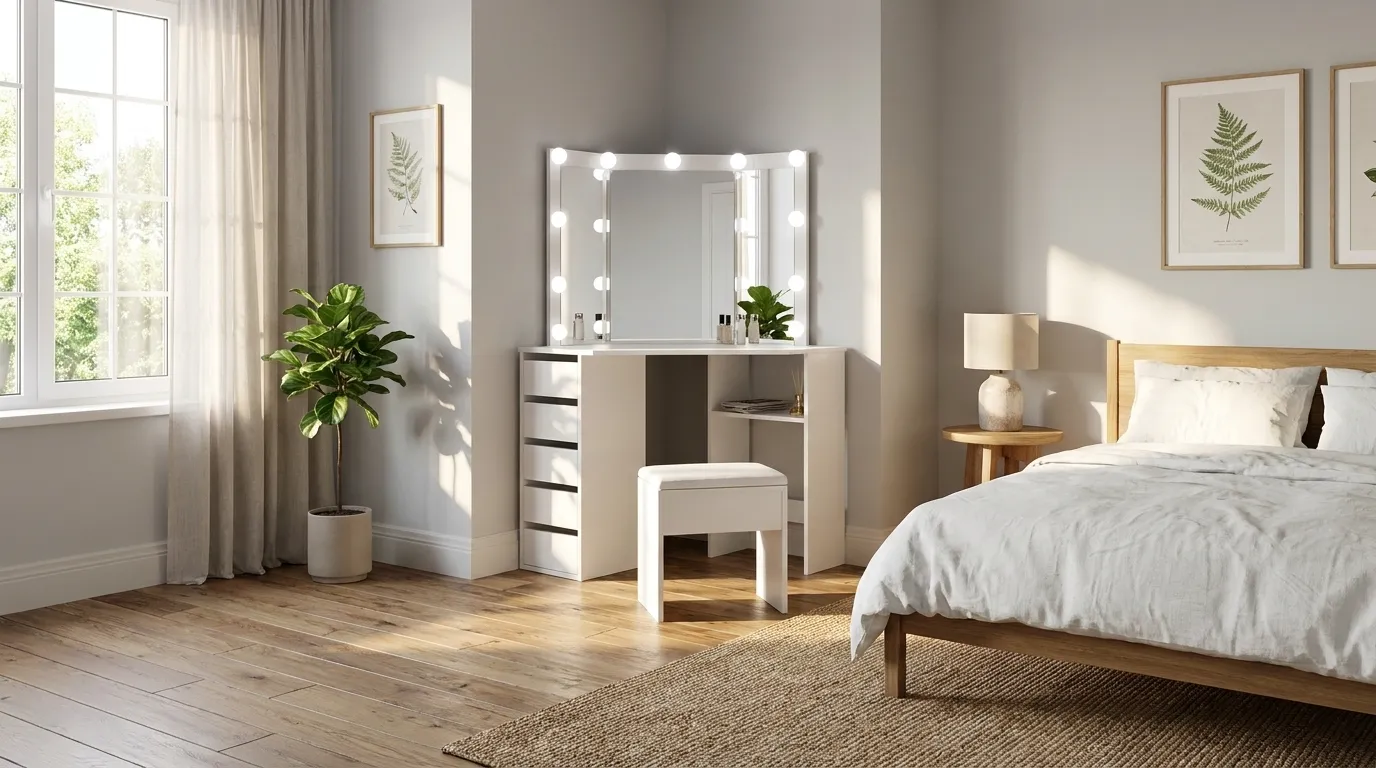
Most UK bedrooms are not the generous, magazine-shoot spaces that dressing table adverts photograph them in. If you’re looking for the best dressing table for a small bedroom, you’ll quickly discover that a standard-width table often will not fit the available space. A large share of British bedrooms, particularly second bedrooms, box rooms and flats, are small enough that every centimetre matters. That does not mean a dressing table is off the table. It means the shape, mirror type and floor footprint matter far more than they would in a spare room with wall space to burn.
This guide covers exactly which types of dressing table work in a genuinely small UK bedroom, how to measure before you buy rather than after, and which specific designs solve which version of the small-room problem. If you want the fuller picture on mirror types, height, lighting and safety, our complete dressing table with mirror buying guide covers that in more depth. This article focuses specifically on what changes when the room itself is the limiting factor.
Quick answer:
For most small UK bedrooms, a corner dressing table or a flip-up lid table will fit spaces a standard straight-wall table cannot. Corner units use a section of floor that is otherwise wasted, while flip-up lids let the table close flat when not in use so the mirror does not visually shrink the room. Slimline tables under 45cm deep are the third option, useful where even a corner is not available. Whichever shape you choose, the floor space rule matters more than the table’s width alone: allow the table’s footprint plus enough clearance for the stool to be pulled out and used without hitting a bed, door or wardrobe.
What Actually Counts as a Small Bedroom in the UK
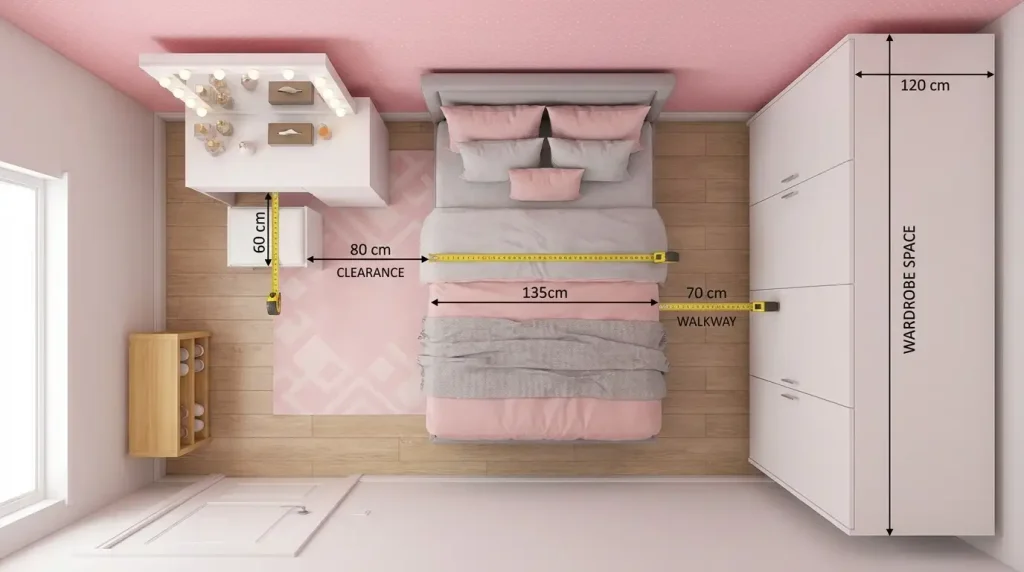
“Small bedroom” gets used loosely, so it helps to have real numbers before deciding what your room can realistically take.
Under the government’s own Nationally Described Space Standard, a single bedroom only needs to measure 7.5 square metres to meet the minimum, and a double bedroom 11.5 square metres. Plenty of existing UK housing, particularly Victorian terraces, ex-council flats and older conversions, was built before that standard existed at all, and many second bedrooms and box rooms in city flats sit at or below that minimum today. New-build bedrooms have also been shrinking over time rather than growing. According to Statista’s data on British new-build bedroom sizes, even master bedrooms in new UK houses have fallen from around 15.3 square metres in the 1930s to roughly 13.4 square metres in the 2010s, and second bedrooms in the same properties are typically smaller again.
In practical terms, if your bedroom is a single room under around 9 square metres, or a double room with a large bed, wardrobe and chest of drawers already taking up most of the floor, you are working with a genuinely small space, and the standard advice written for an average-sized spare room will not apply cleanly to your layout.
The Real Space Rule Before You Buy Anything
The single most common mistake in a small bedroom is measuring the table but not the stool. A table that fits neatly against the wall on paper can still be unusable if the stool cannot be pulled out without hitting the bed frame or blocking a wardrobe door.
The rule that avoids this: table width, plus enough floor space in front of it for the stool to be pulled out and used comfortably. In a genuinely tight room, that clearance can be trimmed to around 65 to 70cm as a working minimum. Where you have a little more room to spare, 90cm gives a noticeably more comfortable sit-down-and-stand-up motion, which our full buying guide covers in more detail if you want the complete measuring walkthrough.
Before shopping, take five minutes to do the following:
- Measure the exact wall space available, side to side, including any skirting board or radiator that eats into it.
- Measure out from that wall to the nearest obstruction, bed, door swing, or wardrobe, at floor level.
- Check the ceiling height at that specific spot if the wall slopes, since taller mirror sections need more headroom than a flat wall gives them.
- Confirm the table and any corner unit will actually travel through your doorway and up the stairs on delivery day, since corner pieces in particular can be wider assembled than they first appear in a photo.
- Note where the nearest socket is if you want an LED or bulb-lit mirror, since retrofitting one afterwards is far more disruptive than checking before you order.
Which Small-Space Dressing Table Type Actually Suits You
There is no single best format for every small bedroom. The right shape depends on which constraint you are actually working around: floor space, visual space, or simply having no free wall left at all.
| Type | Best for | Typical footprint | Storage | Renter friendly |
| Corner unit | Rooms with an unused corner and no free straight wall | Uses a dead corner other furniture cannot | Often the most drawers of any small-space format | Yes, freestanding |
| Flip-up lid table | Rooms that need the surface to double as something else | Compact, closes flat | Moderate, usually a mirror well plus one or two drawers | Yes, freestanding |
| Slimline console (under 45cm deep) | Narrow walls where any depth beyond arm’s reach is wasted | Very shallow, minimal intrusion into the room | Limited, often one or two drawers | Yes, freestanding |
| Wall-mounted floating table | Rooms with genuinely no floor space to spare | No floor footprint at all | Usually one small drawer or shelf | No, requires wall fixing |
Corner Dressing Tables: The Best All-Round Fix
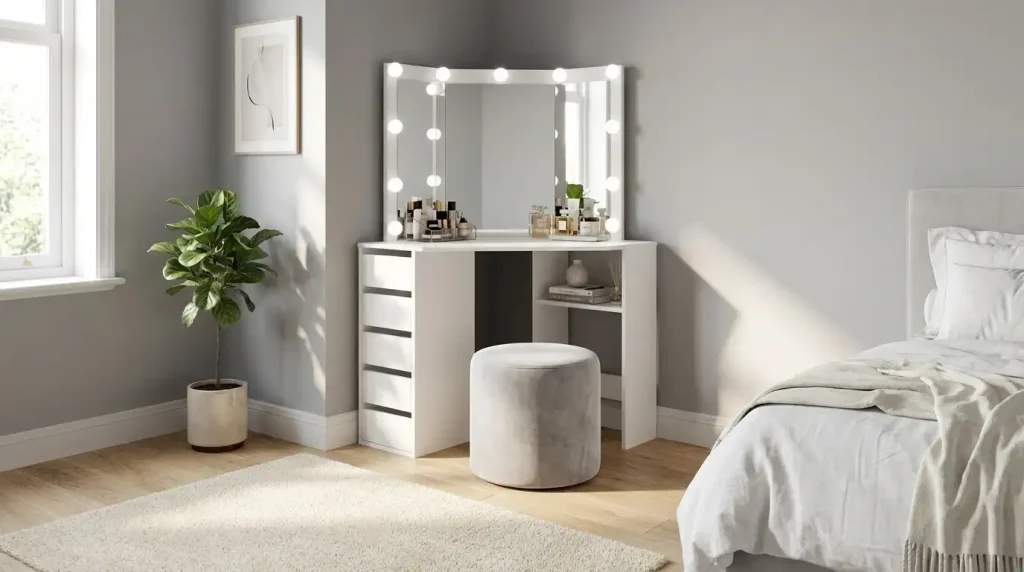
For most small UK bedrooms, a corner dressing table solves the problem more completely than any other format, because it uses floor space that almost nothing else in the room can occupy productively. A corner sitting empty behind a door or beside a wardrobe is dead space in every other layout. Turned into a dressing table, that same corner often delivers more usable surface and more drawers than a straight table pushed against an open wall would, simply because the shape follows the room rather than fighting it.
Our corner dressing table with drawers, storage shelf and adjustable LED lights is built specifically around this problem, pairing a curved worktop with a three-way folding mirror so a tight corner still gives you a full hair and makeup setup rather than a compromise. If storage matters more to you than mirror style, our white corner dressing table with three mirrors, five drawers and three shelves pushes storage capacity further still, which is worth considering if the dressing table also needs to absorb some general bedroom storage rather than just cosmetics.
One detail worth checking before buying any corner unit: measure both walls forming the corner, not just one, since an asymmetric corner unit needs a minimum length on each side to sit flush.
Flip-Up and Fold-Flat Tables for Multi-Use Rooms
A flip-up lid table solves a different version of the small-room problem: not a shortage of floor space, but a shortage of visual space. In a small bedroom, a mirror that is permanently visible can make the whole room feel busier and smaller than it actually is, especially opposite a bed or a doorway. Closing the lid removes the mirror from view entirely, leaving a flat surface that can double as a spot for a lamp, a laptop or a stack of books outside of your getting-ready routine.
This format also suits box rooms doing double duty as a guest room, home office corner or nursery, where a permanently visible mirror and stool would clash with the room’s other function. Because these tables are freestanding, they suit renters just as well as homeowners, with no wall fixing needed beyond the anti-tip strap most flat-pack furniture ships with as standard.
Slimline and Narrow Console Tables
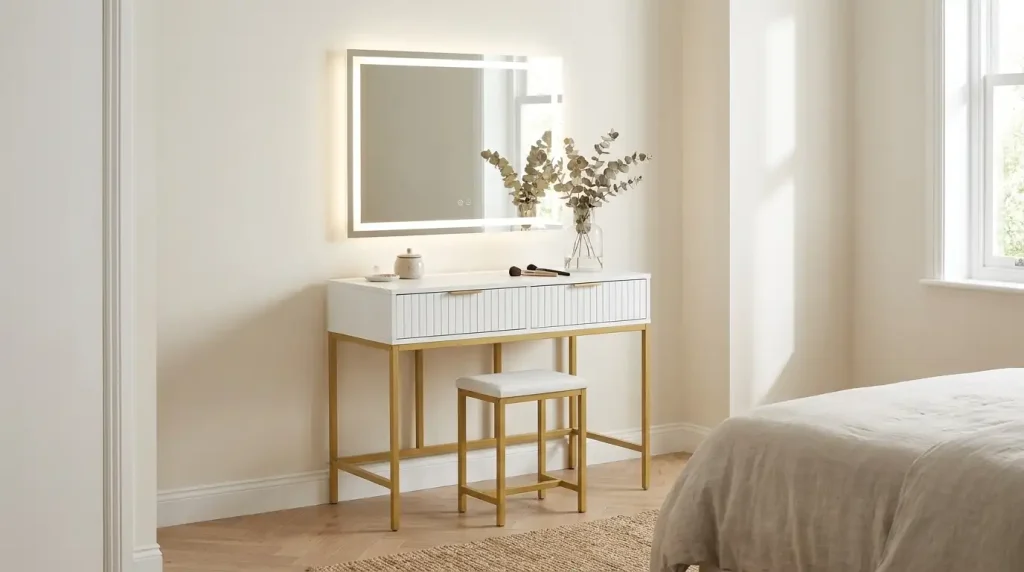
Where even a corner is not available, a slimline table under 45cm deep is the next practical option. Depth is the dimension that eats into a small room fastest, since a table that is 60cm deep pushes the stool almost a metre from the wall once you account for legroom, while a 40 to 42cm deep table keeps the same footprint noticeably tighter to the wall.
Our Hollywood dressing table with mirror and stool in stone grey and its white LED equivalent both sit at 42cm deep, which keeps them shallow enough for a narrow bedroom wall while still fitting a genuine Hollywood bulb mirror and a proper drawer split rather than a token single drawer.
This is the format worth checking first if your available wall is narrow rather than your room being small overall, since a slim table against a full-length wall often fits where a corner unit physically cannot.
Wall-Mounted Floating Tables: What to Know Before Choosing One
Wall-mounted or floating dressing tables fit directly to the wall with no legs reaching the floor, which genuinely maximises clear floor space in a room where every centimetre counts. They suit box rooms and studio layouts where even a slimline freestanding table’s footprint is more than the room can spare.
The trade-off is real, though, and worth knowing before you commit to this format specifically. A floating table needs a solid wall fixing, ideally into a stud or masonry rather than plasterboard alone, since the table and anything placed on it hangs entirely on that fixing.
This makes the format less suited to rented properties where drilling into walls is restricted, and it generally offers less drawer storage than a freestanding corner or console table of a similar width, since the wall fixing limits how much weight and depth the design can safely support. If you rent, move frequently, or simply prefer not to drill into a wall, a freestanding corner or slimline table will usually serve you better for very similar space savings.
Making a Small Room Feel Bigger With Mirror Placement
Beyond fitting the table into the room, where the mirror sits and faces has a real effect on how large the room feels day to day, which is worth getting right given how much this costs to change once furniture is already assembled.
Position the table on a wall at right angles to the window rather than directly opposite it. A mirror facing a window head-on catches direct glare that makes it genuinely difficult to use during the day, while a mirror positioned perpendicular to the window catches soft, indirect natural light without the glare, and reflects that light further into the room rather than bouncing it straight back out through the glass.
A mirror that is proportionate to the table, rather than oversized for the sake of visual drama, also tends to suit a small room better. An oversized mirror on a compact table can visually dominate a room that already has limited wall space, while a well-proportioned mirror integrated into the table design, such as the tri-fold and Hollywood styles covered in our mirror types breakdown, reflects useful light back into the room without becoming the single dominant feature of the wall it sits against.
Storage That Actually Works in a Compact Table
Small-space tables inevitably offer less storage than a full-width dressing table, so it pays to be realistic about what you actually need before choosing based on drawer count alone.
- Count your daily-use items first. If you use fewer than ten products each morning, a two-drawer slimline table is genuinely enough. Buying more storage than you need in a small room simply eats floor space you could have kept clear.
- Prioritise depth over drawer count where the choice is between many shallow drawers and fewer deeper ones, since a shallow top drawer struggles with anything taller than lipsticks and small brushes.
- Use dividers inside whatever drawers you do have, since a single undivided drawer in a compact table filled with loose items is far faster than the same drawer in a larger table with other storage to spread the load.
- Keep the tabletop itself nearly empty. In a small room, an open surface reads as significantly more spacious than the same surface covered in bottles and jars, even if the total floor footprint is identical.
Colour and Finish Choices for Small Rooms
Colour has a genuine, measurable effect on how large a small bedroom feels, separate from the table’s actual dimensions.
White and other pale finishes reflect available light rather than absorbing it, which keeps a compact table from visually anchoring the room the way a dark, heavy finish can. This is part of why white remains the most popular finish across UK dressing tables generally, and it matters more, not less, in a small room where every surface contributes to how enclosed the space feels.
Darker finishes are not automatically wrong for a small room, but they work best paired with a lighter wall colour behind the table, so the furniture reads as a defined piece rather than blending into a dark corner and making the whole wall feel heavier. If in doubt in a genuinely tight room, choose the lighter option between two otherwise similar tables.
Doubling as a Desk or Multi-Use Surface
In a small bedroom, furniture that only does one job is a harder sell than furniture that earns its floor space twice over. A flip-up lid table is the clearest example: closed, it is a flat desk surface suitable for a laptop or an evening spent reading, and opened, it becomes a full dressing table with a mirror.
Even a fixed-mirror table can serve a second purpose if the drawers are used for general bedroom storage, such as chargers, notebooks or spare bedding items, rather than cosmetics alone, particularly in a room that does not have a separate desk or a full chest of drawers.
Common Mistakes to Avoid in a Small Bedroom
- Measuring the table but not the stool clearance, ending up with a stool that cannot be pulled fully out without hitting the bed.
- Choosing a corner unit without measuring both walls of the corner, resulting in a unit that does not sit flush against one side.
- Assuming a wall-mounted table will suit a rented property, when most floating designs need a solid wall fixing that a tenancy agreement may not allow.
- Buying the deepest table that visually fits, rather than checking the actual depth measurement against the wall, since even a few centimetres of extra depth changes how far the stool needs to sit out.
- Positioning the mirror directly opposite a window, creating daytime glare that makes the mirror harder to use rather than better lit.
- Overbuying storage, choosing a table with far more drawers than daily items actually require, at the cost of floor space that could have stayed clear.
Quick Checklist Before You Buy
- Measure your wall space and the clear floor needed for the stool, not just the table width.
- Decide whether your constraint is floor space, wall space, or visual space, since each points to a different table type.
- Check whether a corner in the room is currently unused and could take a corner unit instead of a straight table.
- Confirm the finish is light enough to suit the room if the room is already dark or north-facing.
- Check the mirror position relative to your window before committing to final placement.
Frequently Asked Questions
What is the best type of dressing table for a very small bedroom?
A corner dressing table is generally the strongest option, since it uses floor space that most other furniture cannot occupy productively. A flip-up lid table is the next best option where visual space, rather than floor space, is the main constraint.
How much floor space does a dressing table need in a small bedroom? As a working minimum, allow the table’s width plus around 65 to 70cm of clear floor in front of it for the stool. Where possible, 90cm gives a more comfortable sit-down motion.
Can I fit a dressing table in a bedroom under 8 square metres?
Yes, in most cases. A slimline table under 45cm deep or a corner unit will usually fit a single bedroom in this size range, provided the bed and any wardrobe are positioned to leave one clear wall section or corner.
Do wall-mounted dressing tables need drilling into the wall?
Yes, floating designs need a solid fixing into a stud or masonry to support the table safely, which makes them less suitable for rented properties with drilling restrictions. Freestanding corner, slimline and flip-up tables need no wall fixing to function.
Is a smaller dressing table less durable than a full-size one?
Not inherently. Durability comes down to material and construction quality rather than size. A well-built slimline or corner table in solid wood or high-grade MDF will outlast a larger table made from lower-grade materials.
Should I choose a table with a stool included for a small bedroom?
Generally yes, since a stool sold as part of a set is designed to the correct seated height for that specific table, removing the guesswork of separately matching a chair’s height and proportions to a compact table.
Making the Small Room Work for You
A small bedroom rules out a handful of dressing table styles, but it does not rule out the category itself. Corner units, flip-up lids and slimline consoles between them cover the great majority of small UK bedrooms, and choosing between them comes down to which specific constraint your room presents: a dead corner to use, a lack of visual space, or simply a narrow wall. Measure first, choose the shape that matches your actual constraint, and the table will earn its place in the room rather than becoming another piece of furniture squeezed in and rarely used.
For the fuller picture on mirror types, lighting, height and safety once you have settled on a shape, our complete dressing table with mirror buying guide covers each of those in depth. To compare options directly, browse the full dressing table range at Kosy Koala.
Top 5 Dressing Tables for Small Bedrooms at Kosy Koala
Based on the space rules covered above, these five are the picks worth shortlisting first if your bedroom is genuinely tight on space, covering corner layouts, narrow walls, and full hair-and-makeup setups without needing extra floor room.
Corner Dressing Table With Mirror, Drawers and Storage Shelf
Best Overall for Small Bedrooms Mirror type: 3-way folding, LED, brightness adjustable Drawers: 5, plus storage shelf Dimensions: Table L114 x W61 x H140cm, stool L40 x W26 x H38cm Finish: Pine wood
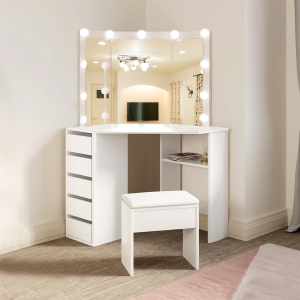
This is the pick that solves the most common version of the small-room problem at once: an unused corner turned into genuine storage and a full hair and makeup mirror, without needing a straight wall the room does not have. The touch-adjustable LED brightness also covers rooms with inconsistent natural light, which is common in box rooms with a single small window.
Shop: Corner Dressing Table With Mirror, Drawers and Storage Shelf
White Corner Dressing Table With 3 Mirrors and Stool
Best for Maximum Storage in a Corner Mirror type: 3 angled mirrors (1 large centre, 2 side panels) Drawers: 5, plus 3 storage shelves Dimensions: Worktop W111 x D53cm, total height 141cm Finish: White, E1-grade particle board with solid wood legs
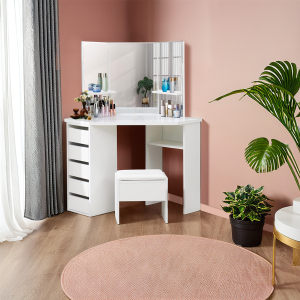
If the room needs to absorb general storage as well as cosmetics, this is the strongest option in the corner category, with five drawers and three additional shelves. The white finish also helps a fairly generous corner footprint stay visually light rather than heavy in a small room.
Shop: White Corner Dressing Table With 3 Mirrors and Stool
Hollywood Dressing Table With Mirror and Stool, Stone Grey
Best Slimline Option Mirror type: Hollywood bulb-lit Drawers: 1 large, 3 small Dimensions: Table L94 x W42 x H140cm, stool L40 x W24 x H40cm Finish: Stone grey effect
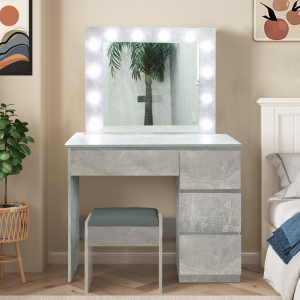
At 42cm deep, this is the table to choose when the room’s constraint is a narrow wall rather than a lack of floor area overall. The Hollywood bulb mirror still delivers even, shadow-free light despite the compact footprint, and the drawer split keeps daily items separate from overflow without needing extra width.
Shop: Hollywood Dressing Table With Mirror and Stool, Stone Grey
White Dressing Table With LED Mirror, Drawers and Stool
Best for North-Facing Small Rooms Mirror type: LED, adjustable via touch button Drawers: 4 Dimensions: Table L94 x W42 x H140cm, stool L40 x W24 x H40cm Finish: White
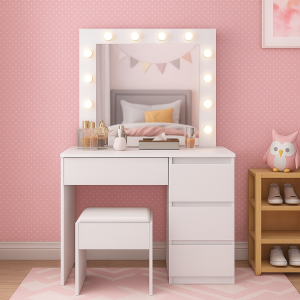
The white finish and touch-adjustable LED mirror make this the pick for a small room that also lacks consistent natural light, a common combination in box rooms with a single north-facing window. The same 42cm depth as the grey version keeps it suited to narrow walls.
Shop: White Dressing Table With LED Mirror, Drawers and Stool
White and Gold Hollywood Dressing Table Set
Best Statement Piece for a Small Room That Still Wants Presence Mirror type: Hollywood bulb-lit, 3 colour tones Drawers: 2, plus open cubbies and side cabinet Dimensions: Table W100 x D40 x H140cm, stool W40 x D26 x H45cm Finish: White with gold hardware and legs
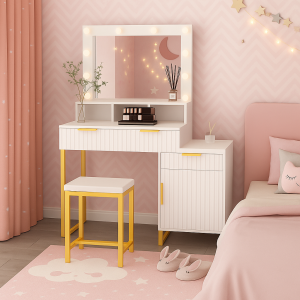
At 40cm deep, this set proves a small room does not have to mean a plain one. The gold detailing gives the table visual presence without adding to its floor footprint, and the side cabinet offers a place for larger tools that a slimline table’s drawers alone could not hold.
Shop: White and Gold Hollywood Dressing Table Set
Browse the full range, filterable by footprint and finish, at Koskyoala dressing tables.
Recommended Supporting Articles
- Dressing Tables With Mirror: The Complete UK Buying Guide
- LED Mirror Dressing Tables Explained: Bulbs, Brightness & Power
- Dressing Table With Stool: What to Check Before You Buy
- Corner Dressing Tables: Ideas for Awkward Bedroom Spaces
- How to Organise a Dressing Table (Storage Tips That Work)
- Dressing Table vs Vanity Desk: Is There Really a Difference?
About the author
This article was written by the Kosy Koala team. We design and source bedroom furniture for UK homes, with a focus on practical details that actually matter once a piece is in your room. Have a question about any product on this page? Get in touch through our About Us page.


 Dining Tables
 Dining Chairs

 Bed Frames
 Mattresses
 Bunk Beds
 Sofa & Sofa Beds


