

Blog
Corner Dressing Tables: Ideas for Awkward Bedroom Spaces

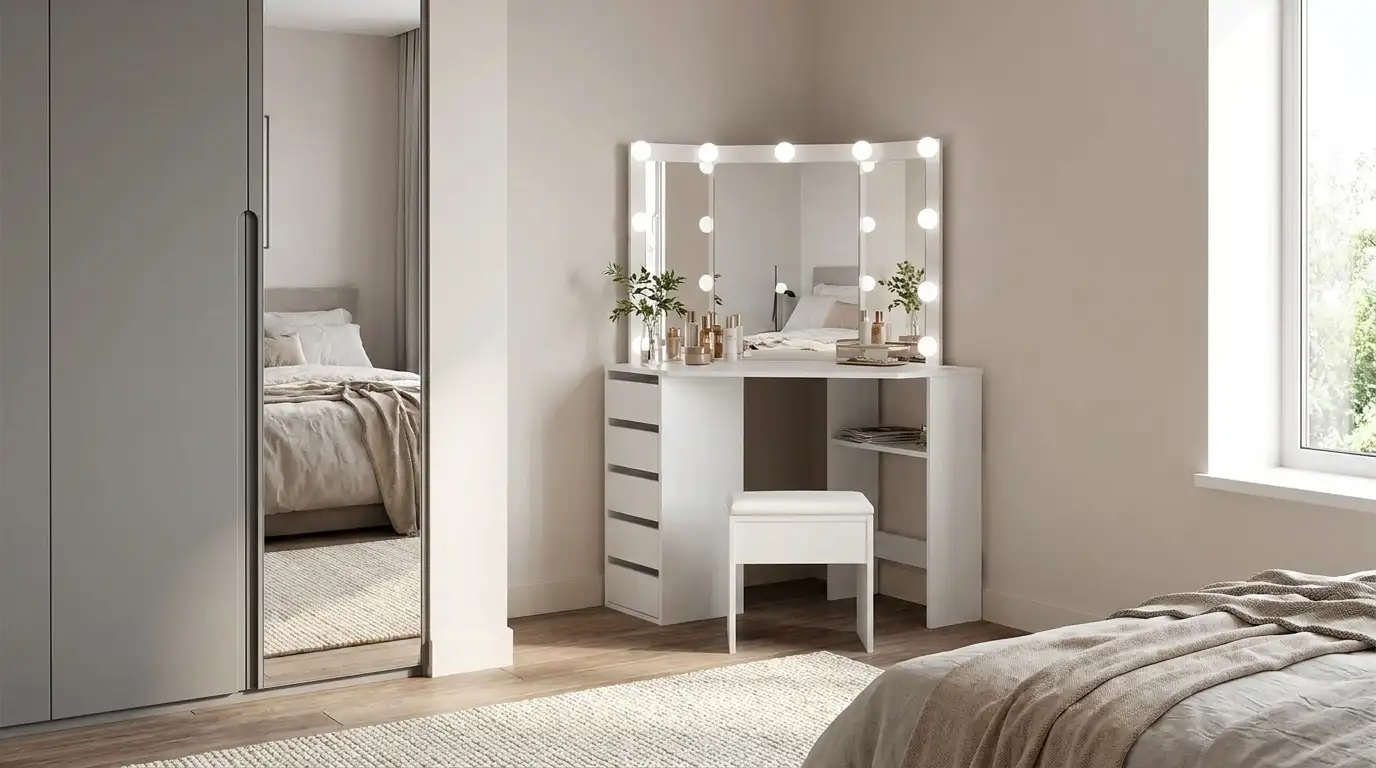
Every bedroom has one. A corner that does nothing. It sits empty behind a door, beside a wardrobe, or under a sloped ceiling. Nothing else in the room fits there properly. It becomes dead space by default, not by design.
A corner dressing table turns that space into something useful. It gives you a mirror, storage, and somewhere to sit, without touching any of the floor space your bed or wardrobe already needs. This guide covers how to measure a corner properly, which type of corner unit suits which layout, and how to handle the trickier spaces most guides skip entirely: sloped ceilings, alcoves, shared rooms, and the awkward gap behind a door.
If you have not yet decided on the wider table style, our complete dressing table with mirror buying guide covers mirror type, height and storage in full. This guide focuses specifically on corners and the awkward spaces they usually come with.
Quick answer:
For most UK bedrooms, a true corner unit, built with an angled or curved front designed to sit flush against two walls, makes better use of the space than a rectangular table placed diagonally across a corner. Measure both walls forming the corner before you buy, not just one. Check for sockets, radiators and skirting boards that might sit in the way. A three-way folding mirror suits a corner setup particularly well, since it gives you a full view without needing extra wall space either side.
Why Corners Are the Most Wasted Space in a Bedroom
Think about the corners in your own bedroom. One probably has nothing in it at all. Another might have a small pile of things that never found a proper home.
This happens because most furniture is built in straight lines. Beds, wardrobes and chests of drawers all expect a flat wall. A corner does not offer one. So it gets left empty, or filled with whatever does not fit anywhere else.
A corner dressing table flips this. Instead of fighting the shape of the room, it works with it. The angled or curved front follows the corner exactly, which means the space is used properly for the first time, rather than avoided.
This matters most in smaller UK bedrooms, where every wall is already claimed by something else. Our guide to the best dressing table for a small bedroom covers this in more depth, but corners specifically deserve a closer look, since they solve a different problem to a simple width issue.
It is also worth saying plainly that not every corner needs a bespoke solution. Most standard right-angle corners in UK bedrooms are well served by an off-the-shelf corner unit. The awkward cases covered later in this guide, sloped ceilings, alcoves, and space behind a door, are the exceptions worth planning around carefully, not the rule.
How to Measure a Corner Properly Before You Buy
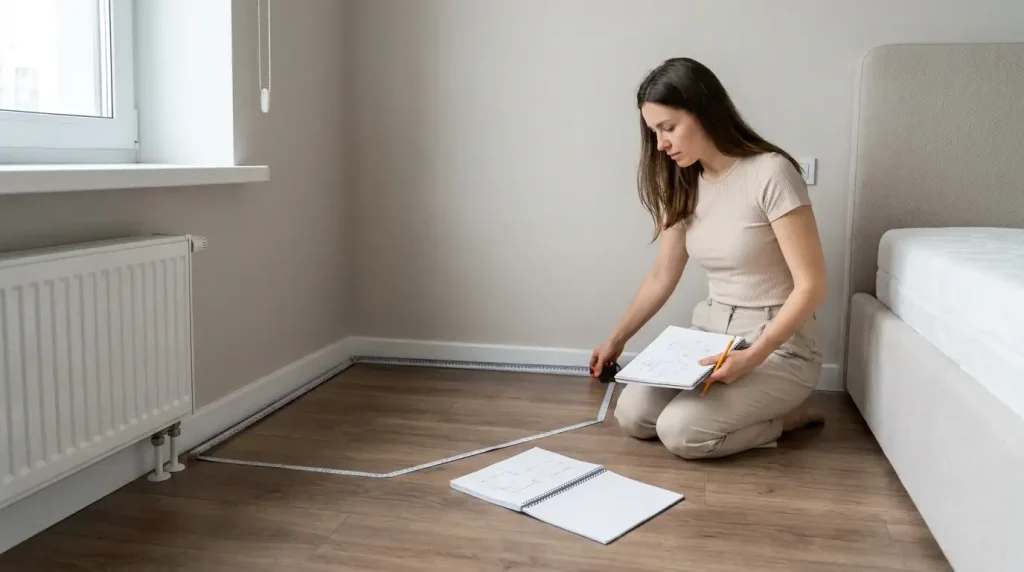
This is the step most buyers rush, and it causes more return requests than any other mistake in this category.
A corner is not one measurement. It is two, plus the depth the unit will project into the room. Here is the full process:
- Measure the first wall, from the corner point outward, to the nearest obstruction such as a door frame, radiator or skirting board edge.
- Measure the second wall, from the same corner point, in the same way.
- Check the shorter of the two measurements against the unit’s stated leg lengths. A corner unit is usually built with two different leg lengths, one for each wall, and needs both to fit.
- Measure how far the unit projects into the room, from the corner point diagonally outward, and check this against your floor plan to confirm the stool will still have room to be pulled out.
- Check the ceiling height directly above the corner, particularly if the wall slopes, since a tall mirror section needs more headroom than a flat wall gives it.
Key note: always measure both walls, not just one. A corner that looks symmetrical from a distance is often slightly different in length on each side, particularly in older UK homes where walls were rarely built perfectly square.
True Corner Units vs Diagonal Placement
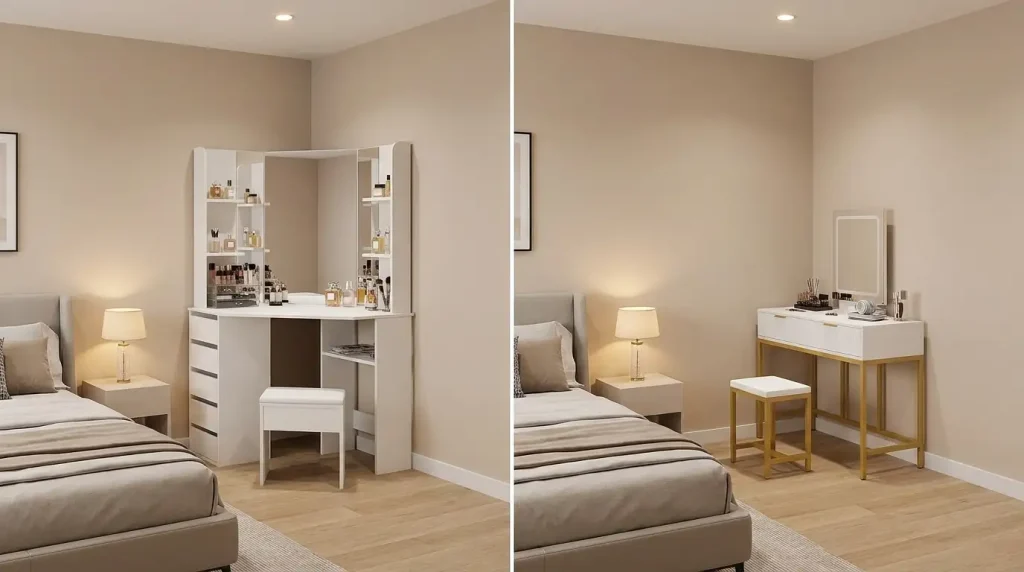
There are two different ways to put a dressing table into a corner, and they are not the same thing.
True corner units are built with an angled or curved front specifically designed to sit flush against both walls. The legs are usually different lengths on each side, following the exact shape of the corner. This gives you the most usable surface area for the amount of floor space taken up, since nothing is wasted on an awkward gap behind the unit.
Diagonal placement means taking a standard rectangular table and turning it at an angle across the corner instead. This works in a pinch, but it leaves a triangular gap behind the table that is usually too small to use for anything else, wasting the space it was meant to save.
For most UK bedrooms, a true corner unit makes better use of the available space. Our corner dressing table with drawers, storage shelf and adjustable LED lights is built this way, with a curved worktop that follows the corner directly rather than leaving dead space behind it.
Symmetric vs Asymmetric Corners
Not every corner is a perfect right angle with two equal walls. Knowing which type you have changes what will actually fit.
Symmetric corners, where both walls offer roughly the same length, suit most off-the-shelf corner units well, since these are generally designed around an even split.
Asymmetric corners, where one wall is noticeably longer than the other, are more common than most buyers expect, particularly in older properties or rooms with a chimney breast nearby. In this case, check the unit’s individual leg lengths against your shorter wall specifically, since this is the measurement that determines whether the piece will actually sit flush.
If your corner is significantly asymmetric, and no off-the-shelf unit quite fits, a slimline table placed against the longer wall, positioned as close to the corner as possible, is often a more practical solution than forcing a symmetric corner unit into a space it was not designed for.
Corner Dressing Tables for a Box Room
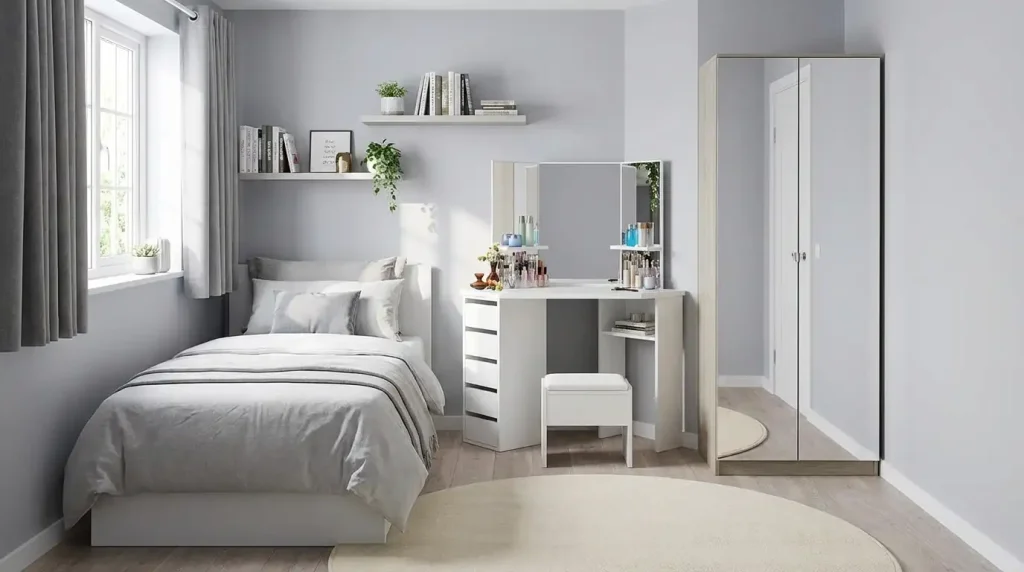
A box room is the most common awkward bedroom in UK housing, often under 7.5 square metres, with barely enough space for a single bed and a narrow gap either side. A corner unit is frequently the only dressing table format that will fit at all.
In a box room, prioritise a unit with a smaller overall footprint, and check the projection measurement carefully against your remaining floor space once the bed is in place. A flip-up lid option is worth considering too, if even a corner unit’s permanent footprint feels like too much for the room, since it lets the table close flat when not in use.
Corner Dressing Tables Under a Sloped Ceiling
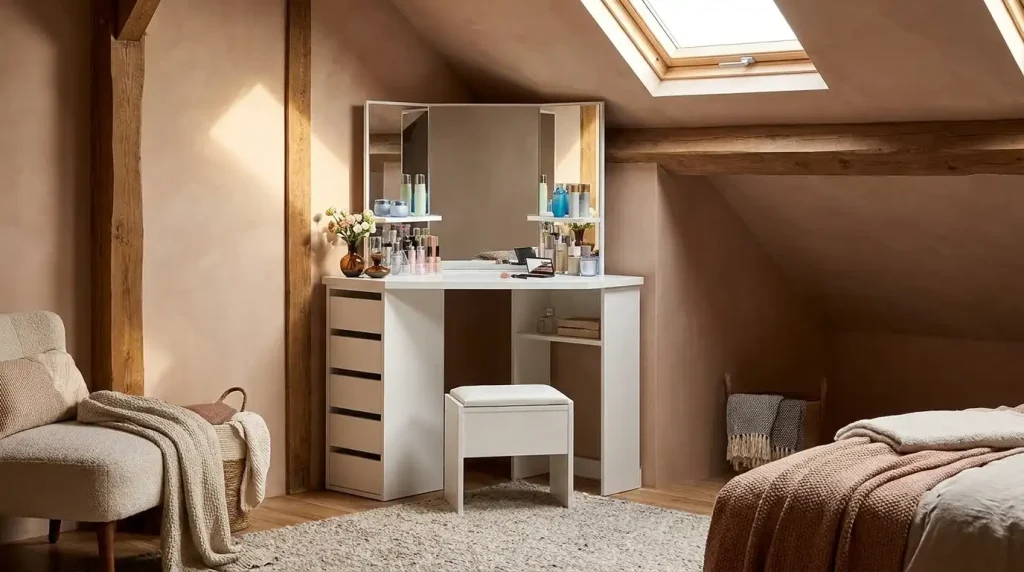
Loft conversions and attic bedrooms often have a sloped ceiling exactly where the useful corner space sits. This rules out very tall mirrored units in that specific spot, but it does not rule out a corner dressing table altogether.
Measure the ceiling height at the exact point the table will sit, not the room’s highest point. Compare that measurement against the unit’s total height, including any raised mirror section, before ordering. Because you will be seated most of the time you use the table, a lower ceiling here is far less restrictive than it would be for standing storage such as a wardrobe. As long as there is enough headroom for a seated user and the mirror sits at a comfortable height, a sloped ceiling corner can work well.
Corner Dressing Tables Beside a Chimney Breast or Alcove
Many UK homes, particularly Victorian and Edwardian properties, have a chimney breast with an alcove on either side. These alcoves are often narrower and deeper than a standard open corner, which changes what will actually fit.
Measure the alcove’s width at its narrowest point, not its opening, since older chimney breasts are not always perfectly straight. A corner unit designed for an open right-angle corner may not sit correctly in a recessed alcove. In this situation, a slimline console table pushed to the back of the alcove often works better than a true corner unit, since it does not rely on two open walls meeting at a clean angle.
Corner Dressing Tables in a Shared Bedroom
Shared bedrooms, whether between siblings, children, or adults sharing a small space, often divide the room into two halves, leaving each person with limited wall space of their own. A corner in each half of the room can give each person a dedicated space without encroaching on the other’s side.
In this setup, matching finishes across both corners, even if the specific unit differs slightly, helps the room feel considered rather than split into two mismatched halves. Our white corner dressing table with three mirrors, five drawers and three storage shelves is worth considering here, since the added storage can help each person keep their own items separate without needing extra furniture elsewhere in the room.
Corner Dressing Tables Behind a Door
The corner directly behind a bedroom door is one of the most overlooked spaces in the whole room, largely because it is easy to forget it exists until you are actively looking for extra space.
Check the door’s full swing arc before placing anything here. Measure from the hinge to the door’s furthest point when fully open, and make sure the dressing table and the stool pulled out in front of it sit clear of that arc. A slightly smaller corner unit, or one with a stool that tucks fully underneath, tends to work best in this position, since the goal is avoiding any clash with the door rather than maximising size.
Choosing the Right Mirror for a Corner Setup
A corner setup benefits from a specific mirror style more than a straight-wall table does. Because you are already working within an angled space, a mirror that follows that same logic tends to give a better result.
A three-way folding mirror, sometimes called a tri-fold or Hollywood mirror, gives you a centre view plus two angled side panels. This suits a corner particularly well, since it gives you the side and back view of your hair without needing extra wall space either side of the unit for a separate mirror. Our corner dressing table with a three-way folding mirror is built specifically around this format.
For our full breakdown of mirror types, including fixed, flip-up and LED options, our dressing table with mirror buying guide covers each in more depth.
Lighting a Corner: Why It Matters More Here
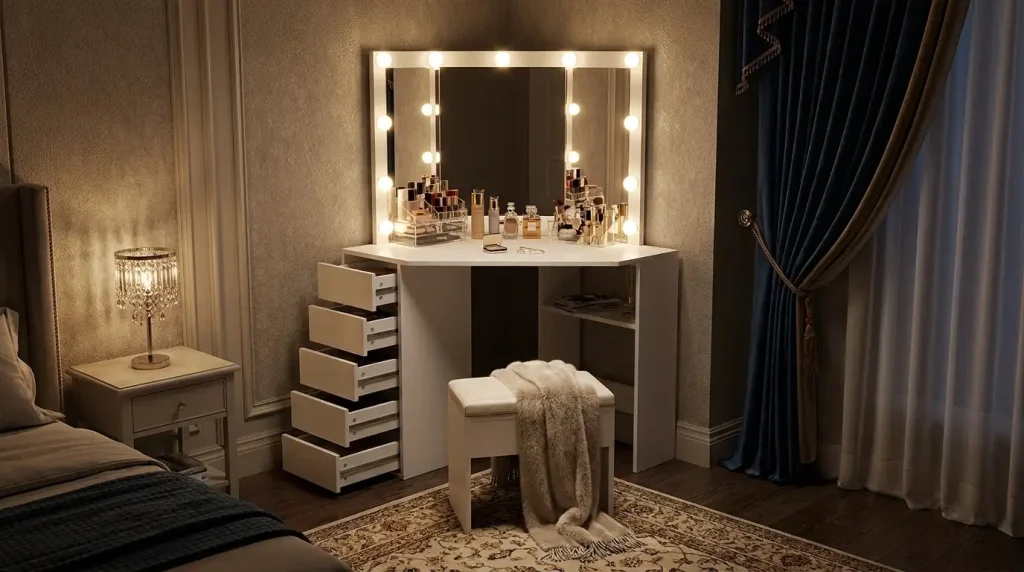
Corners often receive less natural light than open wall space, particularly if the corner sits away from the room’s main window. This makes lighting more important in a corner setup than it would be for a table positioned directly beside a bright window.
An LED mirror with adjustable brightness solves this directly, giving you consistent light regardless of what natural light actually reaches the corner at different times of day. Our corner dressing table with adjustable LED lights pairs the folding mirror format with touch-adjustable LED brightness, which is worth prioritising if your corner does not sit near the room’s main light source. Our full guide to LED mirror dressing tables covers colour temperature, power source and bulb types in far more depth, if lighting is your main concern.
Storage in a Corner: What You Actually Get
Corner units often advertise generous drawer counts, but it helps to understand how that storage is actually shaped before assuming it will hold everything you own.
Drawers in a corner unit follow the angle of the worktop above them, which means the front of each drawer is often wider than the back. This is not a problem for most items, but it does mean very long or wide items, such as a large jewellery box, may not fit as neatly as they would in a straight rectangular drawer of the same stated width.
Key note: if you have a specific large item you need to store, check the drawer’s usable internal dimensions in the product listing, rather than the external drawer width alone, since the two can differ meaningfully in a corner design.
Stool Choice for a Corner Setup
A corner arrangement changes how a stool needs to behave more than a straight table does, simply because the space around it is often tighter.
A small, backless stool that tucks completely under the worktop is usually the better choice in a corner, since a larger stool with a backrest can make an already tight space feel more cramped once it is pulled out for use. Our guide to choosing a dressing table stool covers seat height, weight capacity and build quality in full, all of which still apply here.
Check the stool’s pulled-out position against any nearby obstruction, such as a bed frame or wardrobe door, using the same measuring approach covered earlier in this guide.
Style Ideas: Making a Corner Feel Considered
A corner dressing table can look like an afterthought, or it can look like a deliberate part of the room’s design. A few simple choices make the difference.
- Keep the tabletop mostly clear. A corner already reads as a smaller space than an open wall, so a cluttered surface makes it feel busier still. A few carefully chosen items, rather than everything you own, keep the space feeling calm.
- Match the finish to nearby furniture, not just the closest wall colour. A corner unit beside a wardrobe in a different tone can look disconnected, even if each piece looks fine on its own.
- Use a small wall shelf above the mirror if space allows, for a book or a folded scarf, which adds personality without adding floor clutter.
- Consider the view from two angles, not one. A corner setup is visible from more than one direction as you enter the room, unlike a table pushed flat against a single wall, so it is worth a slightly more considered look than a straightforward wall unit.
Common Obstacles: Sockets, Radiators and Skirting Boards
Corners in real UK bedrooms rarely come completely clear. A few common obstacles are worth checking for specifically before you order.
- Radiators. Many older properties place a radiator close to a corner. Check the radiator’s full width and projection from the wall, not just its visible front panel, since pipework can extend further than expected.
- Plug sockets. If you want an LED mirror, check exactly where the nearest socket sits relative to the corner, and whether the unit’s cable will comfortably reach it.
- Skirting boards. Deep or decorative skirting boards, common in older properties, can prevent a corner unit’s legs from sitting fully flush against the wall. Measure the skirting board’s depth and check this against the unit’s leg design if you are unsure.
- Coving or ceiling roses. Rarely an issue for a seated dressing table, but worth a glance if the corner sits directly under an ornate ceiling feature that a taller mirror section might interrupt visually.
Fire Safety for Upholstered Stools
If your corner setup includes an upholstered stool, it is worth knowing that UK law already protects you here. The Furniture and Furnishings (Fire) (Safety) Regulations set fire resistance standards for upholstered furniture sold in the UK, including filling materials and cover fabrics, and require a permanent fire safety label to be fitted to qualifying items.
Any upholstered stool bought new from a reputable UK retailer should carry this label. It is a simple thing to check for on delivery, and it applies just as much to a small dressing table stool as it does to a sofa.
What to Expect at Each Price Point
Corner units generally cost a little more than a straight table of similar quality, since the angled or curved worktop is more complex to manufacture. Knowing what to expect at each level helps you compare products fairly.
| Price band | What you typically get |
| Under £100 | Basic MDF construction, single fixed mirror, limited drawers, no lighting |
| £100 to £200 | Better MDF or particle board, LED or folding mirror becomes common, matching stool usually included |
| £200 to £350 | Solid wood elements, three-way folding mirrors, additional shelving, more considered hardware |
| £350+ | Premium materials, bespoke or made-to-measure corner units for irregular spaces |
For most buyers, the £100 to £200 bracket delivers the best balance of genuine storage, a proper folding or LED mirror, and a matched stool, without paying a significant premium for a bespoke fit that a standard corner does not actually need.
Corner Dressing Tables vs Fitted Wardrobe Corner Units
Some buyers consider a fully fitted corner wardrobe system instead of a freestanding corner dressing table, particularly if the room is being renovated from scratch. It is worth understanding the real difference before choosing between them.
A fitted corner unit is built into the room permanently, often as part of a wider wardrobe run. It can be tailored precisely to an irregular corner, which suits homes with genuinely unusual angles. The trade-off is cost, installation time, and the fact that it cannot move with you if you relocate.
A freestanding corner dressing table, by contrast, installs in an afternoon, needs no professional fitting, and can be taken with you if you move house. For the vast majority of standard UK bedroom corners, a freestanding unit gives most of the practical benefit of a fitted piece at a fraction of the cost and disruption. Fitted units generally make sense only where the corner itself is unusually shaped, such as a sharply angled loft conversion wall, where no standard product will fit at all.
Assembly Tips Specific to Corner Units
Corner dressing tables are more complex to assemble than a straight table, simply because more panels meet at more angles. A few tips make the process smoother.
- Lay out all panels against the instructions before starting, and identify the left and right leg sections early, since these are usually different lengths and easy to confuse.
- Build the frame loosely at first, without fully tightening every fixing, then check the whole unit sits correctly in the corner before final tightening. This makes small adjustments much easier than trying to correct a fully tightened frame.
- Fit the worktop last, once the frame is confirmed stable, rather than attaching it early and discovering a misalignment further into assembly.
- Have a second person help position the assembled unit into the corner itself, since the angled shape makes it more awkward to manoeuvre alone than a simple rectangular table.
Building the frame in the room it will actually live in, rather than assembling it elsewhere and moving it afterwards, also avoids the risk of an awkward doorway squeeze once the unit is fully built.
Colour and Finish Ideas for a Corner Setup
Colour plays a bigger role in a corner setup than in an open wall placement, since the unit is visible from two directions rather than one straight sightline.
White and other pale finishes work particularly well in a corner, since they reflect available light back into a part of the room that often receives less natural daylight than an open wall. This is especially useful in a box room or a corner positioned away from the window.
Pine and other natural wood finishes suit a corner that already has some warmth in the room, such as wooden flooring or existing oak furniture, and tend to feel less stark in a compact space than a very dark painted finish. If in doubt, choose the lighter of two similar options, since a corner already reads as a slightly enclosed space, and a darker finish here can make it feel more so.
Combining a Corner Dressing Table With Other Furniture
A corner dressing table does not need to work in isolation. In a slightly larger bedroom, it can sit alongside a small reading chair or a narrow bookshelf on the adjoining wall, turning an unused corner into a proper functional zone rather than a single piece of furniture on its own.
In a smaller room, the opposite approach works better: keep the corner dedicated purely to the dressing table, and resist the temptation to add extra pieces nearby, which can quickly make a tight corner feel overcrowded rather than considered.
Common Mistakes When Buying a Corner Dressing Table
- Measuring only one wall of the corner, rather than both, leading to a unit that does not sit flush on the shorter side.
- Forgetting to check the projection measurement, resulting in a stool that cannot be pulled out fully once the unit is in place.
- Assuming a symmetric corner unit will fit an asymmetric alcove, particularly beside a chimney breast where the recess is narrower than an open corner.
- Ignoring nearby obstructions, such as radiators or deep skirting boards, that prevent the unit from sitting flush against the wall.
- Choosing a large stool with a backrest for a genuinely tight corner, making the finished space feel more cramped than a smaller, tucked-away stool would.
- Overlooking lighting, particularly in a corner that sits away from the room’s main window, where natural light alone often is not enough.
Quick Checklist Before You Buy
- Measure both walls of the corner separately, not just one.
- Check the unit’s projection into the room against your remaining floor space.
- Check the ceiling height directly above the corner if the wall slopes.
- Note any radiators, sockets or deep skirting boards nearby.
- Choose a stool that tucks fully away if the space is genuinely tight.
- Confirm a nearby socket if you want an LED mirror.
- Check drawer internal dimensions if you have specific large items to store.
Frequently Asked Questions
Does a corner dressing table need both walls to be the same length?
No, but check the unit’s individual leg lengths against your shorter wall specifically. Many corners in UK homes are slightly asymmetric, particularly in older properties.
Can a corner dressing table fit under a sloped ceiling?
Yes, in most cases, since you are seated for most of the table’s use. Measure the ceiling height at the exact point the table will sit, and check this against the unit’s total height including the mirror section.
Is a true corner unit better than placing a table diagonally across a corner?
Generally yes. A true corner unit is designed to sit flush against both walls with no wasted space behind it, while a diagonally placed table leaves an unused triangular gap.
What mirror type works best for a corner dressing table?
A three-way folding mirror suits a corner particularly well, giving you a full front and side view without needing extra wall space for a separate mirror.
How much floor space does a corner dressing table actually save?
This varies by design, but a true corner unit typically uses floor space that no other furniture in the room could occupy productively, effectively adding usable space rather than simply relocating it.
Do corner dressing tables come with a matching stool?
Many do, particularly matched sets. Check the product listing specifically, since some corner units are sold as the table alone.
Can a corner dressing table be anchored to the wall for safety?
Yes, and it is worth doing. Most flat-pack corner units ship with an anti-tip bracket or strap. Fixing this into a solid part of the wall, ideally a stud rather than plasterboard alone, is a sensible precaution, particularly in a household with children or pets, and takes only a few minutes at assembly.
Is a corner dressing table more expensive than a standard table?
Generally a little, since the angled or curved worktop is more complex to produce. The difference is usually modest, and the extra usable storage a corner unit often provides tends to offset the higher price in practical terms.
Making the Corner Work for You
A bedroom corner does not have to sit empty. With the right measurements and the right unit, it becomes one of the most useful spaces in the room, rather than the one everyone avoids. Measure both walls, check what sits nearby, and choose a shape that follows the room rather than fighting it.
For the fuller picture on mirror types, lighting and stool choice once you have settled on a corner unit, our dressing table with mirror buying guide, our LED mirror guide, and our dressing table stool checklist all cover the wider decision in more depth. When you are ready to compare corner options directly, browse the full dressing table range at Kosy Koala.
Corner Dressing Tables to Consider at Kosy Koala
A short shortlist of corner options, each covered in more depth earlier in this guide.
Corner Dressing Table With Mirror, Drawers and Storage Shelf
Mirror type: 3-way folding, LED, brightness adjustable. Drawers: 5, plus storage shelf. Dimensions: Table L114 x W61 x H140cm, stool L40 x W26 x H38cm. Finish: Pine wood. Best for: box rooms and low-light corners needing a full storage solution.
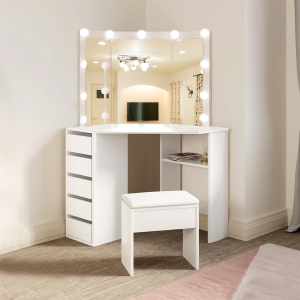
Shop: Corner Dressing Table With Mirror, Drawers and Storage Shelf
White Corner Dressing Table With 3 Mirrors and Stool
Mirror type: 3 angled mirrors (1 large centre, 2 side panels). Drawers: 5, plus 3 storage shelves. Dimensions: Worktop W111 x D53cm, total height 141cm. Finish: White, E1-grade particle board with solid wood legs. Best for: shared bedrooms and rooms needing the highest total storage.
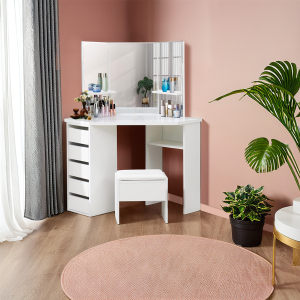
Shop: White Corner Dressing Table With 3 Mirrors and Stool
Browse the full range, including slimline options for narrow alcoves, at kosykoala dressing tables.
Recommended Supporting Articles
- Dressing Tables With Mirror: The Complete UK Buying Guide
- Best Dressing Table for a Small Bedroom
- LED Mirror Dressing Tables Explained: Bulbs, Brightness & Power
- Dressing Table With Stool: What to Check Before You Buy
- How to Organise a Dressing Table (Storage Tips That Work)
- Dressing Table vs Vanity Desk: Is There Really a Difference?
About the author
This article was written by the Kosy Koala team. We design and source bedroom furniture for UK homes, with a focus on practical details that actually matter once a piece is in your room. Have a question about any product on this page? Get in touch through our About Us page.


 Dining Tables
 Dining Chairs

 Bed Frames
 Mattresses
 Bunk Beds
 Sofa & Sofa Beds


