

Blog
LED Mirror Dressing Tables Explained: Bulbs, Brightness and Power

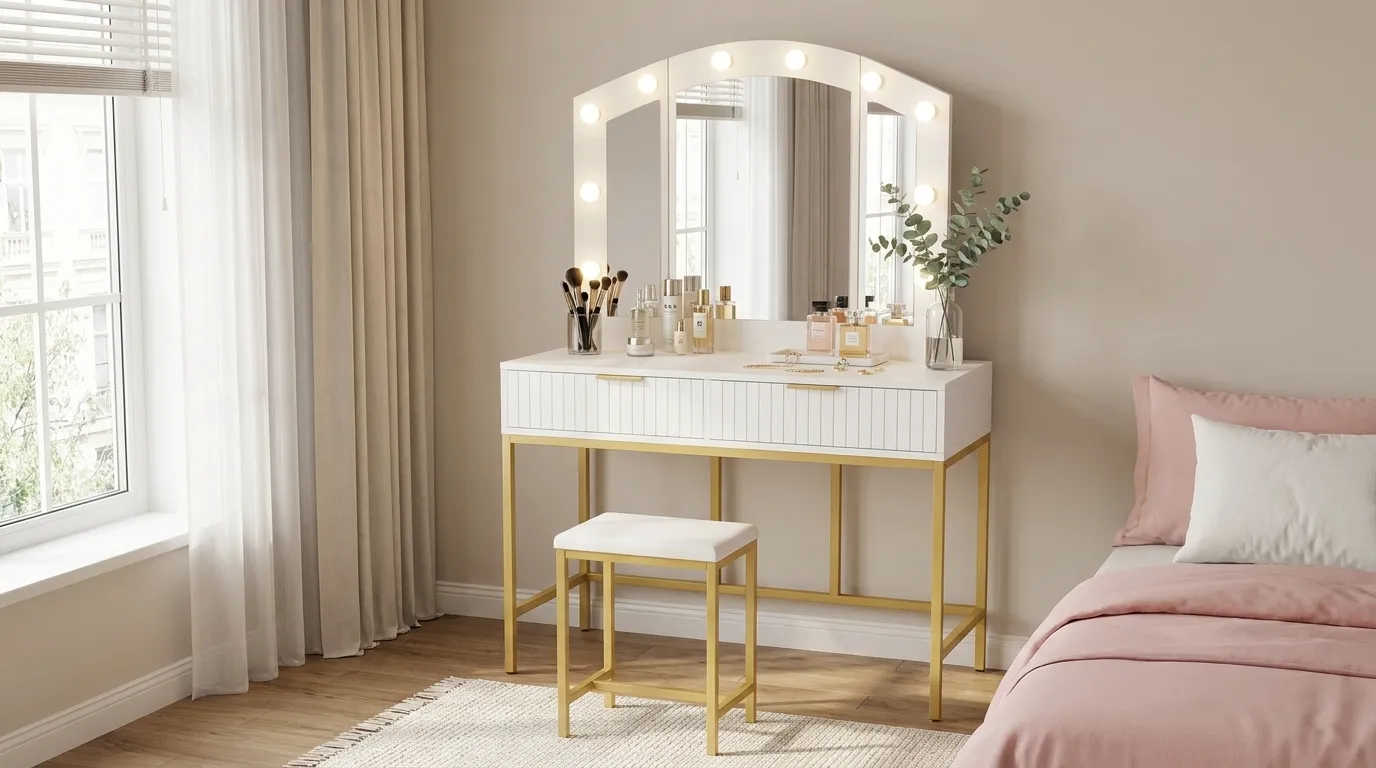
An LED mirror dressing table looks simple in a product photo. Turn it on and you get bright, even light. That is the whole idea. But once you start comparing products, the details pile up fast. Bulb count. Brightness levels. Colour modes. Mains power or USB. Touch control or remote.
None of this is complicated once it is explained properly. This guide breaks it down step by step. We cover bulbs, brightness, colour temperature, power sources, controls, safety and running costs. By the end, you will know exactly what to look for. And you will be able to compare products with real confidence, not just a gut feeling.
If you have not yet chosen the table itself, our complete dressing table with mirror buying guide covers mirror shape, height and storage in full. This article focuses purely on the lighting.
Quick answer:
A good LED mirror dressing table gives you at least three brightness levels, a choice of colour temperature (warm, neutral and cool white), and a stable power connection that suits your room. Bulb-style mirrors, sometimes called Hollywood mirrors, give more even light across the whole face than a single strip. Mains power is more reliable for daily use than battery power. Touch controls are simpler to use than tiny dial switches. Get these basics right and the rest is mostly personal style.
What an LED Mirror Dressing Table Actually Is
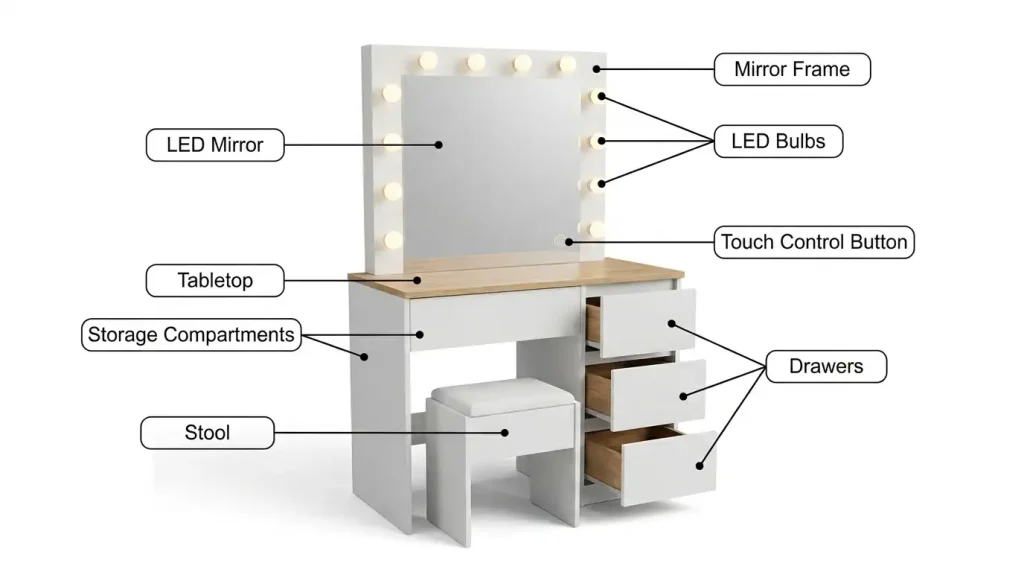
An LED mirror dressing table is a dressing table with lighting built into the mirror itself. The light sits around the mirror frame. It is not a separate lamp. It is not overhead room lighting either.
This matters because task lighting and room lighting do different jobs. Room lighting fills a space with general brightness. Task lighting, like an LED mirror, lights your face directly. That is the difference between a room that looks bright and a mirror that actually helps you apply makeup evenly.
There are two common formats:
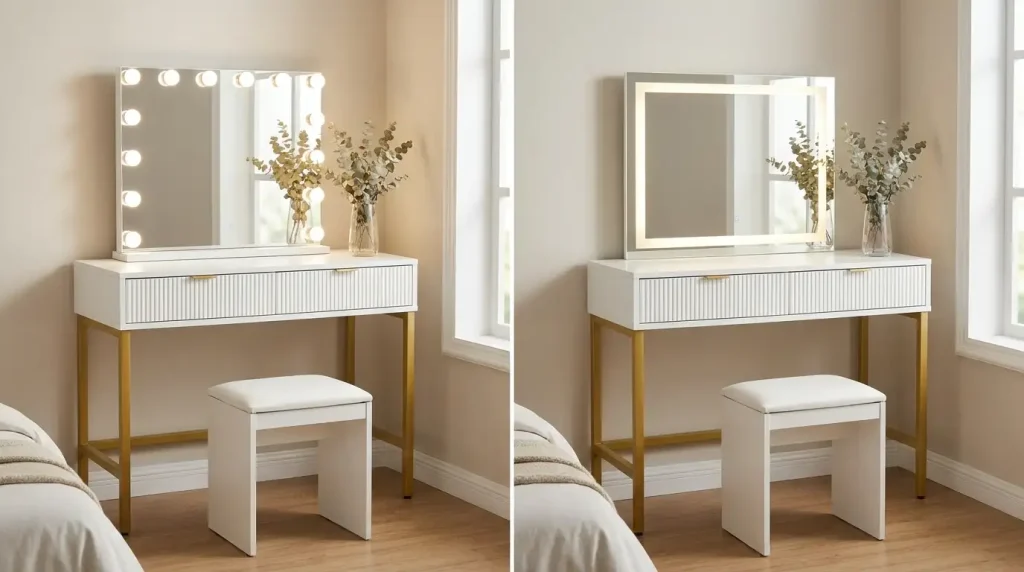
- Bulb-style mirrors. Individual round bulbs sit around the mirror edge. This is often called the Hollywood style, after the mirrors used backstage in film and theatre dressing rooms.
- Strip or ring-style mirrors. A continuous LED strip runs around the mirror edge, or sits behind a frosted panel. Light is more diffused and less directional.
Both formats work well. The right choice depends on how you use the mirror, which we cover shortly.
Bulbs vs LED Strip: What Is the Real Difference
This is the first decision most buyers face. Here is what actually changes between the two.
Bulb-style mirrors place light at multiple points around your face. This reduces shadows under the chin, around the eyes, and along the jawline. It mimics the lighting used by professional makeup artists, where light comes from several angles rather than one source. If you apply makeup daily, or you want salon-style lighting, this format usually gives the better result.
Strip-style mirrors give a softer, more even glow. Light is less directional. This suits general use, such as checking your outfit, doing your hair, or simply seeing clearly while getting dressed. It also tends to look sleeker, since there are no visible bulb shapes around the frame.
Neither is better in every case. Bulb-style mirrors suit detailed makeup work. Strip-style mirrors suit general grooming and a cleaner look. Our Hollywood-style dressing table with mirror and stool uses the bulb format, which is worth checking out if detailed makeup application is your main use.
Colour Temperature Explained
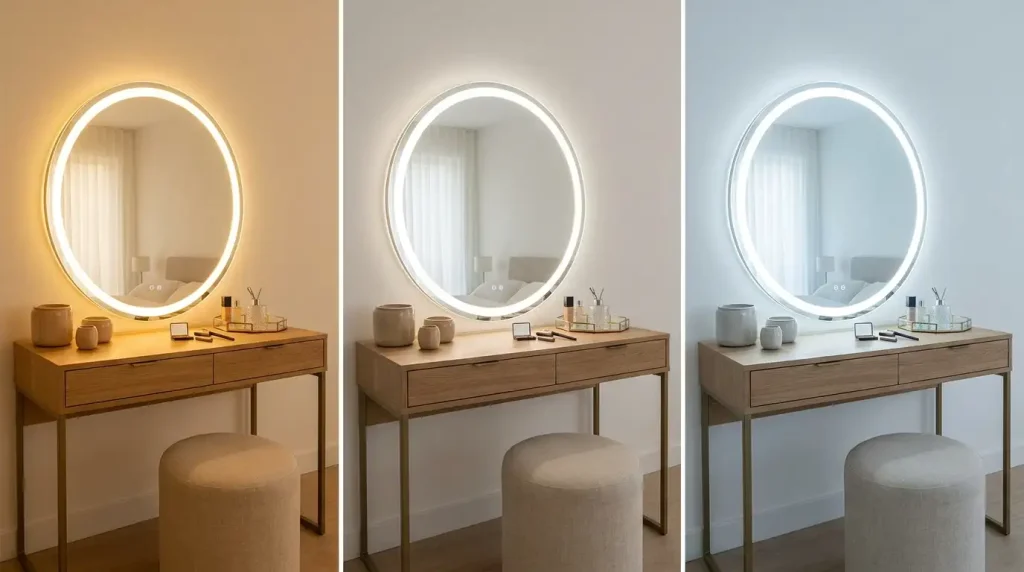
Colour temperature is measured in Kelvin. You will see this written as a number followed by a K, such as 2700K or 6000K. It tells you how warm or cool the light looks, not how bright it is. Brightness is a separate setting entirely.
Here is a simple breakdown:
| Kelvin range | Appearance | Best suited to |
| 2700K to 3000K | Warm, yellow-toned | Evening use, cosy bedroom lighting |
| 3500K to 4500K | Neutral white | General daytime use, most makeup |
| 5000K to 6500K | Cool, blue-toned daylight | Daytime colour matching, photos |
Most LED mirror dressing tables offer three preset modes that roughly match these three ranges. This lets you match the light to the situation you are actually getting ready for.
Here is why this matters more than it sounds. Makeup applied under warm yellow light can look orange or patchy once you step into daylight. Makeup applied under cool blue light can look pale or ashy under evening lamps. A mirror with switchable colour temperature solves this by letting you preview your makeup under the type of light you will actually be seen in.
Key note: if you mostly get ready in the morning for daytime activities, lean towards the neutral to cool settings. If you are getting ready for an evening event under warm lamps, test the warm setting instead. Many people simply flick between settings and judge by eye, which works fine once you understand what each mode is doing.
Brightness and Dimming: What the Settings Actually Mean
Brightness is usually listed as a number of levels, such as “10 brightness levels” or “step dimming.” This number tells you how finely you can adjust the light, not the maximum brightness itself.
A mirror with only one brightness setting is harder to use well. Too bright, and you get glare and eye strain. Too dim, and you cannot see fine detail. A mirror with multiple steps lets you land somewhere in between that actually suits your eyes and your room.
There are two dimming styles in general use:
- Stepped dimming. The light moves through fixed levels, such as low, medium and high. Simple and reliable.
- Continuous dimming. The light adjusts smoothly across a range, usually via a touch slider or dial. More precise, but slightly more fiddly to use one-handed.
For daily use, stepped dimming with at least three to five levels is enough for most people. Continuous dimming is a nice extra, but not essential.
Practical tip: set the brightness level once, based on your usual time of day, and leave it. Constantly adjusting brightness each morning wastes time you do not need to spend.
Why LED Replaced Older Bulb Types
It helps to understand why LED became the standard choice for dressing table mirrors in the first place, rather than older bulb types still used elsewhere in the home.
Older vanity mirrors often used incandescent or halogen bulbs. Both produce a warm, familiar light. Both also run hot. An incandescent bulb turns most of its energy into heat rather than light, which is wasteful and can make a small mirror frame uncomfortably warm to sit near for long periods.
LED bulbs solve this in two ways. First, they use far less electricity to produce the same brightness. Second, they run much cooler, since LEDs convert more of their energy into light rather than heat. This matters more than it sounds for a dressing table, since you sit close to the mirror for several minutes at a time, often every single day.
There is a second reason LED took over so completely: lifespan. A halogen bulb typically lasts a few thousand hours. An LED bulb often lasts tens of thousands of hours. In a dressing table used daily, that difference can mean the gap between replacing bulbs every year or two, and never replacing them at all during the years you own the table.
Positioning the Mirror for the Best Light
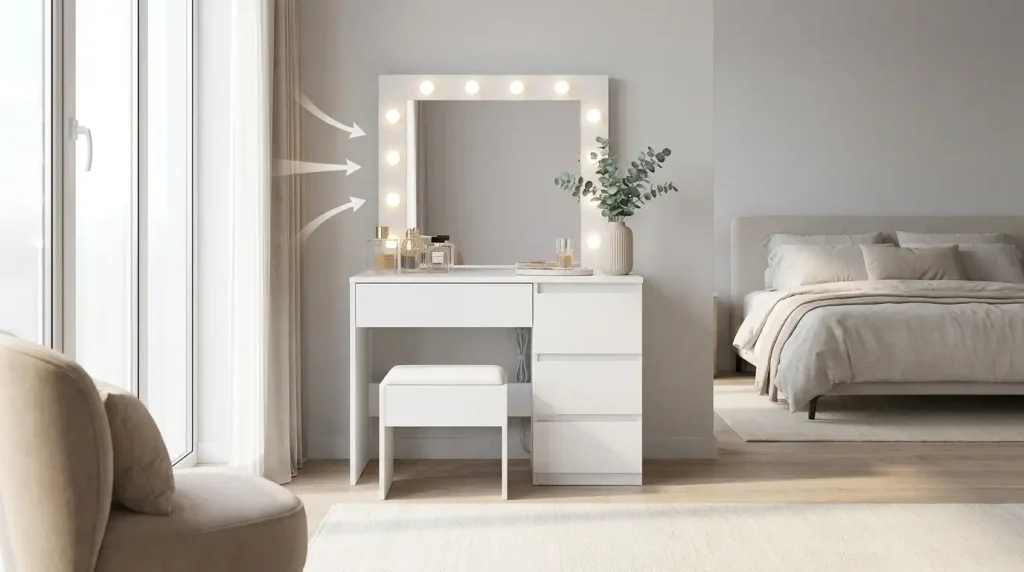
Even the best LED mirror will not perform well if it is positioned badly. A few placement details make a real difference to how the light actually reaches your face.
- Sit close enough that the light reaches you evenly. LED mirror lighting is designed for close-range use, typically 30 to 50cm away. Sitting too far back reduces how evenly the light covers your face.
- Avoid strong competing light sources nearby. A bright overhead light or a lamp positioned to one side can create conflicting shadows, even with a good LED mirror doing its job correctly.
- Keep the mirror at the height covered in our main buying guide. A mirror positioned too high or too low changes the angle the light hits your face from, which changes how flattering and accurate it looks, regardless of how good the bulbs themselves are.
- Consider the wall behind you. A dark wall directly behind the mirror can make the light feel more contrasty than a lighter wall would. This is a small detail, but worth knowing if you are deciding where in the room to place the table.
Testing Brightness and Colour Before You Buy Online
Buying an LED mirror online means you cannot test the light in person before it arrives. A few practical steps reduce the chance of disappointment once it does.
- Check the listed lumen output if it is given. This is a measure of total light output, separate from colour temperature. Higher lumen counts generally mean a brighter maximum setting, which matters if your room already gets a reasonable amount of natural light.
- Read the number of brightness steps, not just “adjustable brightness.” A mirror with only two settings, low and high, gives far less control than one with five or ten steps.
- Look for real customer photos in reviews, taken with the mirror lit, rather than only manufacturer photos. These give a far more honest sense of the actual light colour and intensity than a professionally lit product shot.
- Check whether colour temperature is switchable or fixed. Some budget mirrors only offer one fixed white tone, described loosely as “bright LED light,” without adjustable warm or cool settings. If colour temperature matters to you, confirm this specifically before ordering.
Colour Temperature, Video Calls and Photos
This is a use case competitors rarely mention, but it matters for a growing number of buyers. If you use your dressing table area for video calls, or take photos for social media, colour temperature affects how you look on screen just as much as it affects how you look in the mirror itself.
Most cameras and webcams are calibrated to work best under light in the 4000K to 5500K range, which reads as clean, neutral white on screen. A mirror light set to a very warm 2700K setting can cast an orange tint on camera, even if it looks perfectly natural to your own eye in the room. If your dressing table doubles as a spot for calls or content, testing the neutral to cool settings on camera first, rather than assuming the setting that looks best to your eye will also look best on screen, avoids an unwelcome surprise later.
How Many Bulbs Do You Actually Need
Bulb count varies a lot between products, from around 10 bulbs up to 15 or more on larger Hollywood-style mirrors. More bulbs generally means more even coverage, but it is not simply a case of more being better in every situation.
Here is a more useful way to think about it:
- Under 10 bulbs tend to leave gaps in coverage, particularly at the top and bottom of the mirror.
- 10 to 12 bulbs is the sweet spot for most home dressing tables. Coverage is even, and the mirror does not look overcrowded.
- 12 or more bulbs suit larger mirrors or anyone who wants a stronger visual statement alongside the lighting itself.
Our white dressing table with adjustable LED bulbs sits in that ten to twelve bulb range, giving even coverage without the mirror looking cluttered.
Power Source: Mains, USB or Battery
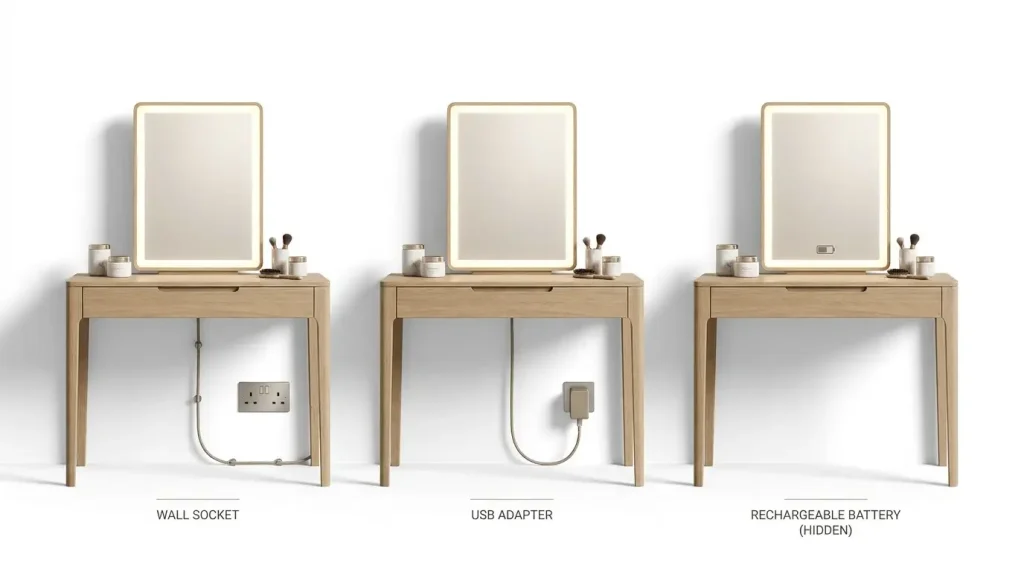
This is the detail buyers check last, and it is often the one that causes the most frustration after delivery. Get this wrong and the mirror simply will not fit your room the way you planned.
Mains-powered mirrors plug directly into a wall socket. This is the most reliable option for daily use. There is no charging to remember, and brightness stays consistent over time. The only requirement is a nearby socket, ideally one that reaches without a trailing cable across the floor.
USB-powered mirrors run from a USB cable, often connected to a plug adaptor, a power bank, or a USB port on nearby furniture. This gives more flexibility in placement, since USB cables and adaptors are widely available and easy to route. It is a good middle ground between mains and battery power.
Battery-powered mirrors need no cable at all. This suits a table positioned away from any socket. The trade-off is battery life. Brightness can also dim gradually as batteries run low, which is easy to miss until the light already looks weaker than usual.
Key Note: check this detail before you buy, not after. Measure the distance from your intended table position to the nearest socket. If it is more than a metre or two, decide whether a cable, an extension lead, or a battery-powered option suits you better before the table arrives.
Controls: Touch, Remote or Dimmer Switch
How you actually turn the light on and adjust it affects daily use more than most buyers expect.
- Touch controls sit directly on the mirror frame or cable. A light tap turns the mirror on, and repeated taps or a touch-and-hold gesture cycles through brightness or colour settings. This is the most common format now, and it keeps everything in one place.
- Remote controls operate the mirror from a small handheld unit. This suits anyone who prefers not to reach across the table each time. The downside is a small remote that can go missing in a drawer.
- Inline dimmer switches sit on the cable itself, often as a small wheel or slider. Simple and reliable, though usually only stepped through a few basic settings rather than fine dimming.
None of these is objectively best. Touch controls suit most people well, since everything is built into the mirror and nothing extra needs to be kept track of.
Wiring and Cable Management
A detail that rarely appears in product photos, but matters once the table is actually in your room: where does the cable go, and does it stay tidy?
Good LED mirror dressing tables route the cable down through the back of the mirror stand, along a leg, or through a small channel in the tabletop. This keeps the cable out of the way of the stool and away from where you sit. Look for this detail in product images or descriptions before buying, particularly if the table will sit somewhere visible.
A loose cable across the floor or trailing over the edge of the table is not just untidy. It is also a trip hazard, and a cable pulled repeatedly at an angle wears out faster than one that is properly routed and secured.
Electrical Safety With LED Mirrors
LED lighting is genuinely low risk when it comes from a reputable retailer and is used as intended. But a few basic checks are worth doing, especially in a bedroom where furniture, bedding and cables share close space.
Electrical Safety First, the UK charity focused on preventing electrical accidents in the home, recommends buying lighting products from reputable retailers, checking for a proper UK three-pin plug, and registering products so you are contacted in the event of a safety recall. The same organisation also notes that bedrooms carry particular fire risk where cables and fabric, such as bedding or clothing, sit close together, which is worth keeping in mind when you route a mirror’s cable.
A short, practical checklist:
- Buy from a retailer that states CE or UKCA marking on the product listing.
- Keep the cable away from anywhere clothing or bedding could fall across it.
- Avoid running the cable under a rug or carpet, where heat cannot dissipate properly.
- Unplug the mirror, rather than leaving it on standby, if you will not use it for an extended period.
- Check the plug and cable occasionally for any visible damage, particularly if the table is moved during cleaning.
None of this should put you off buying an LED mirror. It is the same basic care most people already give to a bedside lamp or phone charger, just applied to one more item in the room.
Running Costs: LED vs Older Bulb Types
One advantage of LED mirror lighting rarely gets a clear explanation: how much it actually costs to run. LED bulbs use significantly less electricity than older halogen or incandescent bulbs to produce the same brightness. A typical LED mirror uses a small fraction of the wattage an old-style vanity bulb setup would use for the same light output.
In practical terms, running an LED mirror for an hour each day costs a small fraction of a penny at current UK electricity prices. Over a year, that is unlikely to add up to more than a few pounds, even used daily. This is one reason LEDs have largely replaced halogen bulbs in dressing tables and vanity lighting altogether.
LED bulbs also last far longer before needing replacement. Many are rated for tens of thousands of hours of use, which in practice means years of daily use before any bulb needs attention.
Choosing Colour Temperature for Your Skin Tone and Routine
This is where colour temperature becomes personal rather than purely technical. There is no single correct setting for everyone. It depends on your skin tone, the products you use, and what you are getting ready for.
- If you wear makeup daily for daytime work or activities, a neutral to cool white setting, around 4000K to 5000K, tends to give the most accurate colour match to daylight.
- If you are getting ready for an evening event under warm lamps or restaurant lighting, testing under the warm 2700K to 3000K setting first can prevent an unpleasant surprise later in the evening.
- If your skin has cooler undertones, a slightly warmer light can help prevent make-up looking flat or grey under a very cool white setting.
- If your skin has warmer undertones, a slightly cooler setting can help prevent an orange cast under warm light.
There is no substitute for testing this yourself. Apply your usual routine under each setting once, and take a phone photo in natural daylight afterwards. This quickly shows you which setting matches reality most closely for your own skin and products.
LED Mirrors in Small Bedrooms
LED mirrors are particularly useful in small bedrooms with limited or inconsistent natural light. A box room with one small window often lacks the daylight needed to judge makeup accurately, especially in winter. A built-in LED mirror solves this without needing extra lamps that would take up more of the room’s limited space.
Our guide on choosing the best dressing table for a small bedroom covers floor space and table shape in detail. When space is tight, a slimline or corner table with a built-in LED mirror gives you good lighting without adding a separate lamp to the room.
Matching LED Mirror Style to Table Style
The mirror lighting should suit the table it sits on, not just your personal taste in isolation.
- Hollywood glamour styles suit bulb-style mirrors with warm gold or brass detailing. Our white and gold Hollywood dressing table set pairs bulb lighting with gold hardware for exactly this look.
- Modern and minimalist styles usually suit a slimmer strip-style mirror, without visible bulbs breaking up a clean frame.
- Corner and space-saving tables often use a folding, multi-panel mirror with LED built into the frame edge. Our corner dressing table with adjustable LED lights combines both, giving a full hair and makeup view with lighting built directly into the folding frame.
Common LED Mirror Problems and Fixes
Most LED mirror issues have simple causes. Here are the most common ones, and what to check first.
The mirror will not turn on: Check the plug is fully seated in the socket. If it is USB-powered, check the cable is fully connected at both ends. Try a different socket to rule out a socket fault rather than a mirror fault.
Lights flicker or dim unexpectedly: This often points to a loose connection rather than a failing bulb. Check the cable at both ends. If the mirror is battery-powered, this is usually a sign the batteries need replacing.
Touch control does not respond: Clean the touch panel with a dry cloth. Moisture, dust or a light coating of makeup residue can interfere with touch sensors over time.
One section of bulbs is dimmer than the rest: On some bulb-style mirrors, bulbs are wired in small groups. A fault in one bulb can occasionally affect its group rather than the whole mirror. Check the product’s warranty terms, since this is usually covered as a manufacturing fault rather than something to fix yourself.
Colour temperature will not change: Check you are pressing and holding the control, rather than tapping once, since many mirrors use a long-press specifically to cycle colour modes rather than brightness.
If a fault persists after these basic checks, contact the retailer rather than attempting any repair yourself, particularly for anything involving the plug or internal wiring.
Maintenance and Cleaning
LED mirror lighting needs very little ongoing care, but a few simple habits keep it working well for longer.
- Wipe the mirror surface and bulb area weekly with a dry or slightly damp microfibre cloth. Dust collects faster around warm bulbs than around an unlit surface.
- Avoid spraying cleaning products directly onto the mirror or bulbs. Spray onto the cloth first instead.
- Check the cable occasionally for wear, particularly near the plug and near the mirror base, where repeated movement causes the most strain.
- Unplug before cleaning near any exposed wiring or touch control panel, as a simple precaution.
Common Buying Mistakes
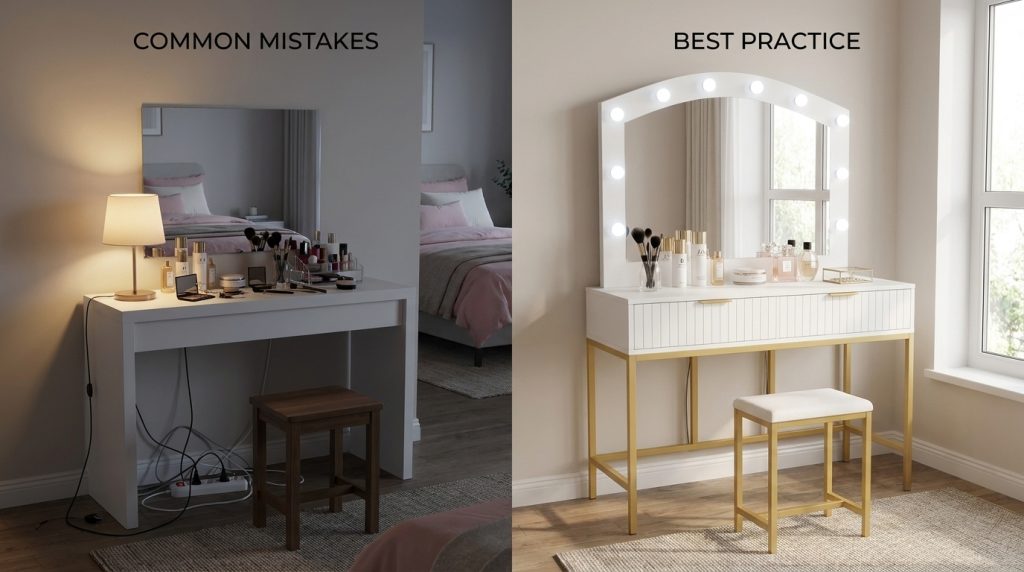
- Assuming all LED mirrors are mains-powered: Always check the power source before ordering, particularly if your table position is far from a socket.
- Choosing based on bulb count alone: Ten well-placed bulbs often give better coverage than fourteen bulbs clustered unevenly around a smaller mirror.
- Ignoring colour temperature entirely: A single fixed white setting will not suit every time of day or lighting situation you get ready for.
- Overlooking cable routing: A mirror with an untidy trailing cable is more of a daily annoyance than most buyers expect before living with it.
- Not checking the warranty: LED components can fail. A clear warranty on the lighting itself, not just the furniture frame, is worth checking before you buy.
Warranty and What It Should Actually Cover
LED components can fail, just like any electrical part. A clear warranty protects you if that happens, but not all warranties cover the same thing.
Check specifically whether the warranty covers the lighting itself, not just the table frame and hardware. Some furniture warranties focus on structural faults, such as a wobbly leg or a broken drawer runner, while treating the LED mirror as a separate accessory with shorter or more limited cover.
A reasonable standard to look for is at least twelve months of cover on the lighting component, with a clear process for reporting a fault. Keep your order confirmation and any product registration email, since these are usually the first things a retailer asks for if you need to make a warranty claim later.
Frequently Asked Questions
Are LED mirror dressing tables safe to use every day?
Yes. LED lighting runs cool compared to older bulb types and uses very little electricity. Basic care, such as buying from a reputable retailer and keeping cables tidy, is all that is generally needed.
What is the best colour temperature for makeup application?
A neutral to cool white setting, around 4000K to 5000K, most closely matches daylight and tends to give the most accurate colour result for daytime makeup.
Do LED mirror dressing tables need a nearby plug socket?
Only if they are mains-powered. Many models run on USB or battery power instead, which gives more flexibility in table placement.
How long do LED mirror bulbs last?
Most LED bulbs are rated for tens of thousands of hours. In everyday use, this typically means years of daily use before any bulb needs replacing.
Is a bulb-style or strip-style LED mirror better for makeup?
Bulb-style mirrors generally give more even coverage across the whole face, which suits detailed makeup application. Strip-style mirrors give a softer, more general light, which suits everyday grooming.
Can I fit an LED mirror dressing table in a small bedroom?
Yes. LED lighting is especially useful in small or low-light rooms, since it removes the need for a separate lamp that would otherwise take up limited space.
Why does my makeup look different under LED mirror light compared to daylight?
This usually comes down to colour temperature. If the mirror is set to a warm setting, makeup can look slightly different once you step into daylight. Switching to a neutral or cool white setting for daytime use usually solves this.
Do LED mirror lights affect sleep if the table is in a bedroom?
Only if used late at night close to bedtime. Cool white light can delay the body’s natural wind-down process, so a warm setting in the evening is a sensible choice if the table sits close to your bed.
What should I do if only some bulbs on my mirror stop working?
Check whether the bulbs are wired in groups, which is common on larger Hollywood-style mirrors. A single group failing usually points to a manufacturing fault rather than something you can fix at home, so it is worth checking your warranty and contacting the retailer directly.
Bringing It All Together
An LED mirror dressing table comes down to a small number of real decisions. Bulb style or strip style. Warm, neutral or cool light. Mains, USB or battery power. Touch control, remote or dimmer switch. None of these decisions are difficult once you understand what each one actually changes about daily use.
Work through them in that order, and almost any LED mirror you choose will suit your routine rather than just looking good in a product photo. For the full picture of choosing the table itself, our dressing table with mirror buying guide and our guide to the best dressing table for a small bedroom both cover the wider decision in more depth. When you are ready to compare LED options directly, browse the full dressing table range at Kosy Koala.
LED Mirror Dressing Tables to Consider at Kosy Koala
A short shortlist if you want to go straight to specific products, each covered in more depth earlier in this guide.
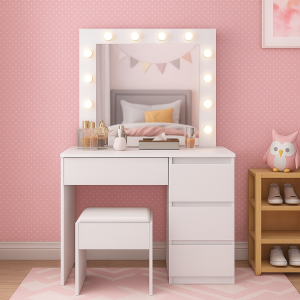
Hollywood Dressing Table With Mirror and Stool, Stone Grey
Bulb-style LED mirror. Best for detailed daily makeup routines. Shop: Hollywood Dressing Table With Mirror and Stool, Stone Grey
White Dressing Table With LED Mirror, Drawers and Stool
Touch-adjustable LED mirror. Best for low-light bedrooms. Shop: White Dressing Table With LED Mirror, Drawers and Stool
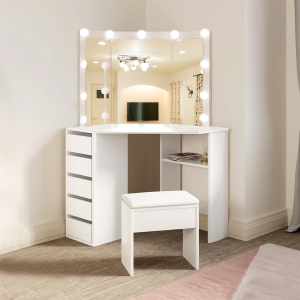
Corner Dressing Table With Mirror, Drawers and Storage Shelf
Folding LED mirror with adjustable brightness. Best for small rooms needing full coverage lighting. Shop: Corner Dressing Table With Mirror, Drawers and Storage Shelf
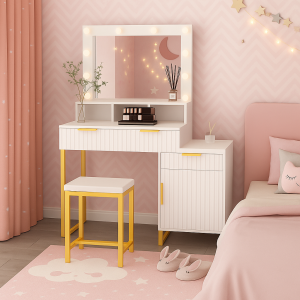
White and Gold Hollywood Dressing Table Set
Bulb-style mirror with three colour tones. Best for a statement Hollywood glamour look. Shop: White and Gold Hollywood Dressing Table Set
Browse the full range at kosykoala dressing-tables.
Recommended Supporting Articles
- Dressing Tables With Mirror: The Complete UK Buying Guide
- Best Dressing Table for a Small Bedroom
- Dressing Table With Stool: What to Check Before You Buy
- Corner Dressing Tables: Ideas for Awkward Bedroom Spaces
- How to Organise a Dressing Table (Storage Tips That Work)
- Dressing Table vs Vanity Desk: Is There Really a Difference?
About the author
This article was written by the Kosy Koala team. We design and source bedroom furniture for UK homes, with a focus on practical details that actually matter once a piece is in your room. Have a question about any product on this page? Get in touch through our About Us page.


 Dining Tables
 Dining Chairs

 Bed Frames
 Mattresses
 Bunk Beds
 Sofa & Sofa Beds


