

Blog
How to Organise a Dressing Table (Storage Tips That Work)

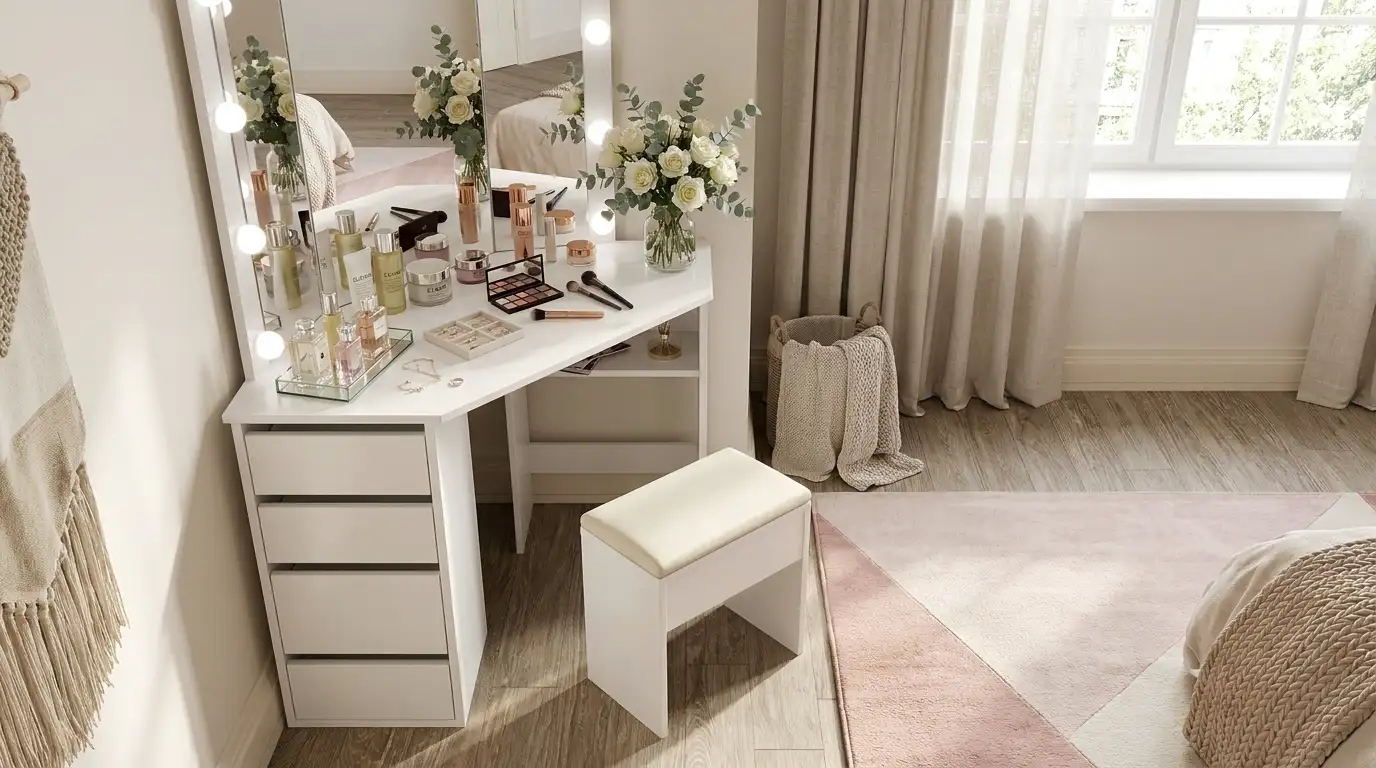
A dressing table gets messy fast. If you’re wondering how to organise a dressing table, one busy week is usually all it takes for clutter to build up. Products pile up. Drawers fill with things that do not belong there. The surface disappears under bottles and brushes.
This guide fixes that properly, not just for one afternoon. We cover sorting, drawer organisation, jewellery storage, and a maintenance routine that actually holds up over time. We also cover something most guides skip: cosmetic hygiene and expiry, backed by real UK labelling standards, not guesswork.
None of this requires expensive storage products or a full weekend. Most of the improvement comes from a proper sort, done once, followed by a few small habits that take only a couple of minutes each day. The goal is a table that still looks and functions well in six months, not just on the day you finish tidying it.
If you are still choosing your table, our complete dressing table with mirror buying guide covers mirror type, storage, and space. This guide picks up once the table is already in your room.
Quick answer:
The fastest way to organise a dressing table is to remove everything first, then sort it into four piles: daily, weekly, occasional, and never. Daily items go on the surface or in the top drawer. Weekly items go in a lower drawer. Occasional items move elsewhere in the bedroom. Everything in the never pile leaves the house. Once sorted, group by category, not by size, and use dividers to stop items from sliding back into a jumbled pile within a week.
Start With a Full Reset, Not a Tidy-Up
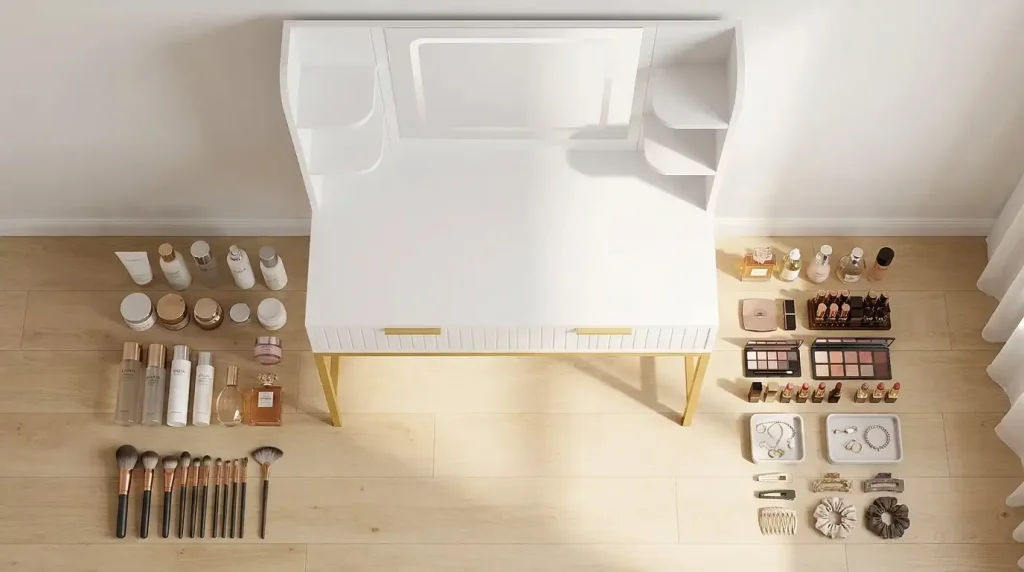
Do not try to organise around what is already there. Take everything off the table and out of the drawers first. Every bottle, every brush, every stray hairband.
This feels excessive, but it is the step that actually works. A partial tidy just rearranges the same clutter. A full reset lets you see exactly what you own, which is the only way to make honest decisions about what stays.
Wipe the empty surface and drawers while everything is out. This is also the easiest moment to check the table itself for anything that needs attention, such as a wobbly drawer runner or a mirror that needs cleaning.
The Four-Pile Sort: Daily, Weekly, Occasional, Never
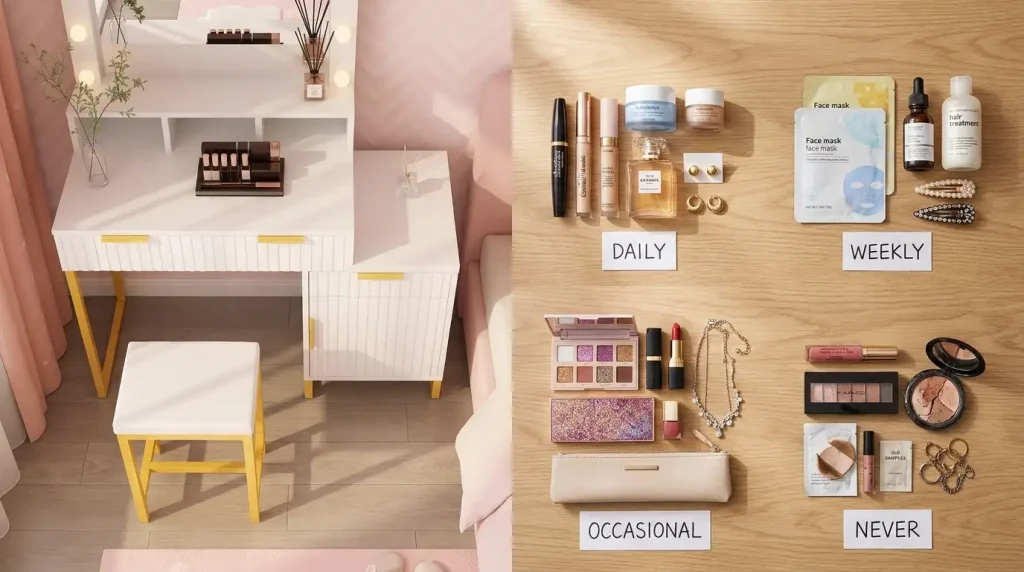
Once everything is out, sort it into four groups. This single step does more for a tidy dressing table than any storage product you could buy.
- Daily. Items you use every single morning. Your everyday makeup, your usual skincare, your go-to hairbrush.
- Weekly. Items are used a few times a week, but not daily. Occasion makeup, a second skincare routine, and hair styling tools are used less often.
- Occasional. Items used rarely, such as special occasion jewellery or a product you only reach for a few times a year.
- Never. Be honest here. Expired products, things you tried once and never used again, anything you keep out of guilt rather than genuine use.
Key note: anything in the never pile leaves the table entirely, not just the drawer. If it is expired, throw it away. If it is unused but still good, consider donating it rather than storing it out of habit.
Daily items earn the best real estate: the surface, or the top drawer. Weekly items go one drawer down. Occasional items move further back, or to another part of the bedroom entirely if the dressing table itself is small.
Zoning Your Dressing Table by Mirror Type
How you zone the table depends partly on the mirror style you have, since different mirror types change how much usable space sits around them.
A fixed mirror on a stand typically leaves the full tabletop clear in front of it, giving you the most flexible surface space for trays or a small organiser on either side.
A flip-up lid mirror stores your everyday items inside the mirror itself when closed, which works well for daily products you want completely out of sight between uses. When organising this type, keep the well itself divided, since a single open compartment fills with loose items just as fast as an open drawer would.
A tri-fold or Hollywood mirror, often found on corners and larger dressing tables, tends to have a wider base, which gives more room on either side for a tray or small dish without crowding the mirror itself.
Our full breakdown of mirror types covers the practical differences between these styles if you are still deciding which suits your routine.
Drawer Organisation: Dividers and Grouping by Category
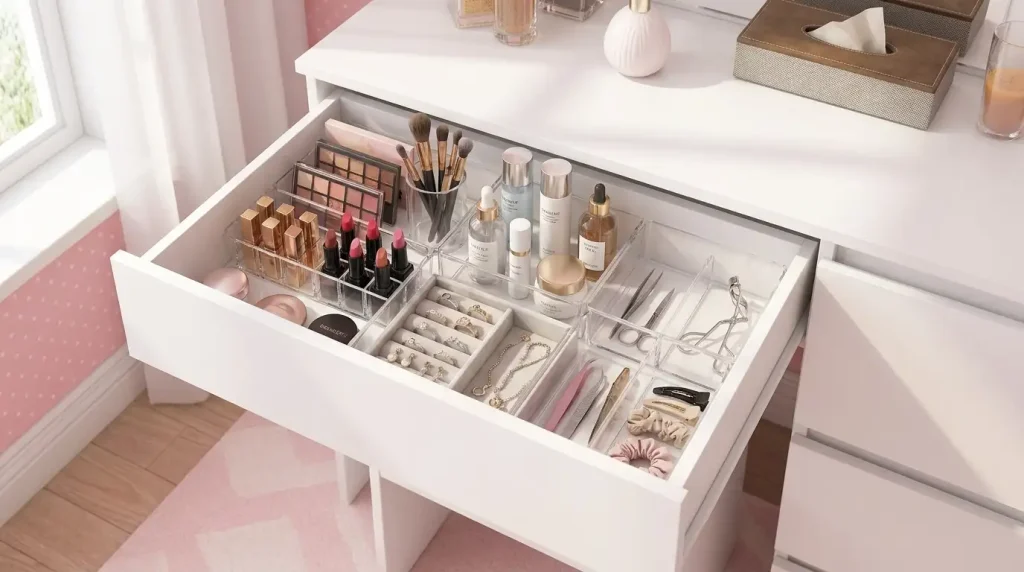
Drawers are where most dressing tables lose the battle against clutter. A single open drawer, no matter how large, becomes a jumbled catch-all within weeks without some structure inside it.
- Group by category, not by size. Keep all skincare together, all makeup together, all hair accessories together, rather than sorting by how well items happen to fit next to each other.
- Use dividers or small trays inside each drawer. Even a simple set of dividers stops products sliding around and re-mixing every time the drawer opens and closes.
- Reserve the shallowest drawer for the flattest items. Palettes, cards, and thin items belong in a shallow top drawer. Taller bottles and brushes need a deeper drawer to stand upright properly.
- Keep one drawer for tools. Hair straighteners, dryers, and brushes are easier to manage in a single dedicated drawer, ideally with a heat-safe mat if the tool is used while still warm.
If your table has limited drawers, prioritise daily and weekly items inside them, and store occasional items elsewhere in the bedroom, such as inside a wardrobe drawer, rather than trying to force everything into a table that was never designed to hold it all.
What Belongs on the Surface
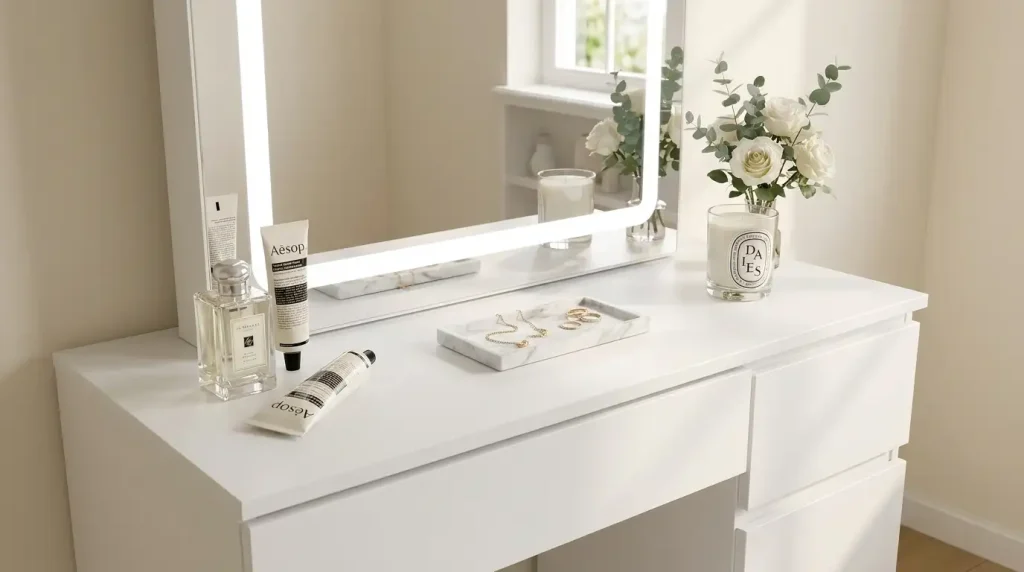
The surface is the part everyone sees first, and it is also the easiest part to overload without noticing.
A good rule: only items used every single day earn a permanent spot on the surface. Everything else belongs in a drawer, even if that means a slightly emptier tabletop than you first pictured.
Items that generally work well on display:
- A small tray for daily perfume or hand cream.
- A single stack of everyday jewellery, kept minimal.
- One or two decorative pieces, such as a candle or small dish, if there is genuinely space for them once the essentials are accounted for.
Items that generally work better in a drawer:
- Full makeup collections, beyond the two or three products used daily.
- Hair tools, once cooled, should be stored safely.
- Anything used only occasionally, regardless of how attractive the packaging is.
A cluttered surface makes the whole table feel smaller and busier than it actually is, particularly in a compact bedroom. Our guide to the best dressing table for a small bedroom covers this effect in more depth if your room is on the tighter side.
Storing Jewellery Without the Tangle
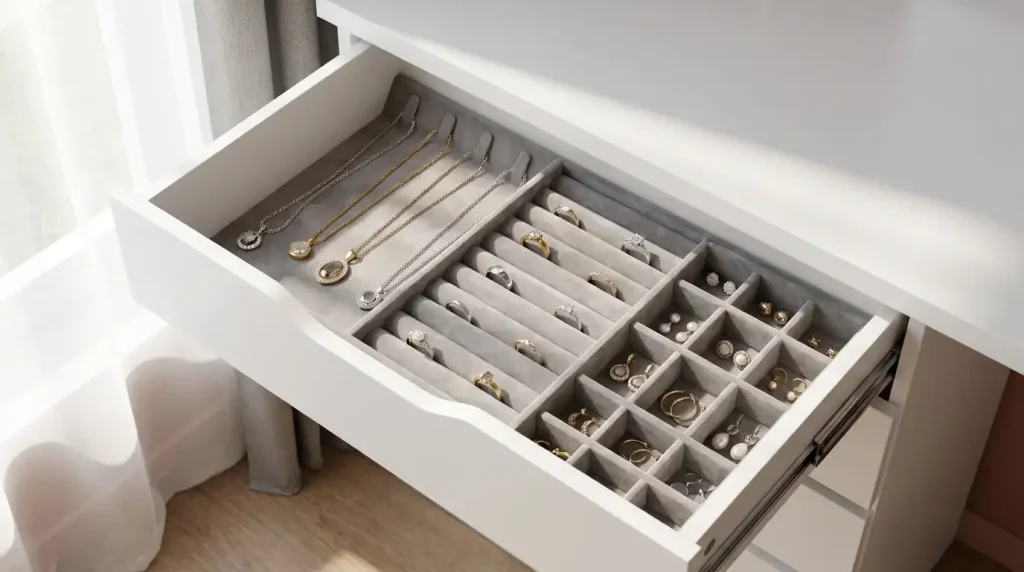
Jewellery causes more frustration than almost any other category on a dressing table, mostly because it is rarely stored with any real structure.
- Separate necklaces from everything else. Tangling almost always starts here. A hook, a small stand, or even a row of cup hooks fixed to the inside of a drawer lid keeps chains hanging freely rather than knotting together in a pile.
- Use a shallow, divided tray for rings and earrings. Small, flat compartments stop tiny items from disappearing to the back of a drawer.
- Keep fine or sentimental pieces in a soft pouch inside a drawer, rather than on open display, both for protection and to reduce daily tangling.
- Store daily jewellery separately from special occasion pieces. The items you wear constantly need to be quick to grab, while occasional pieces are better protected further back.
If your table has a lift-up mirror or hidden compartment, this is often the best spot for jewellery specifically, since it keeps pieces out of daily dust while still being close at hand.
Managing Cables if You Have an LED Mirror
An LED mirror adds real value to a dressing table, but it also adds a cable that needs a proper place, or it becomes part of the clutter rather than solving a problem.
Route the cable down the back of the mirror stand or through any built-in channel the table provides, rather than letting it trail loosely across the surface. A small cable clip or sleeve, fixed to the back or underside of the table, keeps the cable gathered and out of the way of drawers opening and closing.
If you are still deciding on a mirror, our full guide to LED mirror dressing tables covers bulb types, brightness, colour temperature, and power source in detail, including practical cable management advice specific to LED setups.
Organising an Angled or Corner Layout
A corner dressing table is organised a little differently from a straight table, since the drawers and surface follow the angle of the room rather than a simple rectangle.
Drawers in a corner unit are often wider at the front than the back, which means very long or bulky items may not sit as neatly as they would in a straight drawer. Group smaller, more flexible items in these drawers, and reserve any straight-sided storage elsewhere in the room for larger pieces.
Because a corner setup is visible from two angles as you enter the room, keep both visible sides tidy, not just the side that faces the mirror directly. Our full guide to corner dressing tables covers layout, storage shape, and styling for this format in far more depth.
Using the Stool for Extra Storage
Many dressing table stools include a lift-up seat with hidden storage underneath. This is useful extra space, but it works best with a specific type of item rather than general overflow.
Flat, soft items suit stool storage well: folded scarves, spare hair accessories, or a slim makeup bag. Avoid using it for anything you need quickly during your daily routine, since lifting the seat each time adds a genuine extra step you will likely skip after the first week.
Our guide to choosing a dressing table stool covers storage stools, seat height, and build quality if you are still deciding on the right stool for your table.
Organising a Small Dressing Table
A compact table needs a stricter version of everything covered so far, simply because there is less room for anything that is not earning its place.
- Keep only genuinely daily items on the surface. In a small space, this matters more, not less.
- Use vertical space inside drawers with stacking trays, rather than spreading items flat across limited drawer width.
- Store occasional items elsewhere in the bedroom entirely, rather than trying to fit everything into one small table.
- Choose slim, purpose-built organisers over bulky ones, since a large organiser can eat more surface space than the clutter it was meant to solve.
Our guide to the best dressing table for a small bedroom covers table shape and floor space in more depth, which pairs well with the organisation habits covered here.
Cosmetic Hygiene and Expiry: What to Actually Check
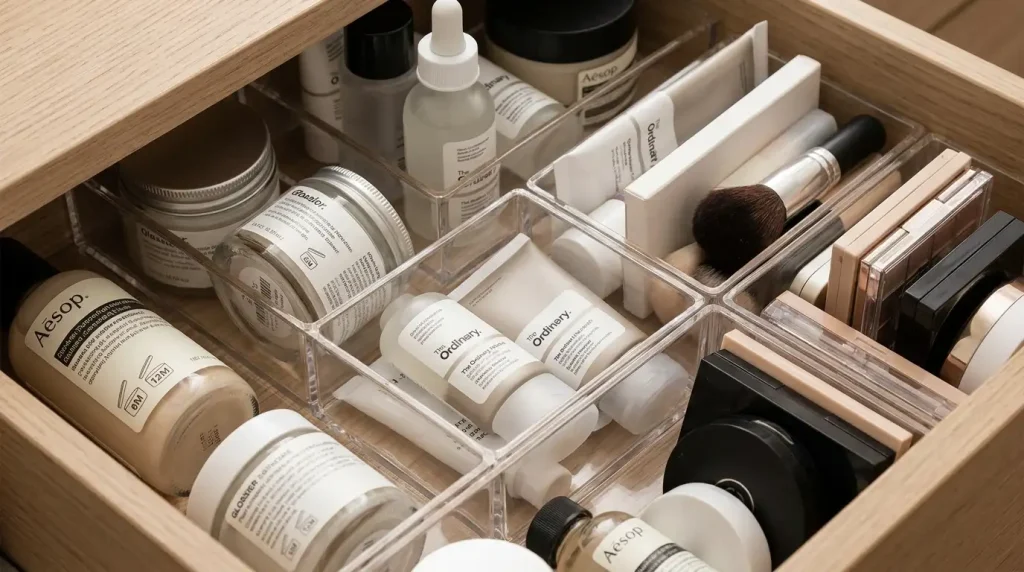
This is the part most organisations’ guides skip entirely, and it matters more than a tidy surface does.
Cosmetics carry genuine expiry information, and it is not guesswork. In the UK, cosmetic products are legally required to show either a best-before date or a Period After Opening symbol, a small open jar icon with a number of months printed inside or beside it.
According to the Cosmetic, Toiletry and Perfumery Association, the UK trade body for the cosmetics industry, this symbol tells you the period during which a product stays safe and performs as expected once opened, and it is worth checking on products you are unsure about rather than guessing based on how old you think something is.
Products past this point are not just less effective. Used makeup, particularly liquid and cream products such as foundation, mascara, and cream blush, can harbour bacteria that build up with repeated use, since each application introduces new microorganisms into the product. This is a genuine reason to be strict during your organisation session, not just a tidiness preference.
Key note: when in doubt, check the product for the open jar PAO symbol, or the batch code alongside a best-before date, rather than relying on memory for when something was first opened.
A Simple Expiry Reference
As a general guide, once opened, most cosmetic products follow rough timelines like these. Always check the product’s own PAO symbol first, where one is printed, since this varies by formulation.
| Product type | Typical period after opening |
| Mascara | 3 to 6 months |
| Liquid foundation | 6 to 12 months |
| Cream products (blush, concealer) | 6 to 12 months |
| Lipstick | 12 to 18 months |
| Powder products (eyeshadow, bronzer) | 18 to 24 months |
| Skincare with active ingredients | 6 to 12 months |
| Fragrance | Several years, stored away from heat and light |
Use this as a general guide during your sorting, alongside the PAO symbol on each specific product, rather than a strict rule for every item you own.
Building a Maintenance Routine
An organised dressing table stays organised only with a little ongoing upkeep. The good news is that this takes minutes, not hours, once the initial sort is done.
Daily. Put items back in their assigned spot after use, rather than leaving them on the surface. This single habit prevents most clutter from building up in the first place.
Weekly. Wipe the surface and mirror. Check that nothing has crept back onto the tabletop that belongs in a drawer.
Monthly. Quickly scan drawers for anything sliding out of its category, and correct it before it becomes a bigger job.
Seasonally. Do a fuller review. Check expiry dates, remove anything unused since the last review, and reassess whether your daily, weekly, and occasional groupings still reflect how you actually use the table.
Key note: the seasonal review is the one step most people skip, and it is the one that matters most. Products expire, routines change, and a system that worked six months ago often needs a small adjustment to keep working now.
A simple way to stay consistent is to tie the seasonal review to something you already do regularly, such as a change of season in your wardrobe or the clocks changing. Attaching the habit to an existing routine makes it far more likely to actually happen than relying on remembering it on its own.
Storage Accessories Worth Buying
You do not need to buy anything to organise a dressing table properly, but a few accessories genuinely help once the sort itself is done.
- Drawer dividers or small trays, sized to fit your specific drawers, to keep categories separate.
- A shallow, divided tray for jewellery, ideally with a soft lining to protect finer pieces.
- Stacking boxes for occasional items makes the most of vertical drawer space rather than spreading everything flat.
- A small dish or tray for the surface itself, to contain daily items rather than letting them spread across the whole tabletop.
Avoid buying a large, elaborate organiser before you have done the sort itself. It is far easier to choose the right size and shape of storage once you know exactly what you are storing, rather than buying first and hoping it fits.
Styling the Surface Without Cluttering It
A tidy surface does not need to be a bare one. A few styling choices add personality without undoing the work of organising in the first place.
- Choose one or two decorative pieces, rather than several competing for attention.
- Keep any styling items slightly to one side, leaving the direct area in front of the mirror clear for daily use.
- Repeat a colour or material already present elsewhere in the room, such as a brass tray if your handles or light fittings share the same tone, for a considered rather than random look.
Organising by Routine Type, Not Just Category
Category grouping works well for storage, but daily use often follows a routine rather than a category. It helps to think about your actual morning or evening sequence, not just where items technically belong.
If your routine is quick, a two-minute skincare and light makeup sequence, keep every item for that routine within arm’s reach in a single drawer or tray, in the order you actually use them. If your routine is longer, involving a full makeup application or hair styling, it is worth separating the table into a rough sequence: skincare and prep closest to hand, colour products next, and finishing or styling tools last. This small shift, organising by sequence rather than only by category, often saves more time each morning than any storage product could.
Dealing With Testers, Samples and Gifted Products
Free samples and testers accumulate quietly, and they are one of the most common sources of drawer clutter, since they rarely get used but also rarely get thrown away.
A simple rule works well here: give every sample a two-week window from the day it enters the house. Try it within that window, or it goes. Samples that sit unopened for months rarely get used at all, and small foil or trial-size packets often have a shorter shelf life than the full-size product, making them a poor long-term storage decision even if you do intend to use them eventually.
Keep any samples you do want to try in a single small pouch or tray, separate from your established daily and weekly products, so they do not dilute the organisation you have already built for the items you use regularly.
Heat, Light, and Where You Store Products
Where a product sits on or near your dressing table affects how long it stays in good condition, separate from the expiry date itself.
Avoid storing cosmetics directly beside a bulb-lit mirror, since the heat from bulbs, even LED ones, sits closer to products than a typical room light would. Fragrance in particular degrades faster with regular heat and light exposure, so a closed drawer suits it better than an open shelf beside a lit mirror. This is a small detail, but it genuinely extends how long products perform as intended, on top of the expiry guidance covered earlier.
Organising Hair Tools Safely
Hair straighteners and dryers need a specific approach, both for organisation and for basic safety around a table you use daily.
- Allow tools to cool fully before putting them away in a drawer, rather than storing them warm.
- Use a heat-resistant pouch or mat inside the drawer if you regularly put tools away shortly after use.
- Keep cords loosely coiled rather than tightly wound, since tight winding stresses the cable at the same point every time and shortens its working life.
- Store tools away from any fabric-covered stool cushion or nearby soft furnishings, particularly while a tool is still cooling down.
None of this is complicated, but it is worth building into your routine from the start, particularly if hair tools are used daily and stored close to other electrical items such as an LED mirror.
Organising a Shared Dressing Table
If more than one person uses the same dressing table, a little extra structure prevents the whole system from breaking down within weeks.
- Assign specific drawers or trays to each person, rather than a shared free-for-all space that inevitably becomes disorganised faster than a single-user table.
- Keep genuinely shared items, such as a shared hairbrush or styling tool, in a neutral middle drawer that both people can access easily.
- Agree on a simple rule for surface space, such as splitting it evenly, so the table does not end up dominated by whichever person uses it first each morning.
This matters particularly in a smaller shared bedroom, where the dressing table may be doing more work than a single-person table would in a larger room.
Common Organisation Mistakes
- Skipping the full reset and trying to tidy around existing clutter: This rarely produces a lasting result.
- Sorting by size rather than category: Items end up back in a jumbled pile within a week, even if the drawer looked tidy on the day.
- Keeping expired products out of habit: Check the PAO symbol rather than assuming a product is still fine because it looks unchanged.
- Overloading the surface with daily items that would fit better in a drawer: A crowded surface makes the whole table look untidy, even if the drawers themselves are well organised.
- Buying storage accessories before sorting: It is easy to buy the wrong size or shape without first knowing exactly what needs to be stored.
- Skipping the seasonal review: A system that worked when first set up drifts out of date without a periodic check.
Quick Checklist Before You Start
- Remove everything from the table and drawers before sorting anything.
- Sort into four piles: daily, weekly, occasional, never.
- Assign daily items to the surface or top drawer, and work outward from there.
- Group drawer contents by category, and add dividers where needed.
- Check expiry dates and PAO symbols on anything you are unsure about.
- Set a simple weekly and seasonal maintenance habit, and stick to it.
Colour-Coding and Labelling Systems
For anyone who prefers a more visual system, colour-coding or simple labelling can reinforce the category grouping covered earlier, particularly useful in a shared table or a table with several similar-looking drawers.
A small label inside each drawer, or on the underside of a tray, stating what belongs there, takes a few minutes to set up and makes it far easier to put things back in the right place without thinking, which is the real goal of any organisation system.
Colour-coded trays, one colour per category such as skincare, makeup, and hair, work particularly well for households where more than one person uses the same table, since the visual cue reduces the chance of items drifting back into the wrong drawer over time.
This step is optional. A well-sorted table with clear, honest categories works perfectly well without labels. But for anyone who has tried the four-pile sort before and watched it slowly unravel within a month, a simple label is often the missing piece that makes the system stick.
Frequently Asked Questions
How often should I fully reorganise my dressing table?
A full reset once or twice a year is usually enough, alongside a quick weekly wipe and put-away habit in between. A seasonal review is the best time to check expiry dates and adjust your daily, weekly, and occasional groupings.
What is the best way to stop necklaces from tangling?
Store them separately from other jewellery, ideally hanging rather than piled together. A hook, small stand, or a row of cup hooks fixed inside a drawer lid all work well.
Should I throw away makeup even if it still looks fine?
Check the Period After Opening symbol on the packaging rather than judging by appearance alone. Products can harbour bacteria and lose effectiveness well before they show any visible signs of ageing.
How do I organise a dressing table with very few drawers?
Prioritise daily and weekly items inside the drawers you do have, and store occasional items elsewhere in the bedroom. Vertical stacking trays also help make the most of limited drawer space.
What should never go on the dressing table surface?
Anything used less than daily. Full makeup collections, hair tools once cooled, and occasional jewellery all belong in a drawer rather than on permanent display.
Do corner dressing tables need a different organisation approach?
Slightly. Drawers in a corner unit are often wider at the front than the back, so bulky or long items may not fit as neatly. Group smaller, more flexible items here, and store larger pieces elsewhere in the room.
Is it worth buying an LED mirror just to help with organisation?
Not purely for organisation, but a well-lit mirror does make it easier to see what you are doing while sorting products, and it helps you spot when something needs cleaning or replacing sooner than dim lighting would.
How do I stop testers and samples from building up in my drawers?
Give each sample a two-week window to be tried after it enters the house. If it has not been used within that time, it is unlikely to be used at all, and it is better removed than left to take up drawer space indefinitely.
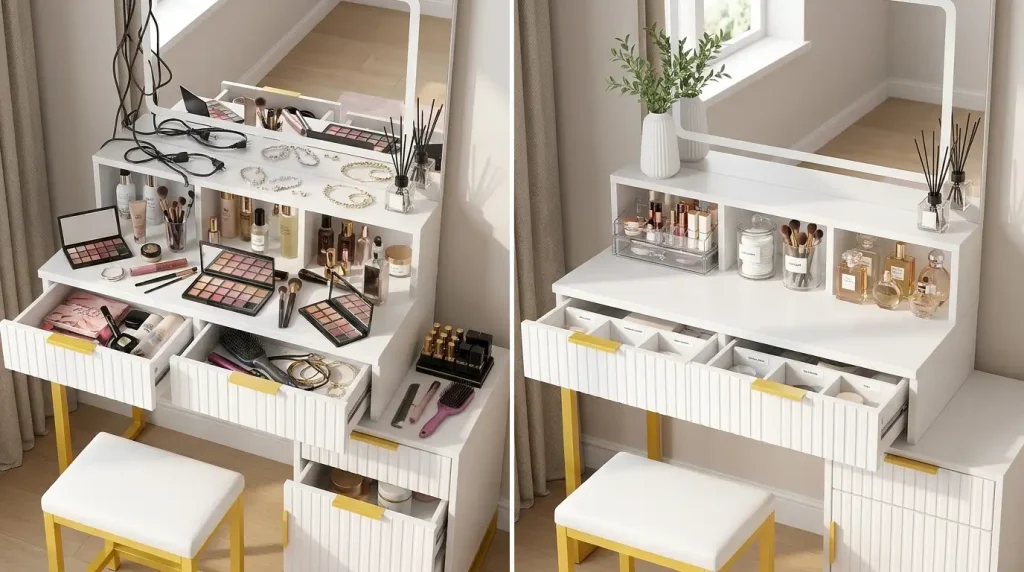
A System That Actually Lasts
An organised dressing table is not a one-off achievement. It is a small system, built once properly and maintained in minutes each week. Reset fully, sort honestly, group by category, and check expiry dates rather than guessing. The result is a table that stays useful, not just tidy, for a single photo.
For the fuller picture on choosing or upgrading the table itself, our dressing table with mirror buying guide, our LED mirror guide, our corner dressing table ideas, and our dressing table stool checklist all cover the wider decision in more depth. When you are ready to browse options with the storage you actually need, explore the full dressing table range at Kosy Koala.
Recommended Supporting Articles
- Dressing Tables With Mirror: The Complete UK Buying Guide
- Best Dressing Table for a Small Bedroom
- LED Mirror Dressing Tables Explained: Bulbs, Brightness & Power
- Dressing Table With Stool: What to Check Before You Buy
- Corner Dressing Tables: Ideas for Awkward Bedroom Spaces
- Dressing Table vs Vanity Desk: Is There Really a Difference?
About the author
This article was written by the Kosy Koala team. We design and source bedroom furniture for UK homes, with a focus on practical details that actually matter once a piece is in your room. Have a question about any product on this page? Get in touch through our About Us page.


 Dining Tables
 Dining Chairs

 Bed Frames
 Mattresses
 Bunk Beds
 Sofa & Sofa Beds


