

Blog
Dressing Table vs Vanity Desk: Is There Really a Difference?

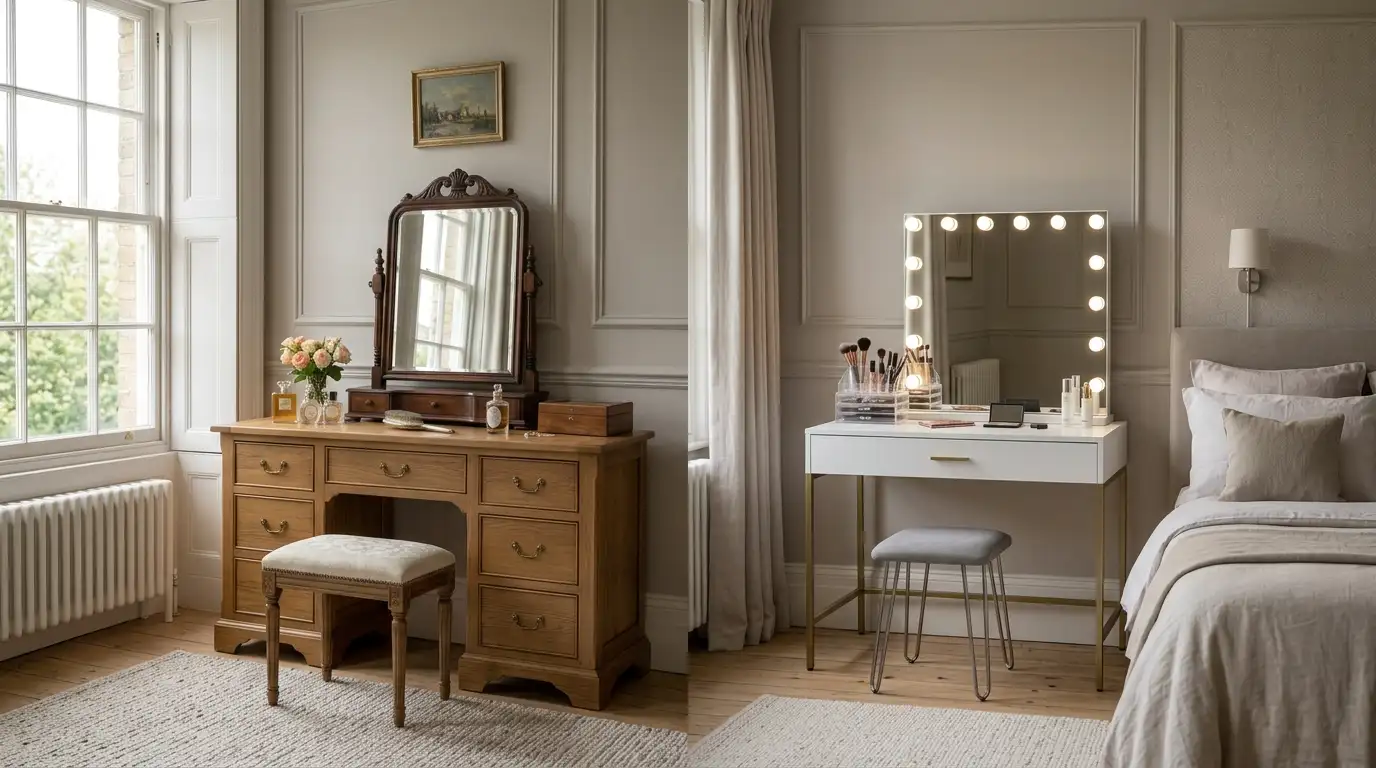
You search for a dressing table. Half the results say vanity desk instead. Some retailers use both terms on the same product page. This is confusing, and it is a fair question to ask. Is there an actual difference, or is it just two names for the same thing?
The honest answer is both. There is a real historical difference. But in today’s UK furniture market, the terms overlap so heavily that the label on a product page tells you very little on its own. This guide explains where each term came from, what genuinely still separates them, and what actually matters when you are choosing a piece for your own bedroom.
If you have already decided this is the right category of furniture for you, our complete dressing table with mirror buying guide covers mirror type, height, and storage in full. This guide focuses purely on the terminology question and how to buy with confidence regardless of which word a listing uses.
Quick answer:
A dressing table traditionally means a larger, storage-focused piece of bedroom furniture, often with a separate or attached mirror, rooted in British furniture history. A vanity desk traditionally means a smaller, more compact grooming station, closely associated with the Hollywood-style lit mirror popularised in America. In practice, most furniture sold in the UK today blurs this distinction completely. What matters far more than the name is the actual mirror type, storage capacity, and footprint of the specific product you are looking at.
Where These Terms Actually Come From
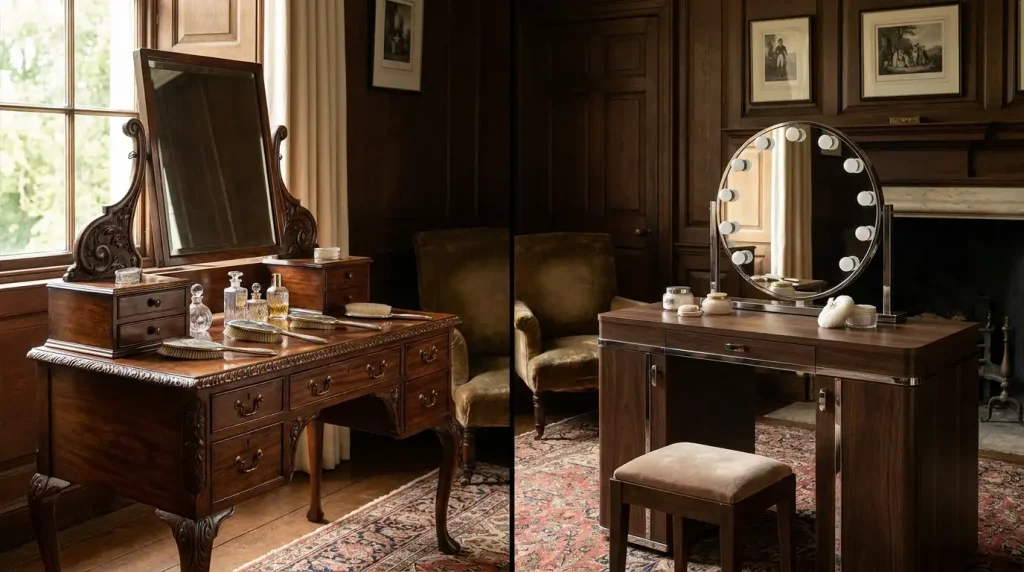
Understanding the history helps explain why the confusion exists at all.
The dressing table has deep roots in British furniture. The Victoria and Albert Museum’s furniture collection traces the earliest form of this piece back to the French toilette table, named after the toile, or linen cloth, laid across the top to hold a mirror, brushes, and other grooming items. English cabinet makers adapted the design through the 18th and 19th centuries, and it became a fixture of British bedrooms, often built with generous drawer space and designed to double as a general-purpose writing or grooming surface, not a beauty station alone.
The vanity table, or vanity desk, is a more recent term, closely tied to American design in the early 20th century. It gained real popularity during Hollywood’s golden age, when actresses used small, brightly lit mirrors backstage to check their makeup under stage lighting. This is where the now-familiar Hollywood mirror, ringed with individual bulbs, originally comes from. The vanity table was built around that mirror first, with storage as a secondary consideration.
So historically, the difference was genuine. A dressing table was storage-first, general-purpose, and rooted in British tradition. A vanity was mirror-first, beauty-focused, and rooted in American glamour. Today, most products borrow from both, which is exactly why the terms have become so interchangeable in modern retail.
A Word of Warning: Vanity Desk vs Vanity Unit
Before going further, there is a UK-specific mix-up worth clearing up properly, since it causes genuine confusion during a search.
A vanity desk, sometimes called a vanity table, is bedroom furniture. It is a seated grooming station with a mirror, exactly what this article is about.
A vanity unit is a completely different product. It is a bathroom fitting, a cabinet built around a sink, designed to hide pipework and hold bathroom storage underneath a basin. It is not built for seated use, has no dressing table mirror, and is made from moisture-resistant materials suited to a bathroom rather than a bedroom.
Key note: If you are shopping online and searching for “vanity” alone, double-check the category before you buy. A UK retailer selling bathroom fittings and one selling bedroom furniture can both use the word “vanity” for entirely different products, and it is easy to land on the wrong one without noticing.
What a Dressing Table Traditionally Means
In its classic form, a dressing table is built around three things: a flat tabletop, a set of drawers, and a mirror, either integrated or standing separately on top. The emphasis has always sat on storage and versatility, giving you somewhere to keep cosmetics, jewellery, hairbrushes and, historically, correspondence and personal items well beyond beauty products alone.
This versatility is part of why dressing tables remain so popular in British bedrooms, specifically. They are rarely used for one job only. A dressing table doubles easily as a spot to write a card, charge a phone overnight, or simply sit and think for a few quiet minutes, alongside its main role as a grooming station.
What a Vanity Desk Traditionally Means
A vanity desk, in its classic form, is smaller and more tightly focused. The mirror is the centrepiece, usually lit, and the surface is designed around a seated beauty routine specifically, rather than general use. Storage tends to be more compact, often a drawer or two, sized for makeup and skincare rather than a broader range of personal items.
This makes a genuine vanity desk a strong choice for anyone whose main use is a focused daily makeup or skincare routine, without needing the piece to double as general bedroom storage or a desk substitute.
Do the Differences Still Hold Up Today?
Not really, and this is the honest answer most buying guides avoid giving directly.
Walk through any UK furniture retailer’s dressing table section, and you will find plenty of compact, Hollywood-lit mirror sets labelled as dressing tables. Search for vanity desk, and you will find large, storage-heavy pieces that would have been called dressing tables a generation ago. Retailers use whichever term performs better in search, rather than applying the historical distinction consistently.
This means the label on a product listing tells you very little about what you are actually buying. The product’s actual specifications, mirror type, drawer count, and tabletop size do the real work of telling you whether a piece suits your routine, regardless of which word sits in the title.
Practical Differences: What Still Separates Products Today
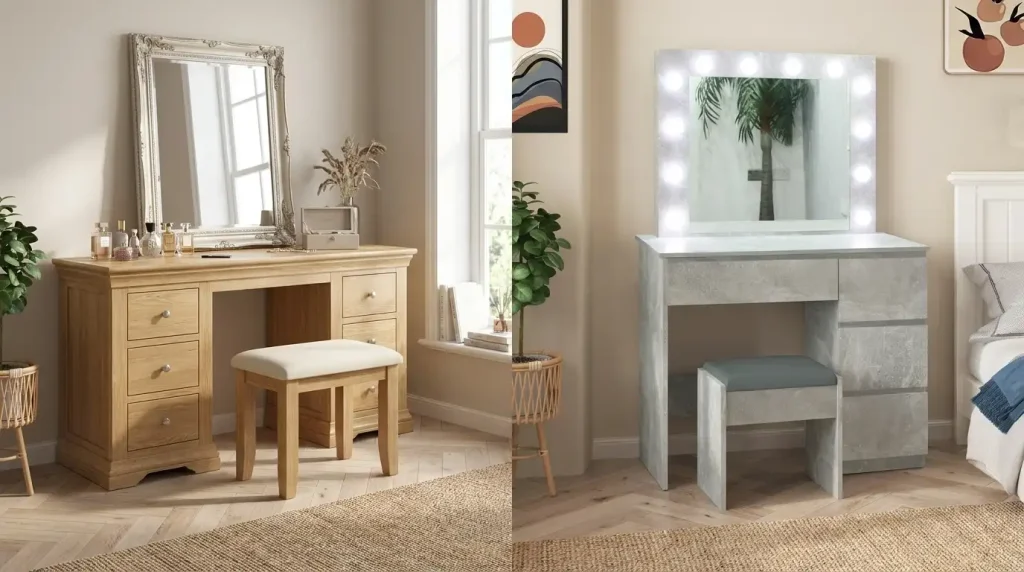
While the terms themselves have blurred, a few practical tendencies do still show up more often under one label than the other, worth knowing as a general pattern rather than a strict rule.
| Feature | More common under “dressing table” | More common under “vanity desk” |
| Storage | Multiple drawers, sometimes a side cabinet | Fewer drawers, more compact |
| Mirror | Fixed, flip-up, or tri-fold, sometimes separate | Hollywood bulb-lit, integrated |
| Footprint | Larger, sometimes 90cm plus wide | Smaller, often under 80cm wide |
| Secondary use | Doubles as a desk or general surface | Focused purely on grooming |
| Typical UK price | Wider range, roughly £80 to £300 | Often £60 to £200 for compact sets |
Treat this as a general tendency in how products are marketed, not a rule you can rely on for any individual listing. Always check the actual specification rather than assuming from the name alone.
Mirror Style: Where the Real Difference Often Sits
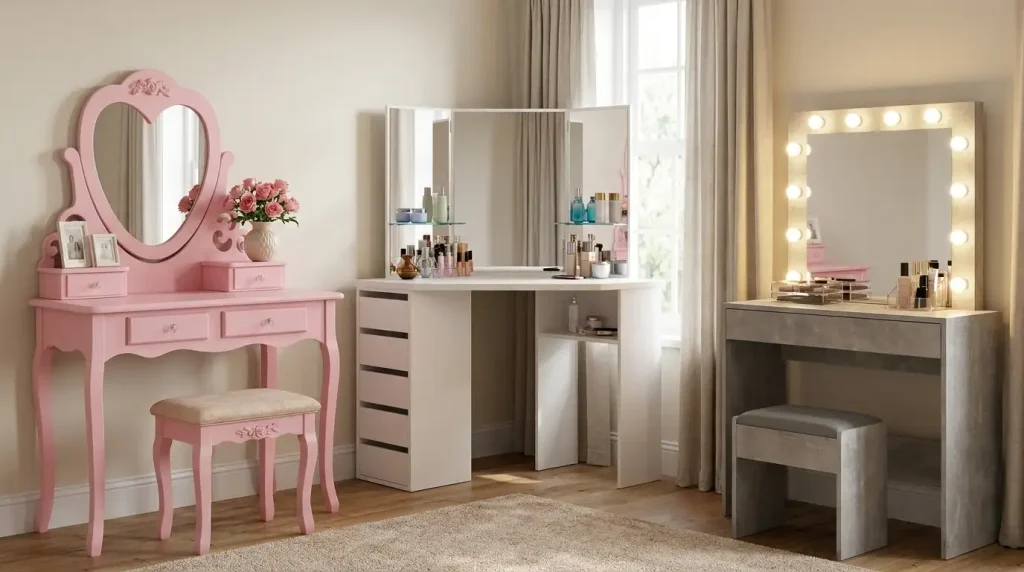
If there is one detail that still tracks reasonably closely with the traditional distinction, it is the mirror. Products marketed as vanity desks lean more often toward the Hollywood bulb-lit format, following that original American design lineage directly. Products marketed as dressing tables show more variety: fixed mirrors, flip-up lids, and tri-fold designs all appear regularly.
Our full breakdown of mirror types covers the practical differences between these styles in depth, and our dedicated guide to LED mirror lighting explains bulb count, brightness, and colour temperature if a lit mirror is your main priority, regardless of what the table itself is called.
Storage: The Biggest Practical Difference
If you are choosing based on genuine day-to-day function rather than label, storage capacity is usually the most reliable signal of which category a piece actually belongs to in practice.
A table with three or more drawers, or additional shelving and side cabinets, functions as a traditional dressing table regardless of what the listing calls it. A table with one shallow drawer or a small mirror well functions as a traditional vanity desk, again, regardless of the label.
Key note: count your daily-use items before deciding how much storage you actually need. If you use fewer than ten products each morning, a compact, vanity-style table is genuinely enough. If your collection is larger, prioritise drawer count over the name on the listing.
Size and Footprint
Footprint is the other genuinely reliable difference. Traditional dressing tables tend to run wider, often 90cm or more, to accommodate the extra storage. Vanity-style pieces tend to sit under 80cm wide, designed to fit into a tighter corner of the room without dominating it.
This matters most in a small UK bedroom, where every centimetre of wall space counts. Our guide to the best dressing table for a small bedroom and our guide to corner dressing table ideas both cover how to make the most of a compact footprint, whichever term the piece itself is sold under.
Height and Seating
Both formats are generally built to the same seated height range, typically 74 to 79cm at the tabletop, paired with a stool around 44 to 50cm. This detail has not diverged between the two terms in practice, since both are designed around comfortable seated use.
If you are sourcing a table and stool separately rather than buying a matched set, our guide to choosing a dressing table stool covers height matching and build quality in more depth, and applies equally whether the table itself is labelled a dressing table or a vanity desk.
Style and Era
Style is where the historical roots still show through most clearly, even now. Pieces marketed as vanity desks lean toward Hollywood glamour, gold or brass detailing, and a more overtly decorative mirror frame. Pieces marketed as dressing tables span a wider range, from traditional wood finishes to minimalist modern designs, reflecting the format’s broader, less beauty-specific history.
Neither is objectively better. The right choice depends on which visual direction suits your bedroom, not which historical lineage the piece is more faithful to.
Price Expectations in the UK
Price ranges overlap considerably between the two terms, but general patterns still show up. Compact vanity-style sets, with a smaller footprint and simpler storage, often sit toward the lower to middle end of the market, roughly £60 to £200. Larger dressing tables, with more drawers and additional features such as folding mirrors or side cabinets, span a wider range, often £80 to £300 or beyond for premium materials.
As with every other comparison in this guide, treat this as a general tendency rather than a fixed rule. The specific features of a product, not its label, ultimately determine where it sits in that range.
Does It Matter Which One You Buy?
In practical terms, no. What matters is whether the specific product in front of you, regardless of its name, suits your room, your storage needs, and your daily routine.
This is genuinely good news for anyone who has been stuck trying to decide between the two terms before even starting to shop. Instead of searching for the “correct” category, search using the features that actually matter to you: mirror type, drawer count, footprint, and finish. The label becomes far less important once you approach the decision this way.
A Simple Decision Framework
If you are still unsure which type of piece suits you, work through these questions in order.
- How many products do you use daily? Fewer than ten points toward a compact, vanity-style table. More than that points toward a dressing table with several drawers.
- Will the table double as anything else, such as a desk or general storage? If yes, lean toward a dressing table’s broader footprint and storage.
- Is a lit mirror a priority for your routine? If yes, look specifically for Hollywood bulb or LED features, which appear more consistently under the vanity desk label, though increasingly on dressing tables too.
- How much wall space do you actually have? Measure first, and let that measurement, not the product name, guide your search.
- What style suits your existing bedroom? Choose based on the finish and detailing that match the room, rather than the terminology used in the listing.
Whichever combination of answers you land on, focus your search on those specific features rather than the category label itself.
Regional Naming Differences Worth Knowing
Terminology also shifts depending on where a product is manufactured or marketed, which adds another layer to the confusion for UK shoppers browsing internationally listed furniture.
In the United States, “vanity table” is by far the more common term, reflecting the format’s Hollywood-era origins there. In the United Kingdom, “dressing table” remains the more traditional and widely recognised term, particularly among established UK furniture retailers, though “vanity desk” has grown noticeably in search popularity in recent years, partly driven by social media trends around makeup routines and lit mirrors.
This matters practically if you are comparing listings across different retailers. A product manufactured for the international market may default to “vanity” in its title even if it is functionally closer to a traditional British dressing table in size and storage. Do not assume the name reflects the product’s country of origin, era of design, or feature set. Check the actual specification every time.
How UK Retailers Typically List These Products
Understanding how retailers approach these terms in practice can save you time when searching.
Most UK furniture retailers, including larger high street and online names, list products under whichever term ranks better in search results for that specific style. A compact, bulb-lit set is more likely to appear under “vanity” simply because that term now drives more search traffic for that particular style of mirror. A larger, multi-drawer piece is more likely to stay under “dressing table,” since that remains the more established term for bigger, storage-focused furniture in the UK market specifically.
This is a marketing decision, not a strict category rule. It means the same physical product could plausibly be listed as either term by two different retailers, depending on their own search strategy. Filtering by feature, mirror type, drawer count, footprint, rather than by category name, remains the most reliable way to compare products across multiple UK retailers at once.
Common Misconceptions
- “A vanity desk is always smaller.” Not necessarily. Some vanity-labelled products, particularly matched sets with a stool, rival dressing tables in overall footprint.
- “A dressing table never has lighting.” Increasingly untrue. Many dressing tables now include LED or bulb-lit mirrors as standard, blurring this distinction further.
- “Vanity desk and vanity unit are the same thing.” As covered earlier, these are entirely different product categories. One is bedroom furniture, the other is a bathroom sink cabinet.
- “The terms are strictly defined in UK retail.” They are not. Retailers use both terms fairly loosely, often based on search trends rather than any formal distinction.
Frequently Asked Questions
Is a vanity desk smaller than a dressing table?
Often, but not always. Traditional vanity desks tend toward a smaller footprint, but many modern products labelled as vanity desks include full storage and a stool, closing the size gap considerably.
Can I use the terms interchangeably when shopping?
For most UK retailers, yes. The terms overlap heavily in modern furniture listings. Focus on the actual product specification, mirror type, drawer count, and dimensions, rather than the category name.
What is the difference between a vanity desk and a vanity unit?
A vanity desk is bedroom furniture, a seated grooming station with a mirror. A vanity unit is a bathroom fitting built around a sink. They are entirely different products despite the similar name.
Which is better for a small bedroom, a dressing table or a vanity desk?
Generally, a compact vanity-style table or a dedicated small-footprint dressing table, such as a corner or slimline design, rather than a large multi-drawer piece. Our guide to the best dressing table for a small bedroom covers this in more depth.
Do dressing tables and vanity desks use the same size stool?
Generally yes. Both formats are built around a similar seated height range, so stool sizing follows the same principles regardless of which term the table itself is sold under.
Choosing by Function, Not by Name

The historical difference between a dressing table and a vanity desk is real, but it has faded almost completely in modern UK retail. Chasing the “correct” term will not get you closer to the right piece of furniture. Checking the mirror type, storage capacity, footprint, and finish will.
For the fuller picture on choosing between mirror types, lighting, and storage, our dressing table with mirror buying guide covers the full decision in depth. Once your table has arrived, our guide to organising a dressing table helps you make the most of whatever storage you end up with, regardless of what the listing called it.
Which Kosy Koala Range Actually Fits You
Rather than choosing based on the word “dressing table” or “vanity” alone, match the feature that matters most to you.
If a lit mirror and a compact footprint matter most, look at our Hollywood dressing table with mirror and stool, which delivers the classic vanity-style lit mirror in a 42cm deep footprint. If storage is the priority, our corner dressing table with drawers and a storage shelf leans firmly toward the traditional dressing table format, with genuine multi-drawer capacity alongside the mirror.
Browse the full range and compare by feature rather than category at Koskyoala dressing tables.
Recommended Supporting Articles
- Dressing Tables With Mirror: The Complete UK Buying Guide
- Best Dressing Table for a Small Bedroom
- LED Mirror Dressing Tables Explained: Bulbs, Brightness & Power
- Dressing Table With Stool: What to Check Before You Buy
- Corner Dressing Tables: Ideas for Awkward Bedroom Spaces
- How to Organise a Dressing Table (Storage Tips That Work)
About the author
This article was written by the Kosy Koala team. We design and source bedroom furniture for UK homes, with a focus on practical details that actually matter once a piece is in your room. Have a question about any product on this page? Get in touch through our About Us page.


 Dining Tables
 Dining Chairs

 Bed Frames
 Mattresses
 Bunk Beds
 Sofa & Sofa Beds


