

Blog
Dining Table and Chairs Sets: The Complete UK Buying Guide

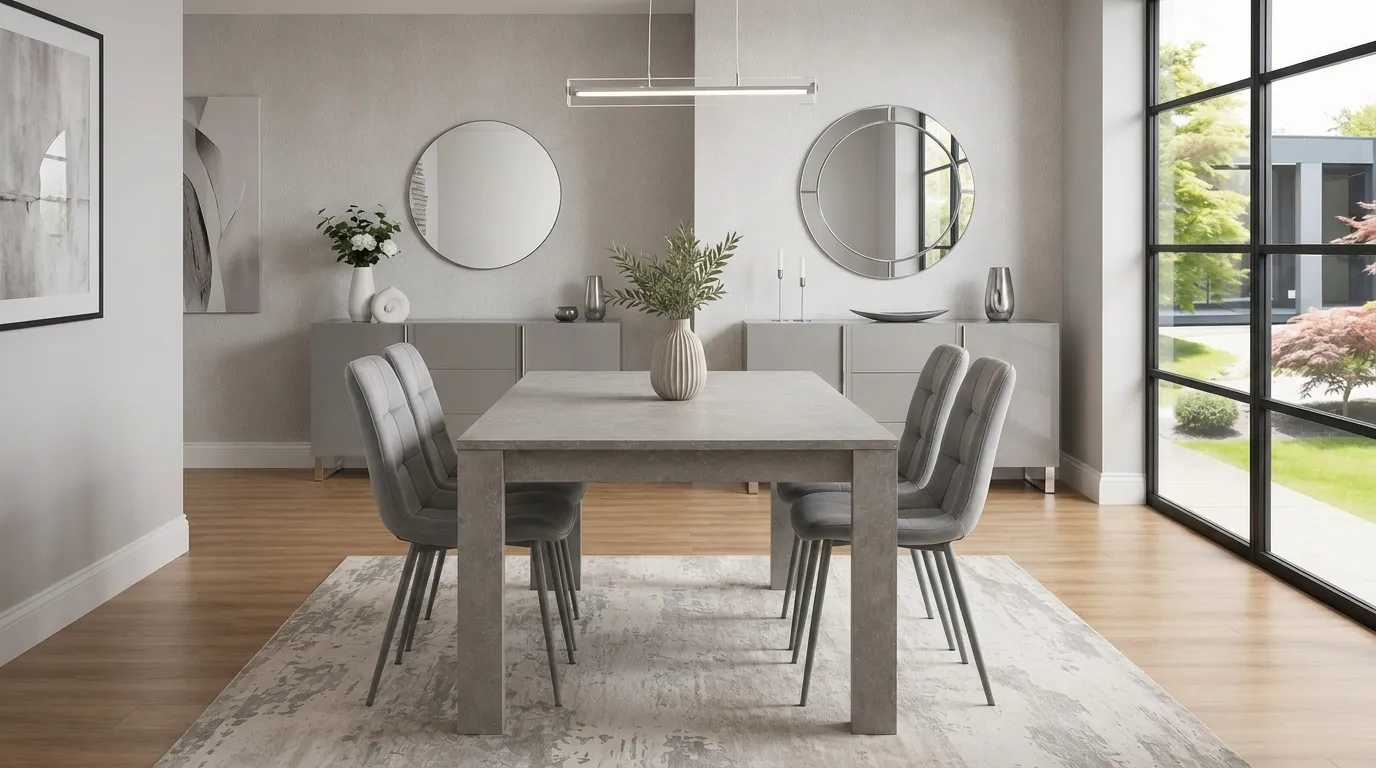
A dining table and chairs set is one of the biggest purchases in a home. It sits in the middle of the room. Everyone sees it every day. Get it right, and it becomes the place where meals, homework, and conversations all happen. Get it wrong, and you feel it every single time you sit down.
This guide walks through everything that actually matters. Room size and seating. Table shape and material. Chair comfort and height. Build quality and safety. By the end, you will know exactly what to check before you buy, and you will be able to shop our dining table and chairs range with real confidence rather than guesswork.
Quick answer:
The right dining table and chairs set comes down to five decisions, in this order. First, how many people do you need to seat regularly, not just on special occasions? Second, how much floor space do you actually have, including room for chairs to be pulled out and walked past? Third, the table shape that suits that space: round, rectangular, or square. Fourth, a material that matches your household, easy-clean surfaces for busy family life, or a more considered finish for a quieter dining room. Fifth, chairs matched to the table’s height for genuine comfort, not just a matching look. Get those five right, and almost any style will serve you well for years.
What Counts as a Dining Table and Chairs Set
A dining table and chairs set pairs a table with a matching number of chairs, sold together as one purchase. This removes a genuine headache: matching finish, height, and proportion yourself across two separate purchases. The table and chairs are designed together, which means the seat height, table height, and overall scale are already coordinated before the set reaches your home.
This differs from buying a table and chairs separately, which gives more flexibility but adds risk. A chair bought from a different retailer might sit slightly too low or clash in tone with a table bought elsewhere. For most buyers, particularly anyone furnishing a room from scratch, a matched set removes that risk entirely.
Sets typically include four or six chairs, sometimes paired with a bench instead of one side of chairs. Our 4 seater dining sets and larger 6-seater options cover most household sizes, with a full range of shapes and materials to suit different rooms.
How Many Seats Do You Actually Need
This is the first decision, and it is worth being honest about rather than optimistic. Count the people who eat at the table on a normal week, not the number you would need for a big family gathering twice a year.
A 2-to 4-seater table suits a couple, a small family, or a compact kitchen diner where floor space is limited. A 4-to-6-seater table suits most family households, giving room for everyday meals plus the occasional guest. A 6-seater or larger table suits larger families or households that regularly host, where a bigger table gets genuine daily use rather than sitting mostly empty.
Key note: If you occasionally need more seats than your everyday household requires, an extendable table solves this without permanently taking up the floor space of a larger fixed table. We cover this trade-off in more depth further down this guide.
Measuring Your Dining Space Properly
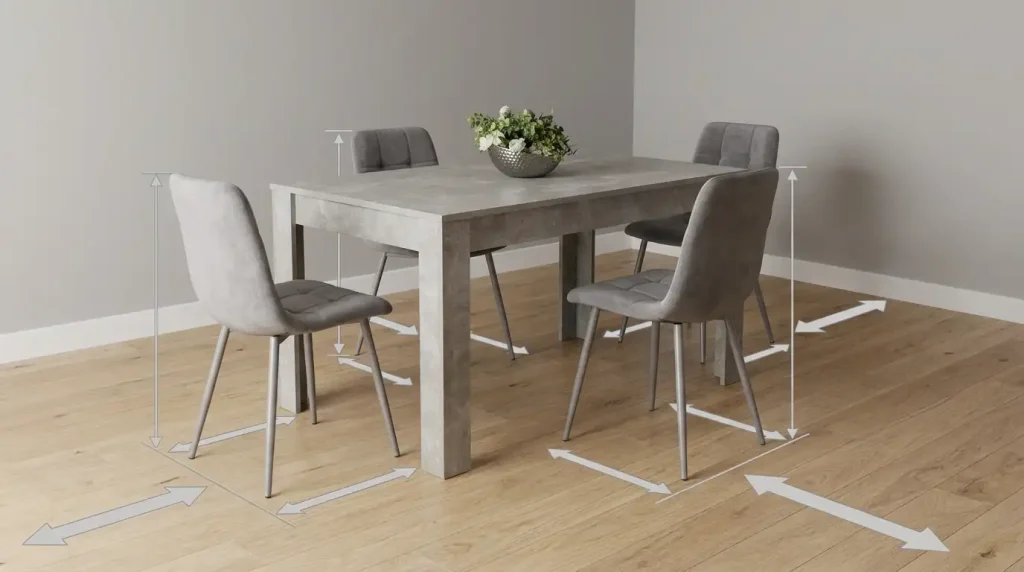
This is the step most buyers rush, and it causes more disappointment after delivery than any other mistake on this list.
The rule that avoids the problem: table footprint, plus at least 90cm of clear floor space around every side used for seating. This is not padding. It is the space a chair needs to be pulled out fully, and for someone to sit down, stand up, and walk behind a seated guest without squeezing past.
|
Table seats |
Minimum room length needed (table plus clearance) | Minimum room width needed |
| 4 seats (rectangular) | 340cm | 280cm |
| 6 seats (rectangular) | 400cm | 280cm |
| 4 seats (round) | 280cm |
280cm |
Before you shop, measure properly:
- Measure the full length and width of the room, or the section of an open-plan space you plan to dedicate to dining.
- Mark out the table’s actual footprint using tape or paper on the floor, rather than judging by eye from a product photo.
- Add 90cm on every side where a chair will be used, and check this against any nearby walls, doorways, or kitchen units.
- Check for obstructions at chair height specifically, such as a radiator, skirting board, or a door that swings into the space.
- If the table sits near a doorway used regularly, allow extra clearance on that side so people are not squeezing past a seated guest during a busy family meal.
For context on how much room UK homes typically offer for this kind of space, the government’s own Nationally Described Space Standard sets minimum floor areas for new homes, though it does not prescribe dining room size specifically. In practice, this means many UK dining spaces, particularly in flats and terraced housing, are smaller than furniture photography tends to suggest, which is exactly why measuring your own room properly matters more than following a generic size guide.
Table Shape: Round, Rectangular, and Square
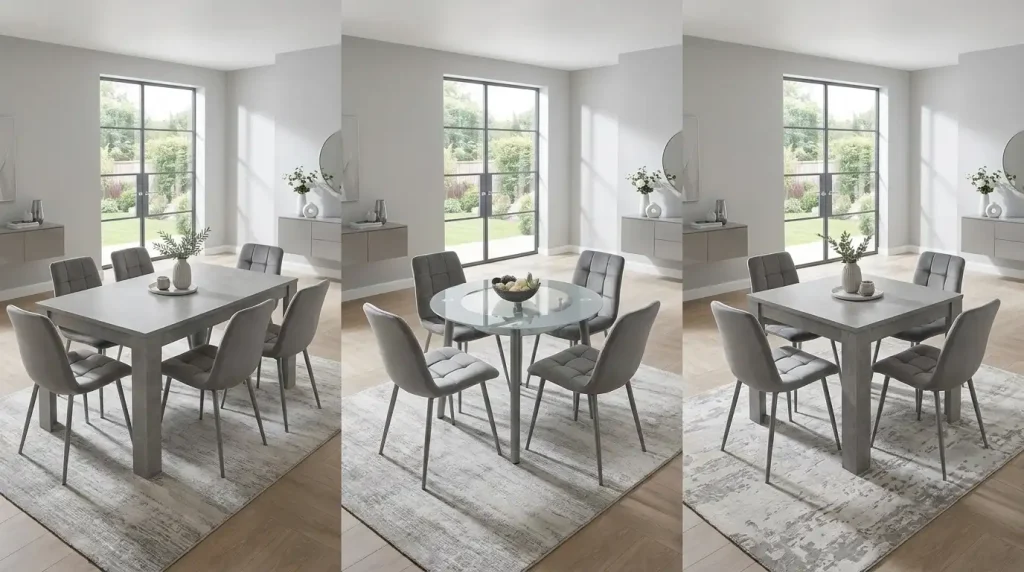
Shape affects both how many people comfortably fit and how the table feels to use day to day, not just how it looks in the room.
Rectangular tables are the most common choice for UK dining rooms, and for good reason. They make the most efficient use of a long, narrow room, and they scale easily from four seats up to six or more. Our dark grey dining table set with four velvet chairs and a bench is a good example of this format at 140cm long, comfortably seating six with the bench included.
Round tables suit smaller or more square-shaped rooms particularly well, since they have no corners to work around and every seat feels equally included in the conversation, with no head of the table. They work best for four seats, since adding more quickly requires a large diameter that can dominate a small room. Our round glass dining table with four chairs at 90cm in diameter is a strong fit for a compact kitchen diner or apartment dining space.
Square tables suit a genuinely square room and work particularly well for smaller households of two to four, where a round or rectangular shape would leave awkward gaps in the room’s layout.
How Much Table Length Do You Need Per Seat
Beyond overall room clearance, it helps to know how much table edge each seated person actually needs, since this is what determines whether a table comfortably fits the number of chairs it is sold with.
As a general rule, allow 60cm of table edge per seat, with a little extra at the ends of a rectangular table for anyone seated there. This gives enough elbow room to eat comfortably without bumping the next person’s arm throughout the meal.
| Table length | Comfortable seats along the long sides |
| 100cm | 2 per side |
| 120 to 140cm | 2 per side, more relaxed spacing |
| 150 to 160cm | 3 per side, or 2 with generous spacing |
| 180cm+ | 3 per side comfortably |
This is why a table advertised as seating six sometimes feels tight in practice. Always check the table’s actual length against this rule, rather than assuming the advertised seat count alone tells you everything about comfort.
Material Guide: What Each Option Actually Offers
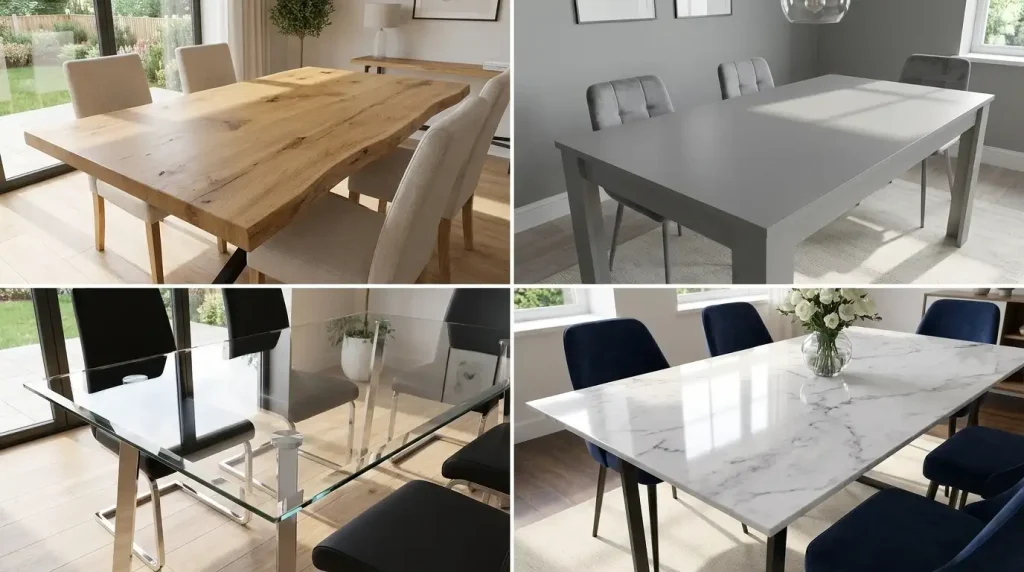
Material affects durability, cleaning, and price more than most buyers expect before living with a table day to day.
Solid wood and wood-effect finishes bring warmth and character to a dining room and generally hold up well to years of daily family use. Our dining table with a curved live-edge wooden top shows this finish well, pairing natural grain with a more contemporary hairpin leg design.
MDF with a melamine laminated finish is the most common construction in the mid-price UK market. It gives a smooth, easy-to-clean surface at a lower price point than solid wood, and resists everyday marks well, making it a practical choice for a busy family kitchen. Our dining table with a striking white and black finish uses this construction, with a UV-painted surface designed for daily wipe-down cleaning.
Glass tables bring a light, contemporary look and tend to make a smaller dining space feel more open, since the tabletop does not visually block the room the way a solid material can. Our round glass dining table pairs a tempered glass top with slim chrome legs for exactly this effect.
Marble-effect finishes, usually a printed or laminated surface over MDF rather than genuine stone, give a premium look at a fraction of the cost and weight of real marble, without the staining risk that natural stone carries in daily kitchen use.
Glass Dining Tables and Safety
If you are considering a glass table, it is worth understanding the safety standard behind it, since not all glass is built the same way.
Genuine dining table glass should be tempered, also called toughened, rather than standard annealed glass. According to Glass Helper’s UK safety guide, toughened glass sold for furniture use in the UK should meet BS EN 12150, the British standard for thermally toughened safety glass, which is designed to break into small, blunt fragments rather than sharp shards if it is ever broken. This is a meaningful safety difference, particularly in a household with children.
Key Note: When buying a glass dining table, check that the listing specifically states the glass is tempered or toughened, rather than assuming this by default. Reputable UK retailers will state this clearly in the product description.
Chair Types: Fabric, Velvet, Faux Leather, Wood, and Plastic
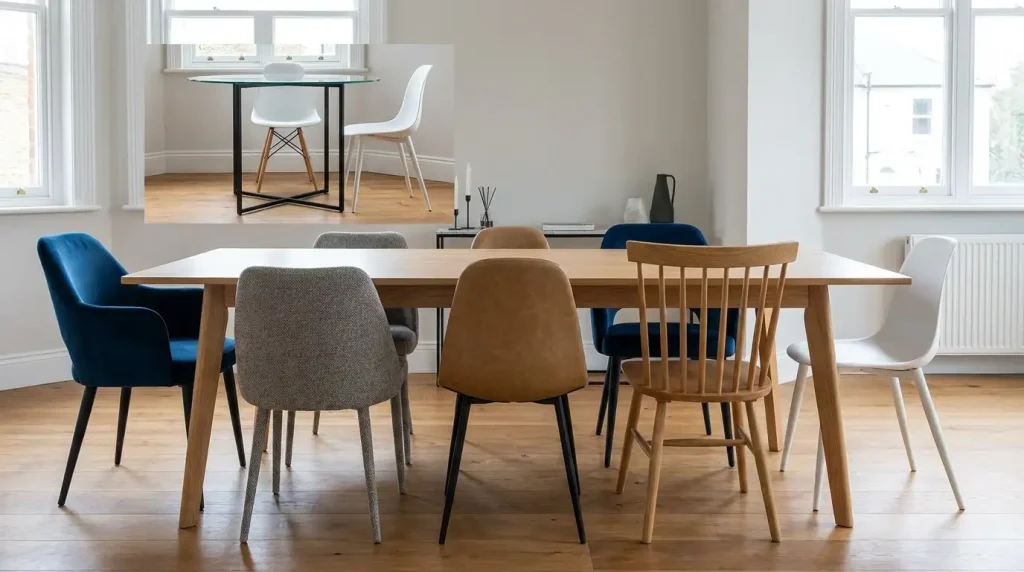
The chairs matter just as much as the table, since they are what you are actually sitting on for every meal.
Velvet and fabric-upholstered chairs add real comfort and a softer, more elevated look to a dining room. Our set of four velvet chairs with tufted backs suits a dining room prioritising comfort and a warmer aesthetic, though fabric needs slightly more regular care around spills than a wipeable surface.
Faux leather chairs offer a genuine middle ground. They wipe clean easily, resist everyday spills far better than fabric, and hold their shape well over time. Our black faux leather chairs with a diamond-stitched pattern suit a household that wants a smart look without the maintenance a fabric seat demands.
Wood and plastic chairs are the easiest to keep clean of all, with no upholstery to stain or wear. Our mixed colour plastic chairs suit a busy household with young children, where daily spills are simply part of family life, and a fully wipeable seat genuinely saves time.
Chair and Table Height: Getting the Match Right
This is the detail that separates a comfortable dining set from one that quietly bothers you every time you sit down, and it rarely gets the attention it deserves in a typical buying guide.
The general rule mirrors what works for any seated furniture: table height, minus chair seat height, should sit around 28 to 30cm. This gives your knees clearance under the table while keeping your arms at a natural, comfortable height for eating.
Most UK dining tables sit at 75 to 76cm tall, paired with a chair seat height of around 44 to 46cm. This is the range you will see across the great majority of standard dining sets, including our own range, where table height typically runs 75 to 76cm and chair seat height sits around 44 to 45cm.
Key Note: If you are buying a table and chairs separately, rather than as a matched set, measure both before ordering. A mismatch of even 5cm is enough to make a dining chair uncomfortable for anything beyond a quick meal.
Benches vs Chairs
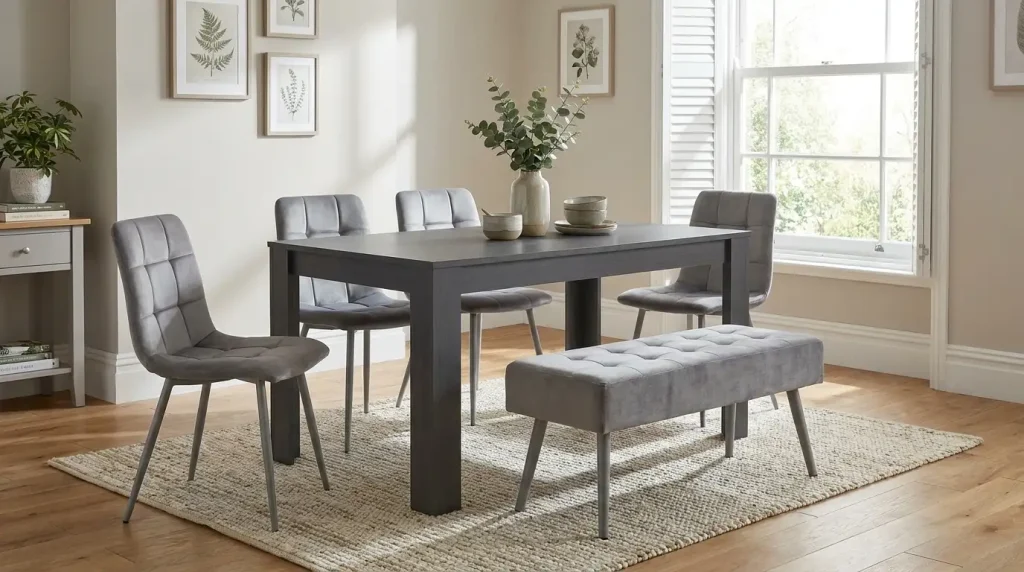
Some sets pair a bench along one side of the table instead of individual chairs on every side. This is worth considering on its own merits, rather than assuming individual chairs are automatically the better default.
A bench seats more people along the same length of table than individual chairs generally allow, since there are no armrests or chair legs taking up space between seats. This makes a bench a practical choice for a household that regularly needs flexible seating, such as fitting an extra child in for a meal without needing an additional chair. Our dining set with four chairs and a matching bench shows this combination well, pairing the flexibility of a bench on one side with the individual comfort of chairs on the other.
The trade-off is that a bench offers no back support, which suits shorter meals better than long, relaxed dinners. For most households, a mixed approach, chairs on the sides used most for everyday seating, with a bench on the side used more occasionally, gives the best balance of comfort and flexibility.
Extendable vs Fixed Tables
A fixed table is simpler, generally sturdier, and does not require remembering how to operate an extension mechanism. It suits households whose seating needs stay consistent throughout the year.
An extendable table trades a small amount of everyday simplicity for genuine flexibility. Most UK extendable dining tables use one of two mechanisms: a pull-out leaf, where a hidden panel slides out from under the tabletop, or a butterfly leaf, where a folded panel lifts and locks into place at the centre of the table. Both add length when you need extra seating for guests, then return to a smaller everyday footprint the rest of the time.
This is worth considering carefully if your household’s seating needs genuinely change throughout the year, hosting more over the festive period or during school holidays, for example, but eating as a smaller group most weeks. An extendable table avoids the choice between a table that is too small for occasional guests and one that feels oversized for daily use.
Assembly and Build Quality: What to Check
Almost all UK dining table and chair sets arrive flat-packed, and build quality genuinely affects how the table performs over years of daily use, not just how it looks on delivery day.
- Check the leg-fixing method: Metal hairpin legs, bolted rather than screwed into a thin panel, generally offer a sturdier base than a simple screw-in leg on a lower-cost table.
- Check adjustable feet are included: These allow you to level the table on an uneven floor, common in older UK homes, and prevent an annoying wobble that a table without them cannot correct.
- Read reviews specifically for mentions of stability, since this is one of the most reliable signals of genuine build quality once a table has seen real daily use, rather than just first assembly.
- Check chair joint construction: Reinforced corner brackets or a cross brace between chair legs generally indicate a chair built to withstand regular use, rather than one that will loosen within months.
A few practical assembly tips make the process smoother once your set arrives:
- Lay out all parts and fixings before starting, checking that nothing is missing against the included parts list.
- Build on a soft surface, such as a blanket or the cardboard packaging, to avoid scratching the tabletop during assembly.
- Tighten every fixing fully before testing stability, since loose fixings are the most common cause of an early wobble.
- Assemble chairs one at a time, following the same fixing order for each, rather than building all four partially before finishing any of them.
Style Matching to Your Kitchen or Dining Room
The right dining set should belong in the room it sits in, not just look good in isolation in a product photo.
A modern open-plan kitchen diner generally suits a table with clean lines and an easy-clean surface, such as glass or a melamine laminated finish, since this space often does double duty as a food preparation area as well as a place to eat. A traditional or period dining room suits a solid wood finish with more visible grain and classic proportions, which tends to sit more comfortably against original features such as skirting boards and cornicing than a stark, ultra-modern finish would.
A small kitchen diner or apartment benefits from a round or space-saving table, since these shapes make the most of a compact footprint without leaving awkward corners of unused floor space. Our space-saving dining table with four velvet chairs is designed specifically around this need, with chairs that tuck fully under the table when not in use.
Family Considerations: Kids, Pets, and Durability
A dining table sees more daily wear than almost any other piece of furniture in the home, particularly with children or pets in the household. A few practical choices make a genuine difference over time.
- Choose a wipeable surface if spills are a daily reality: Melamine-laminated MDF and glass both wipe clean easily, while fabric upholstery needs more regular care and occasional deeper cleaning.
- Check chair leg protection: Adjustable protective feet prevent scuffing on hard floors, particularly important in a household with chairs that get moved and scraped back regularly.
- Consider seat height for younger children: Standard dining chair height suits most school-age children and adults, but very young children generally need a booster seat rather than relying on standard chair height alone.
- Faux leather and wood chairs generally outlast fabric for high-use households: simply because there is no upholstery to stain, fade, or wear through with daily use.
Lighting and Placement Above the Table
A dining table is rarely used in isolation from the lighting above it, and getting this pairing right affects how the whole room feels once the table is in place.
If you are hanging a pendant light above the table, aim for the bottom of the fitting to sit around 70 to 80cm above the tabletop. This gives enough clearance to see across the table comfortably without the light hanging at eye level, while still casting useful light directly onto the table surface rather than the ceiling. For a table that will host longer dinners, a warmer light temperature suits the space better than a stark, cool white, similar to the colour temperature principles that apply to task lighting elsewhere in the home.
Position the table itself to take advantage of natural light where possible, without sitting directly in the glare of a low afternoon sun through a west-facing window. A table positioned at a slight angle to a bright window, rather than directly facing it, generally gives the most comfortable everyday lighting for meals.
Caring for Your Table by Material
Different materials need different day-to-day care, and getting this right extends how long a table stays looking its best considerably beyond simply wiping up spills.
- Solid wood and wood-effect finishes benefit from a soft, slightly damp cloth for everyday cleaning, with a dry cloth immediately after to avoid moisture sitting on the surface. Avoid placing very hot dishes directly on the surface without a mat, since heat can affect the finish over time.
- Melamine-laminated MDF is the easiest surface to maintain, wiping clean with a damp cloth and mild cleaning product without special care needed. Avoid abrasive scourers, which can dull the surface finish over repeated use.
- Tempered glass wipes clean easily with a standard glass cleaner, though it shows fingerprints and smudges more visibly than an opaque surface, so a quick daily wipe keeps it looking its best.
- Faux leather chairs wipe clean with a damp cloth, and any spills should be addressed promptly rather than left to dry, which can make cleaning marks afterward more difficult.
- Fabric and velvet chairs benefit from a fabric-safe cleaner for spot cleaning and a regular vacuum to lift dust and crumbs from the weave before they become embedded.
Key Note: Whichever material you choose, avoid harsh chemical cleaners on any painted or laminated surface, since these can strip the finish over time, even when a spill is removed successfully in the short term.
Rugs and Flooring Under a Dining Table
An often overlooked detail: what sits underneath the table affects both comfort and practicality more than most buyers expect before living with the setup day to day.
A rug under a dining table can anchor the space visually and add warmth underfoot, but it needs careful sizing. As a general rule, a rug should extend at least 60 to 70cm beyond the table’s edge on every side, so that a chair remains on the rug even when pulled fully out. A rug that is too small leaves chair legs catching the rug’s edge every time someone sits down or stands up, which becomes a genuine daily annoyance rather than a minor styling detail.
Hard flooring, such as wood, laminate, or tile, is generally the more practical choice directly under a dining table, particularly in a household with children, since spills and crumbs are far easier to manage than on a rug in the same spot. If you do want a rug for warmth or styling, a low-pile, easy-clean option holds up far better in this high-traffic spot than a deep-pile rug prone to trapping crumbs and stains.
What to Expect at Each UK Price Point
Dining table and chair sets span a wide range in the UK market, and price correlates fairly closely with a small number of concrete features, rather than brand name alone.
| Price band | What you typically get |
| Under £200 | Basic MDF construction, simple chair upholstery, limited size options |
| £200 to £400 | Better MDF or laminated finishes, tempered glass options, wider style choice, matched chair sets |
| £400 to £700 | Solid wood elements, extendable mechanisms, more considered hardware and finishes |
| £700+ | Premium materials, bespoke sizing, designer detailing |
For most UK households, the £200 to £400 bracket delivers the best balance of genuine durability, style choice, and matched proportions, without paying a significant premium for features that will not meaningfully change daily use.
Common Buying Mistakes to Avoid
- Measuring the table but not the clearance space needed for chairs, leading to a dining area that feels cramped the moment guests are seated.
- Choosing a table shape based on the photo rather than the room’s actual proportions results in a round table that leaves awkward gaps in a long, narrow room, or a rectangular table that feels oversized in a square space.
- Assuming a table advertised as seating six will comfortably fit six people, without checking the actual table length against the per-seat spacing guide covered earlier.
- Buying a glass table without confirming it is tempered or toughened glass is particularly relevant in a household with children.
- Ignoring chair and table height compatibility when buying results in a mismatch that makes the table genuinely uncomfortable to use daily.
- Choosing upholstery based on looks alone, without considering how much daily wear the chairs will actually see in your household.
A Quick Decision Framework
If you are still deciding between two or three sets, work through this order rather than starting with colour or style.
- How many people do you need to seat on a normal week? This determines whether you need a 4-seater, 6-seater, or an extendable option.
- Does it physically fit in your room? Confirm the table footprint plus 90cm of clearance against your measured space.
- Does the table length actually suit the seat count? Check against the 60cm per seat guide, not just the advertised number.
- Does the material suit your household? Wipeable surfaces for busy family life, or a more considered finish for a quieter dining room.
- Are chairs matched to the table height? Confirm this specifically if buying separately rather than as a set.
Any set that clears all five checks is very likely to still be in daily use for years, which is the real test a product photo alone cannot answer.
Frequently Asked Questions
What is the standard height of a dining table and chairs?
Most UK dining tables sit at 75 to 76cm tall, paired with a chair seat height of around 44 to 46cm. This combination gives comfortable knee clearance and a natural eating height for most adults.
How much space do I need around a dining table?
Allow at least 90cm of clear floor space on every side used for seating, on top of the table’s own footprint. This covers the chair being pulled out fully and space to walk behind a seated guest comfortably.
Is glass or wood better for a dining table?
Neither is objectively better. Glass suits a smaller or more contemporary space well, making the room feel open, while wood brings warmth and tends to be more forgiving of daily scuffs and marks in a busy household.
Do I need an extendable table if I only host occasionally?
It depends on how often “occasionally” really is. If you host more than a handful of times a year, an extendable table avoids the compromise between a table too small for guests and one too large for daily use.
How many seats fit around a 120cm table?
Generally, four, two per side plus one at each end if the table has usable end space. Checking the exact seat spacing against the 60cm per person guide is the most reliable way to confirm comfort before buying.
Are bench seats as comfortable as chairs?
For shorter meals, yes, and a bench offers useful seating flexibility. For longer, more relaxed dinners, individual chairs with back support are generally more comfortable over time.
What should I check before buying a flat-pack dining set?
Check the leg-fixing method, whether adjustable feet are included, and read recent reviews specifically for mentions of wobble or instability, since this is the most reliable indicator of genuine build quality.
Choosing With Confidence, Not Guesswork
The dining sets that get used every single day are rarely the ones bought for looks alone. They are the ones where the room was measured properly, the seat count matched real household needs, and the chairs were checked against the table’s own height rather than assumed to match.
Work through the five decisions in this guide in order: seating need, floor space, shape, material, and chair height, and almost any style within that shortlist will genuinely suit your home. When you are ready to compare options side by side, browse the full dining table and chairs range at Kosy Koala, or explore our dining chairs collection separately if you already have a table in mind.
Top 5 Dining Table and Chair Sets at Kosy Koala
Based on everything covered above, seating needs, space, material, and comfort, these five pull from our own range to cover the situations most UK buyers are actually shopping for.
Space Saving Dining Table With 4 Velvet Chairs
Best for Small Spaces Table: 100cm (L) x 100cm (W) x 75cm (H) Chairs: 63cm (L) x 48cm (W) x 44.5cm (D) x 72cm (H), tuck fully under the table Best for: apartments and smaller kitchen diners.
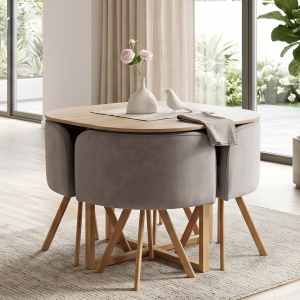
Built specifically for smaller UK homes, this set’s chairs tuck completely under the table when not in use, freeing up floor space between meals. The warm wood tabletop keeps the compact footprint feeling considered rather than purely functional.
Shop: Space Saving Dining Table With 4 Velvet Chairs
Round Glass Dining Table Set With 4 Black Chairs
Best Overall Table: 90cm (L) x 90cm (W) x 75cm (H), tempered glass top. Chairs: H87 x L59 x W44cm, seat height 45cm Best for: compact kitchen diners wanting a light, contemporary look.
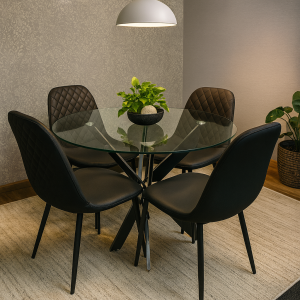
This is the set that answers most of the checklist in this guide at once: a manageable footprint for smaller UK dining spaces, a tempered glass top for genuine safety, and chrome legs that keep the whole room feeling open rather than boxed in. The black chairs give it a smart, versatile look that suits most kitchen and dining styles.
Shop: Round Glass Dining Table Set With 4 Black Chairs
Dining Table and 4 Grey Velvet Chairs, Live-Edge Wood
Best for Comfort and Character Table: 117cm (L) x 77cm (W) x 75cm (H) Chairs: H87 x L59 x W44cm, seat height 44cm Best for: households prioritising comfort and a warmer, more characterful look.
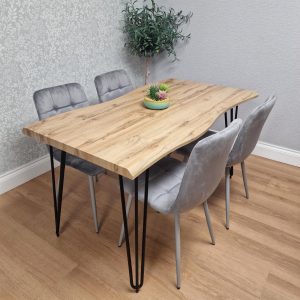
The curved live-edge tabletop brings genuine natural character to a dining room, while the tufted grey velvet chairs add a level of everyday comfort that a hard seat cannot match. A strong choice for a dining room used for longer, more relaxed meals.
Shop: Dining Table and 4 Grey Velvet Chairs, Live-Edge Wood
Modern Dark Grey Dining Table With 4 Blue Velvet Chairs and Bench
Best for Larger Families Table: H75 x L140 x W80 cm Chairs: H87 x L59 x W44cm, seat height 45cm. Bench: L90 x W30 x H45 cm. Best for: families needing flexible seating for six.
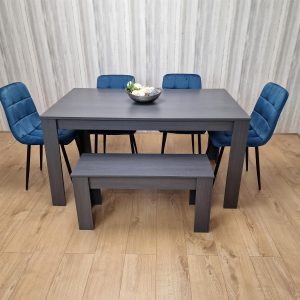
This set covers the most common gap in a family dining setup: enough seats for everyday use, plus a bench for flexible extra seating when needed. The dark grey melamine finish wipes clean easily, which matters in a household with children.
Shop: Modern Dark Grey Dining Table With 4 Blue Velvet Chairs and Bench
White and Black Dining Table With 4 Faux Leather Chairs
Best for Busy Households Table: H75 x L140 x W80 cm Chairs: H85 x L52 x W44cm, seat height 44cm Best for: families wanting an easy-clean set without compromising on style.
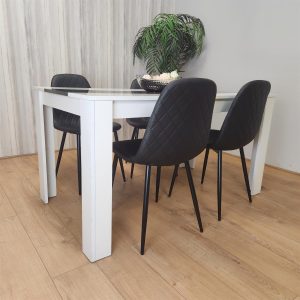
The UV-painted MDF surface is built for daily wipe-down cleaning, while the diamond-stitched faux leather chairs resist spills far better than fabric. A genuinely practical choice for a household eating together every day.
Shop: White and Black Dining Table With 4 Faux Leather Chairs
Browse the full range, filterable by shape, material, and seat count, at Kosykoala dining table sets.
Recommended Supporting Articles
- How Many Seats Do You Actually Need at Your Dining Table?
- Dining Table Dimensions Guide: How Much Space You Need Per Seat
- Dining Bench vs Dining Chairs: Which Should You Choose?
- How to Assemble a Flat-Pack Dining Table (Step by Step)
- Extendable vs Fixed Dining Tables: Which Suits Your Home?
About the author
This article was written by the Kosy Koala team. We design and source furniture for UK homes, with a focus on practical details that actually matter once a piece is in your room. Have a question about any product on this page? Get in touch through our About Us page.


 Dining Tables
 Dining Chairs

 Bed Frames
 Mattresses
 Bunk Beds
 Sofa & Sofa Beds


