

Blog
Extendable vs Fixed Dining Tables: Which Suits Your Home?

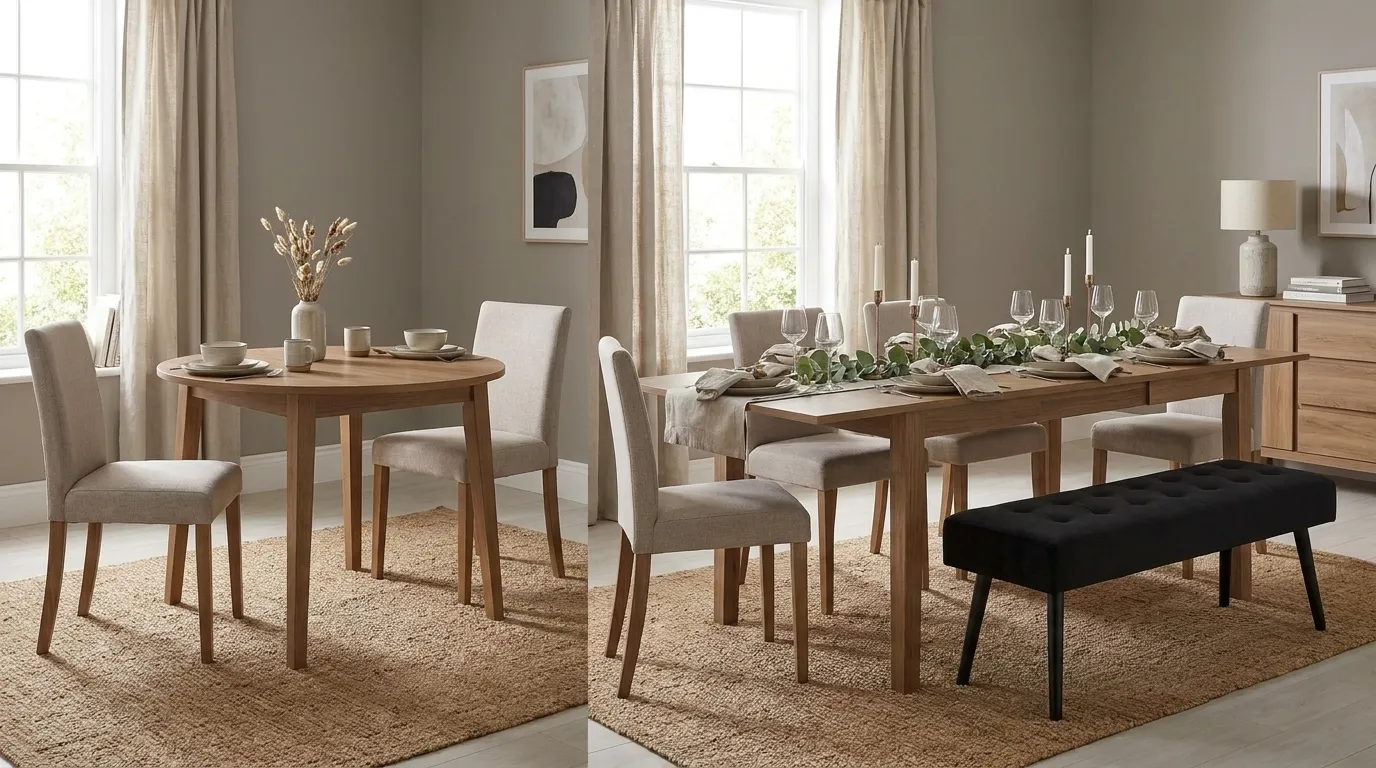
Two tables can look almost identical in a showroom and behave completely differently in your home. One stays the same size forever. The other grows when you need it to, then shrinks back down. Neither is automatically the better choice. It depends entirely on how your household actually eats and hosts.
This guide compares extendable and fixed dining tables properly, covering the mechanisms, the maintenance, the real cost difference, and the space each one genuinely needs. If you have not yet worked out your seating needs or room measurements, our guides to how many seats you actually need and dining table dimensions are worth reading alongside this one.
Quick answer:
Choose a fixed table if your household’s seating needs stay fairly consistent throughout the year, and you value simplicity over flexibility. Choose an extendable table if there is a genuine, regular gap between your everyday headcount and how many people you host a few times a year. Write down both numbers before you decide. If they are close, a fixed table is almost always the calmer, simpler choice. If the gap is wide and hosting happens more than a handful of times a year, an extendable table earns its extra cost and complexity.
What “Extendable” Actually Means
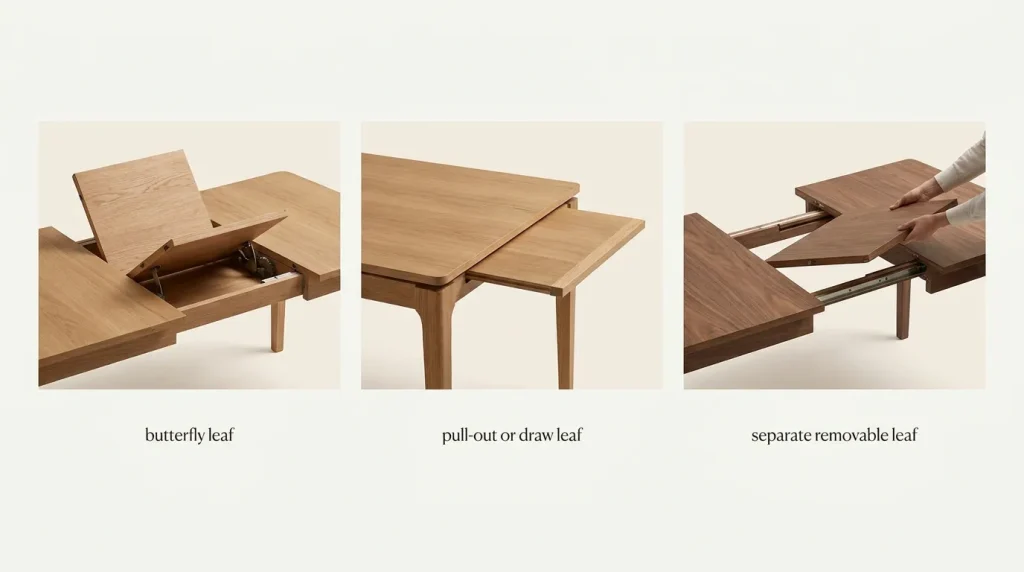
An extendable table increases its surface area using a built-in mechanism, rather than needing a separate piece of furniture entirely. There are three common designs sold in the UK, and they behave quite differently in daily use.
Butterfly Leaf
A hinged panel folds and stores within the table’s own frame, hidden beneath the tabletop until needed. Pulling the two halves of the table apart releases the folded leaf, which unfolds and locks flat to bridge the gap. This is the most self-contained mechanism, since the leaf never needs to be stored separately, and it has become the most common extension method in the UK market for exactly that reason.
Pull-Out or Draw Leaf
A hidden panel slides out from beneath the tabletop on rails, extending the table’s length without folding anything into place. This tends to give a very smooth, sturdy join once extended, though the mechanism itself, the rails and glide system, needs to stay clean and free of debris to keep working smoothly over years of use.
Separate Storable Leaves
An additional leaf, stored elsewhere when not in use, slots into the table when extra length is needed. This gives the largest possible extension in many designs, but it introduces the one genuine drawback none of the other mechanisms shares: you need somewhere in your home to store a leaf you might only use a few times a year.
What “Fixed” Actually Means, and Why That Is Not a Downside
A fixed table has one size, permanently. There is no leaf to fold, slide or store, and no mechanism to maintain. This sounds like the simpler, less capable option, but for a genuine majority of UK households, that simplicity is precisely the point.
A fixed table is one solid structure, which generally means fewer moving parts to develop a fault over time, and a completely predictable footprint that never needs planning around. For a household whose seating needs stay fairly constant through the year, a fixed table removes an entire category of decision: when to extend, how far, and where the leaf goes afterwards, that simply never comes up.
The Real Question: Your Everyday Number vs Your Peak Number
This is the framework worth working through before comparing a single product, and it is covered in more depth in our dining table seating guide. Write down two numbers: how many people eat together on a normal evening, and the largest number you regularly host across a typical year.
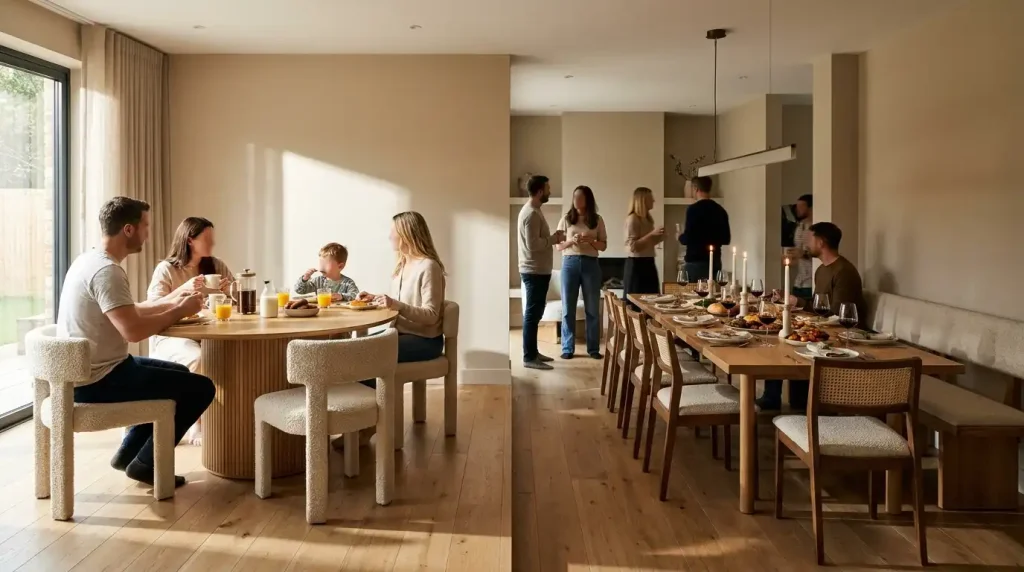
If those two numbers sit close together, a fixed table sized to your everyday number is almost always the calmer, more practical choice. An extendable table solves a problem you do not really have, at the cost of extra complexity and typically extra spend. If the gap between the two numbers is wide, and the larger number comes up more than a handful of times a year, this is exactly the situation an extendable table was designed to solve. It lets you keep a comfortable, intimate footprint most of the time, without permanently living with a table sized for your rarest occasions.
Key note: be honest about how often your peak number genuinely happens. A gap that only shows up once a year, at Christmas, is often better solved with folding chairs or a borrowed seat than with a permanent extension mechanism used for a single day annually.
Measuring for Both States
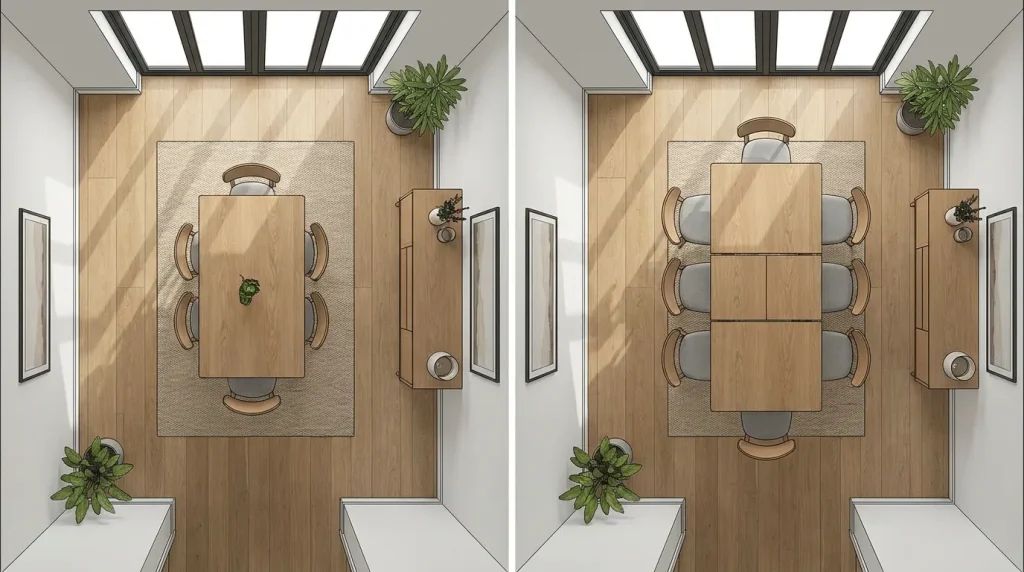
If you are seriously considering an extendable table, measure your room twice, once for its everyday footprint and once for its fully extended length. Our dining table dimensions guide covers the full clearance rules in depth, but the detail worth repeating here is specific to extendable tables: the side that extends often needs walkway clearance it did not need in its compact form. A wall-adjacent side with 90cm of everyday clearance can become genuinely too tight once the table grows into that space, so check the extended footprint against your room’s actual layout, not just its compact size in a product photo.
Maintenance: What Extension Mechanisms Actually Need
This is the detail most buying guides skip entirely, and it matters for anyone weighing up the long-term ownership of an extendable table.
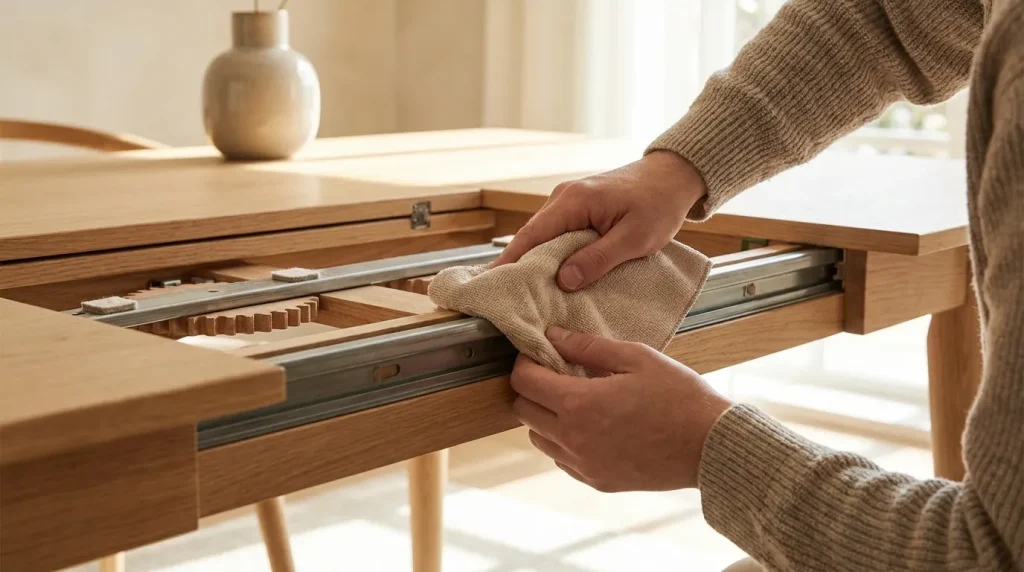
A pull-out or draw leaf mechanism relies on rails or glides staying reasonably free of dust and debris to slide smoothly. An occasional wipe of the rail area, particularly if the table sits on a carpeted or high-traffic floor, keeps the action smooth over years of use. A butterfly leaf, being a hinged rather than sliding mechanism, generally needs less ongoing care, though the hinge itself benefits from an occasional check to confirm it still locks flat and level when extended.
If a mechanism starts to feel stiff or uneven, resist the urge to force it. A gentle clean of the moving parts resolves most stiffness. If a genuine fault develops, this is worth addressing through the manufacturer’s warranty rather than continued force, since forcing a stiff mechanism is the most common way a minor issue becomes a genuine breakage.
Storage: Where Does the Leaf Actually Go
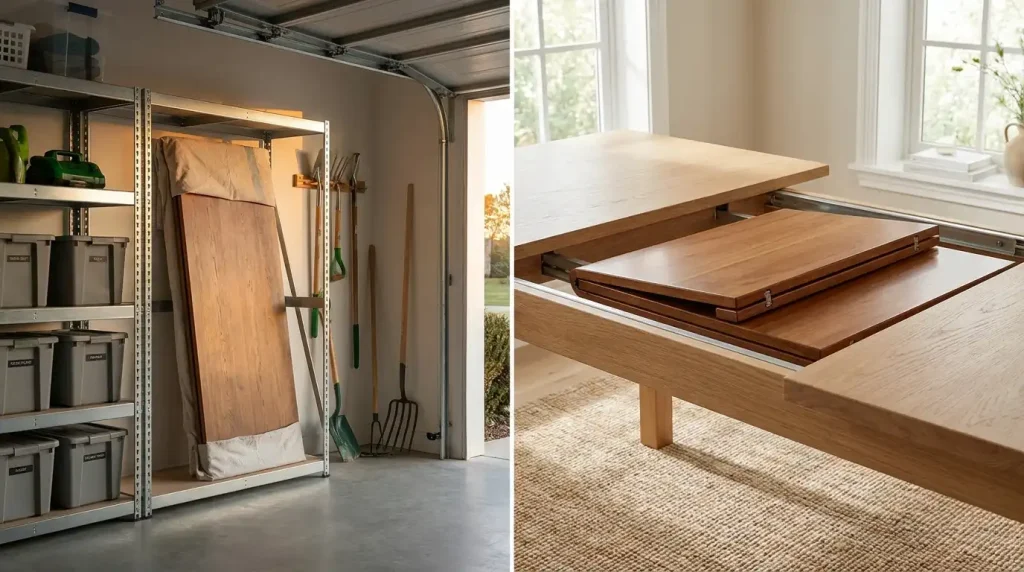
For a table with a separate, fully removable leaf, this is worth thinking through before you buy, not after. A leaf used only a handful of times a year still needs somewhere to live for the rest of the year, ideally flat, protected from knocks, and not blocking access to something else in storage.
A spare room, under a bed, or a garage shelf all work, provided the leaf is protected from damage and easy to retrieve without a genuine hunt each time you need it. This is one of the clearest practical advantages a butterfly leaf design holds over a separate storable leaf: the storage problem simply does not exist, since the leaf never leaves the table.
Cost Comparison
Fixed tables are generally the more affordable option at a given size and material quality, simply because there is no mechanism to engineer, test and build into the frame. An extendable table’s price reflects genuine added engineering, not just marketing, and this cost is usually justified only if the extension feature actually gets used regularly.
Think about how many days a year you would realistically use the extra length. A household hosting monthly or more often will likely find an extendable table pays for itself in convenience over years of ownership. A household hosting a large group once or twice a year may find the same money better spent on a well-built fixed table, paired with a couple of inexpensive folding chairs kept in storage for the rare occasion extra seats are needed.
Stability and Build Quality Differences
A fixed table, being one continuous structure, generally offers the most predictable stability of the two options, since there is no joint or mechanism to potentially loosen over years of use. An extendable table can be every bit as stable when well built, but the mechanism quality genuinely matters here in a way it simply does not for a fixed design.
Check how the table feels when extended, not just when compact, if you get the chance to see one in person. A well-engineered extension locks flat and firm with no perceptible give at the join. A poorly built one can feel slightly less stable in its extended state than in its everyday, compact form, which matters considerably if the extended table will be seating a full house of guests.
Who Should Choose Fixed
- Households whose everyday and peak seating numbers sit close together.
- Anyone who values a completely predictable footprint with nothing to learn, operate or maintain.
- Buyers working to a tighter budget, where a fixed table generally offers more table for the money.
- Households without a sensible place to store a separate leaf, if considering that specific mechanism type.
- Anyone who prefers a solid, single-structure table for genuine long-term stability with minimal upkeep.
Who Should Choose Extendable
- Households with a genuine, regular gap between everyday and peak seating needs, particularly if hosting happens monthly or more.
- Smaller homes or open-plan kitchen diners where floor space is tight most of the year, but occasional larger gatherings still need accommodating.
- Buyers happy to check mechanism quality carefully before purchase, and to keep the moving parts reasonably clean over time.
- Anyone with straightforward, dedicated storage for a leaf, if considering a separate-leaf design specifically.
An Honest Note on Our Current Range
At the time of writing, our own range at Kosy Koala focuses on fixed dining tables across glass, wood and MDF finishes, rather than extendable mechanisms. If everything in this guide points you toward wanting genuine extendable flexibility, that is a real and valid conclusion, and it is worth knowing upfront rather than after browsing our shop expecting to find one.
If your household’s numbers point toward a fixed table, or if an extendable table’s occasional flexibility is better solved with a spare set of folding chairs kept in storage, our dining table and chairs range has a genuinely wide choice of shapes, sizes and finishes to work from.
Common Mistakes
- Buying extendable purely for peace of mind: When the actual gap between everyday and peak seating is small enough that a fixed table would serve just as well.
- Not checking mechanism quality before buying: Assuming all extension systems perform equally well once extended.
- Forgetting to plan leaf storage: For designs with a separate, fully removable leaf.
- Measuring only the compact footprint: And discovering the extended table does not comfortably fit the room’s walkways once guests arrive.
- Forcing a stiff mechanism: Rather than cleaning it gently or addressing a genuine fault through the manufacturer.
- Assuming fixed means limited: A well-chosen fixed table, sized correctly to genuine everyday need, serves the vast majority of UK households perfectly well without ever feeling like a compromise.
A Quick Decision Framework
- Write down your everyday and peak seating numbers: This single step answers most of the decision on its own.
- How often does your peak number actually happen: A few times a year points toward a fixed table plus folding chairs. Monthly or more points toward extendable.
- Do you have somewhere sensible to store a leaf: If not, rule out separate-leaf designs specifically, though butterfly leaf tables avoid this issue entirely.
- Have you measured your room for both states: Confirm the extended footprint fits your walkways, not just the compact size.
- What is your budget, and how many days a year would you actually use the extra length:Weigh the added cost against genuine, regular use rather than rare occasions.
Two Worked Examples
Consider a couple in a two-bedroom flat who eat together most evenings, and host one or two friends for dinner roughly once a month. Their everyday number is two. Their peak number is four, maybe five on a rare occasion. This is a small, consistent gap that shows up regularly but never demands a dramatically larger table. A fixed four-seater table suits this household well, since the everyday and peak numbers sit close enough together that an extension mechanism would add cost and complexity to solve a gap of only two or three seats.
Now consider a family of four whose extended family, six additional people, visits for a full weekend roughly every two months, alongside regular weeknight meals as a family of four. Here, the everyday number is four, and the peak number is ten, a genuinely wide and recurring gap. This household would likely find real, repeated value in an extendable table, since the alternative, either permanently living with a ten-seat table or repeatedly sourcing extra chairs every couple of months, is considerably less convenient than a table built to handle both situations on its own.
Long-Term Flexibility and Moving Home
It is worth thinking beyond your current home when weighing up this decision, particularly if a move is likely within the next few years.
A fixed table sized precisely to your current room may not suit a larger or smaller dining space in a future home, whereas an extendable table offers a little more built-in adaptability across different room sizes, since its footprint is not locked to one fixed figure. This is a minor consideration compared with your actual seating needs, covered throughout this guide, but it is worth factoring in in a genuine tie-break situation between two otherwise equally suitable options.
Equally, a well-built fixed table holds its resale or hand-me-down value well, precisely because it has no mechanism to have worn out or loosened over years of use, which is worth bearing in mind if you tend to sell or pass on furniture rather than keep it long term.
Frequently Asked Questions
Is an extendable dining table worth the extra cost?
It depends on how often you would genuinely use the extra length. If hosting larger groups happens monthly or more, the added cost is usually justified. For rarer occasions, a fixed table paired with folding chairs is often the more sensible spend.
What is the most reliable extendable table mechanism?
Butterfly leaf designs tend to be the most self-contained, since the leaf folds into the table itself with nothing to store separately. Pull-out or draw leaf designs are also reliable but benefit from occasional cleaning of the rail mechanism to stay smooth.
Do extendable tables feel less stable than fixed tables?
A well-engineered extendable table should feel just as stable when extended as a fixed table of the same size. Mechanism quality varies between products, so checking this in person, where possible, is worth doing before you buy.
How much extra clearance does an extendable table need when open?
Measure the fully extended footprint against your room specifically, since a side that had comfortable clearance in the table’s compact state can become a genuine walkway problem once extended. Our dimensions guide covers the full clearance rules in depth.
Where should I store a removable dining table leaf?
Anywhere flat, protected from knocks, and easy to access, such as under a bed, in a spare room, or on a garage shelf. This is one of the genuine practical downsides of a separate-leaf design compared with a self-contained butterfly leaf.
Does Kosy Koala sell extendable dining tables?
Not currently. Our range focuses on fixed dining tables across a range of shapes, sizes and finishes. If your household’s needs point toward extendable flexibility, it is worth knowing this upfront and considering whether a fixed table paired with occasional folding chairs might solve the same problem instead.
Can I add an extension leaf to a fixed table after buying it?
Generally no. Extension mechanisms are engineered into a table’s frame from the design stage, so a fixed table cannot usually be retrofitted with a leaf afterwards. This decision is worth making before you buy, rather than assuming it can be added later.
Is a butterfly leaf or a separate leaf the better extendable design?
A butterfly leaf is generally more convenient day-to-day, since it stores within the table itself with nothing separate to keep track of. A separate leaf can sometimes offer a larger maximum extension, but only if you have somewhere sensible to store it between uses.
Choosing the Table That Matches Your Real Life
There is no universal winner between extendable and fixed. A fixed table rewards a household with steady, predictable seating needs, offering simplicity and genuine long-term stability. An extendable table rewards a household with a real, recurring gap between everyday and peak numbers, provided the mechanism is well built, and the leaf has somewhere sensible to live. Write down your own numbers, measure your room properly, and the right choice for your home becomes considerably clearer than any showroom display could make it.
For the fuller picture on choosing shape, material and seat count, our complete dining table and chairs buying guide covers the wider decision in depth. When you are ready to compare fixed table options directly, browse the full dining table and chairs range at Kosy Koala.
A Few Fixed Tables Worth Considering
Since our current range is built around fixed tables, here are a few worth a closer look if this guide has pointed you toward that choice.
Dining Table Set With 4 Grey Faux Leather Chairs and Bench
Table: H75 x L134 x W70 cm. Bench: L90 x W30 x H45 cm.
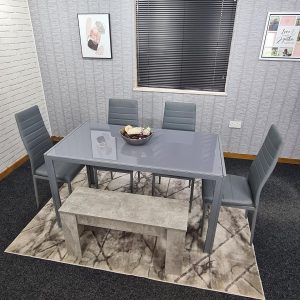
A genuinely flexible fixed set, since the bench absorbs some of the everyday-to-peak seating gap without needing an extension mechanism at all; a practical middle ground worth considering before committing to an extendable set.
Shop: Dining Table Set With 4 Grey Faux Leather Chairs and Bench
Modern Dining Table Set With 4 Black Velvet Chairs
Table: H75 x L134 x W70 cm.
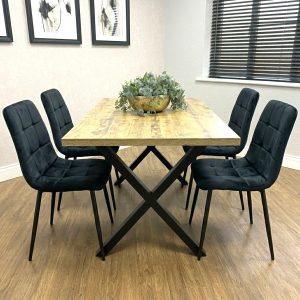
A solid, single-structure fixed table with reinforced X-shaped legs, a strong pick for a household whose everyday and peak numbers sit close together and wants genuine long-term stability without a mechanism to think about.
Shop: Modern Dining Table Set With 4 Black Velvet Chairs
Modern Dining Table Set With 4 White Gem Pattern Chairs and Bench
Table: H75 x L140 x W80 cm. Bench: L90 x W30 x H45 cm.
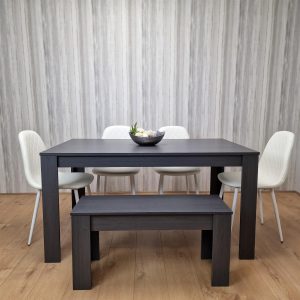
Another bench-and-chairs hybrid, giving six practical seats from a fixed footprint, worth comparing directly against the cost of an equivalent extendable table before deciding which route suits your household better.
Shop: Modern Dining Table Set With 4 White Gem Pattern Chairs and Bench
Browse the full range at Kosy Koala dining table sets.
Recommended Supporting Articles
- Dining Table and Chairs Sets: The Complete UK Buying Guide
- How Many Seats Do You Actually Need at Your Dining Table?
- Dining Table Dimensions Guide: How Much Space You Need Per Seat
- Dining Bench vs Dining Chairs: Which Should You Choose?
- How to Assemble a Flat-Pack Dining Table (Step by Step)
About The Author
This article was written by the Kosy Koala team. We design and source furniture for UK homes, with a focus on practical details that actually matter once a piece is in your room. Have a question about any product on this page? Get in touch through our About Us page.


 Dining Tables
 Dining Chairs

 Bed Frames
 Mattresses
 Bunk Beds
 Sofa & Sofa Beds


