

Blog
How Many Seats Do You Actually Need at Your Dining Table?

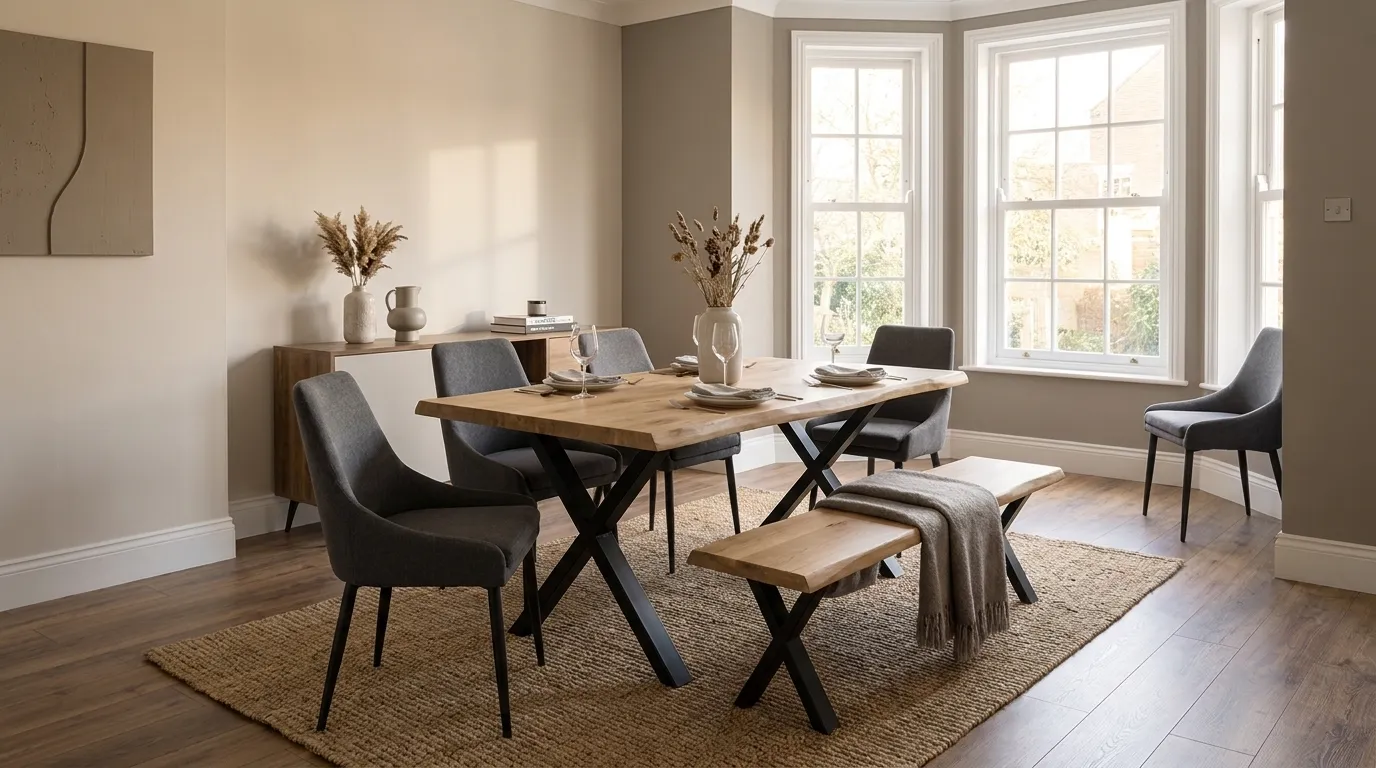
Most people buy a dining table for the meal they imagine having, not the meal they actually have. A big table for Christmas that happens once a year. A six-seater for guests who visit twice. The result is a table that sits mostly empty, in a room that could have used the extra floor space for something else.
This guide is not about table dimensions in centimetres. That is covered in full in our dining table and chairs buying guide, which walks through room measurements, per-seat spacing and shape in detail. This article answers a different question first: how many seats do you genuinely need, based on your household and how you actually live, before you even start measuring the room.
Quick answer:
Count the number of people who eat together on a normal weekday, then add one or two seats for regular guests, not occasional ones. Most UK households are smaller than people assume when shopping for a table. If you host large groups only a few times a year, an extendable table, a bench, or a couple of foldable extra chairs solve the occasional overflow far better than buying a permanently larger table that sits half empty every other day.
Start With a Real Number, Not an Aspirational One
This is the single biggest mistake in dining table shopping, and it happens before anyone even opens a tape measure. People buy for the table they picture in their head, full of family and friends, rather than the table they will actually sit at most days.
According to the Office for National Statistics, the average UK household size was 2.36 people in 2025, and nearly 30 per cent of UK households consist of just one person living alone. This matters because it shows how far the average household actually sits from the six- or eight-seat table that so many buyers default to. A large table is not a mistake in itself, but it is worth knowing that most UK homes genuinely do not need one for daily use.
Key note: write down the actual number of people who eat together in your home on a normal Tuesday evening. That number, not the number from your last big family gathering, is where your seating decision should start.
The Everyday Test: A Normal Tuesday, Not Christmas Day
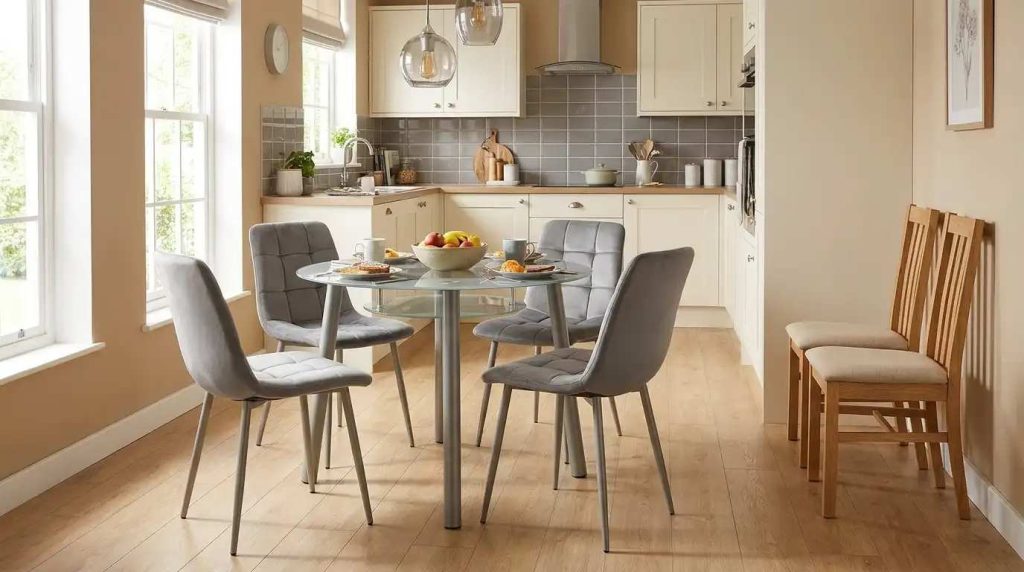
Here is a simple exercise that cuts through the guesswork. Picture last Tuesday evening. Who was actually sitting at the table for dinner? Now picture the biggest gathering you hosted in the last twelve months. Write both numbers down.
The gap between those two numbers tells you almost everything you need to know. A small gap, say two people on a normal night and four at your biggest gathering, means a straightforward table sized for daily use will comfortably cover you most of the time. A large gap – two people on a normal night but ten at your biggest gathering – points toward a different solution entirely: a smaller everyday table paired with a flexible way to add seats occasionally, rather than a permanently large table built around a handful of days each year.
This everyday test matters more than any dimension chart, because it forces you to separate genuine daily need from an occasional, memorable exception.
Seating by Household Type
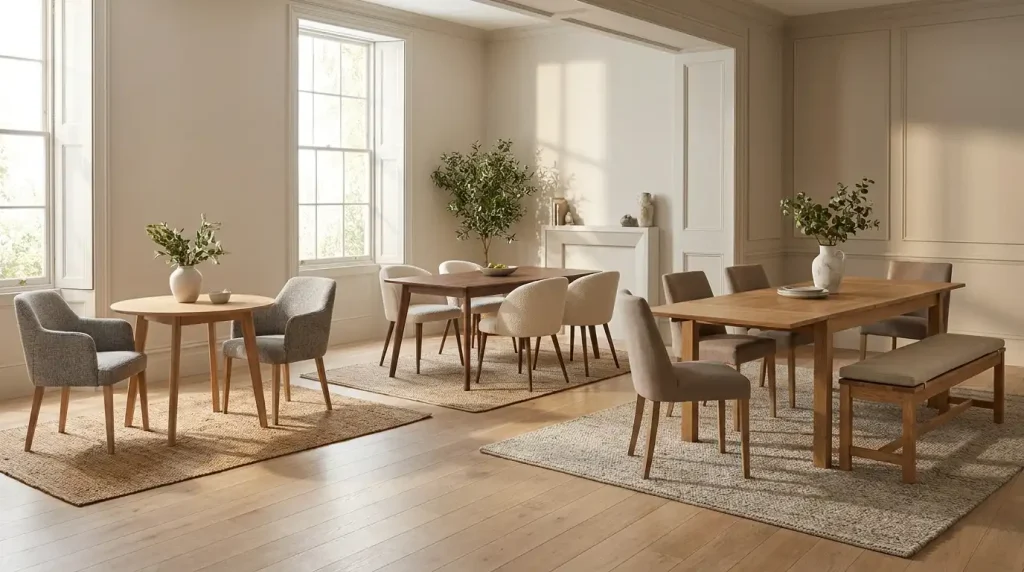
Different households have genuinely different seating needs, and it helps to see where yours fits before deciding on a number.
Couples and Single-Person Households
A single person or a couple rarely needs more than two to four seats for daily use. A 2-seater table suits a couple with little need for guest seating, while a 4-seater table gives a comfortable buffer for the occasional friend or family visit without committing to a large piece of furniture in a smaller home. Our space-saving dining table with four velvet chairs suits this household well, with chairs that tuck fully away when the extra seats are not needed.
Small Families
A household of three or four, typically a couple with one or two children, generally needs a genuine 4-seater table for daily use, with some flexibility for the occasional grandparent or friend joining for a meal. Our round glass dining table with four chairs suits this household size well, keeping the room feeling open in a smaller kitchen diner.
Growing Families
This is where seating needs change fastest, and it is worth planning a little ahead rather than buying purely for today. A young child in a high chair does not need a full seat at the table yet, but within a few years, that same child needs their own proper seat. If you know your household will grow, either through more children or through children simply growing out of a high chair, it is worth choosing a table that comfortably seats one or two more than your current headcount, rather than replacing the whole set again within a couple of years.
Larger and Multi-Generational Households
Households with grandparents, adult children still living at home, or blended families sharing meals regularly need to count everyone who eats together on a normal basis, not just the immediate nuclear family. A 6-seater table, such as our dark grey dining table with four chairs and a bench, suits this household well, with the bench offering flexible extra seating for a fluctuating number of people at any given meal.
Households That Host Often
If regular hosting is a genuine, frequent part of your life, not just a handful of occasions a year, it is worth sizing your everyday table closer to your hosting number rather than treating it as an occasional overflow problem. A household hosting weekly or fortnightly benefits from a table that seats close to its typical guest count as standard, since setting up extra seating often becomes its own recurring chore.
How Often Do You Actually Host? A Reality Check
Be honest here, since this single answer changes the right seating strategy more than almost anything else in this guide.
- A few times a year or less. A table sized for your everyday household, paired with an occasional seating solution covered later in this guide, is almost always the better choice. Buying permanently larger for a handful of days a year means living with an oversized table the rest of the time.
- Roughly once a month. This is the point where an extendable table starts to earn its place. You get a smaller everyday footprint most weeks, with the option to expand for a monthly gathering without needing to borrow or store extra chairs.
- Weekly or more. At this frequency, hosting is effectively part of your daily life, not an exception. Sizing your everyday table closer to your regular hosting number, rather than your smallest everyday headcount, generally serves you better long term.
Key note: be specific with yourself about the real frequency, not the frequency you would like it to be. A table bought for aspirational hosting that happens once or twice a year is one of the most common dining furniture regrets, and it is avoidable with an honest answer at this stage.
The Case for Buying Slightly Smaller Than You Think
There is a genuine, practical case for erring on the side of a smaller table than your instinct suggests, and it goes beyond simply saving floor space.
A table sized closely to your everyday household feels warmer and more intimate for daily meals. An oversized table, used by two or three people most nights, can feel strangely empty, with conversation spread thin across unused space rather than naturally drawn together. This matters more for everyday quality of life than most buyers consider before purchasing, since a dining table is used far more often for ordinary Tuesday dinners than for the rare large gathering it was originally sized around.
A smaller table is also easier to fit comfortably into a UK home, where dining spaces are frequently part of an open-plan kitchen-diner rather than a dedicated room. Our full buying guide covers the exact clearance space a table needs in more depth, but as a general principle, a table sized to your genuine daily need almost always fits the room and the room’s overall flow, more comfortably than one sized for a rare maximum capacity.
The Case for Buying One Seat Bigger
The opposite argument also holds real weight in certain situations, and it is worth being clear about when it applies.
If your household is likely to grow within the next few years, whether through children moving from a high chair to a full seat, a returning adult child, or simply expecting to host more as your circle of friends and family settles into a routine, buying one seat larger than your current strict headcount avoids replacing the whole set again shortly after buying it. Furniture, particularly a full table and chairs set, is not something most households want to repurchase every couple of years, so a small amount of planned headroom is often worth the modest extra cost and footprint.
The difference between this and simply buying oversized for rare occasions is intent. Buying one seat bigger because your household will genuinely grow into it within a reasonable timeframe is planning ahead. Buying several seats bigger purely for a handful of days a year is solving an occasional problem with a permanent, daily compromise.
Overflow Strategies: Solving the Occasional Guest Problem
For most households, the honest answer to “how many seats do I need?” is smaller than the number needed for their biggest gathering of the year. This is not a problem to solve by buying a permanently larger table. It is a problem to solve with flexible, occasional seating instead.
Extendable Tables
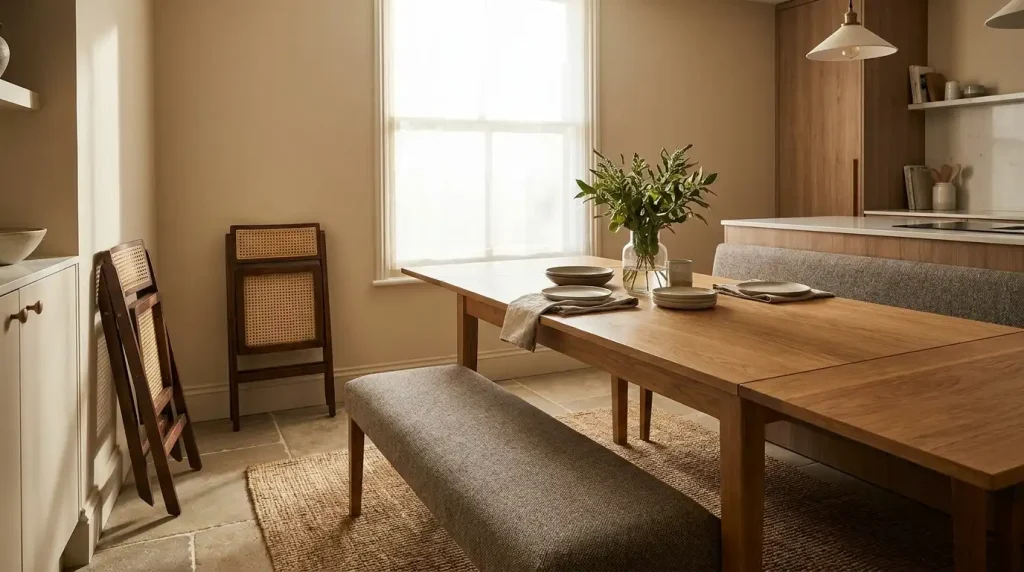
An extendable table gives you a smaller everyday footprint, then adds length exactly when you need it, through either a pull-out leaf or a lifting butterfly leaf mechanism. This is the most complete solution for a household that hosts a genuinely unpredictable number of guests a few times a year, since it avoids both an oversized daily table and the hassle of sourcing extra chairs from elsewhere. Choosing between an extendable and a fixed table involves its own set of trade-offs around mechanism type, sturdiness and everyday convenience, which is worth exploring fully if this route interests you.
Benches for Flexible Seating
A bench along one side of the table seats more people in the same length than individual chairs generally allow, since there is no armrest or chair frame taking up space between seats. This makes a bench a genuinely practical everyday choice for a household with a fluctuating headcount, rather than purely an occasional-use solution. Our dining set with a matching bench shows this approach well, giving a household the flexibility to seat one more person comfortably on busier evenings without a permanent extra chair taking up floor space the rest of the week.
Stacking or Folding Extra Chairs
A pair of simple folding or stacking chairs, stored in a cupboard or utility space, covers the rare occasion when you need one or two more seats than your everyday table provides. This is a low-cost, low-commitment solution for a household hosting only a handful of times a year, avoiding both an oversized permanent table and the higher cost of an extendable mechanism.
Borrowing or Repurposing Seating
For genuinely rare occasions, a dining chair borrowed from a home office, or a spare chair from another room, solves an overflow problem without any dedicated purchase at all. This suits a household hosting large groups only once or twice a year, where investing in dedicated overflow seating is unlikely to be worth the cost or storage space involved.
When the Table Does More Than Dining
Seating needs are not only about mealtimes. In many UK households today, the dining table doubles as a homework spot, a home office desk, or a space for crafts and hobbies during the day, before switching back to a dining table in the evening.
If this describes your household, it is worth counting these daily non-dining uses as part of your seating decision, not treating them as separate from mealtime seating entirely. A child doing homework at the table most afternoons effectively occupies a seat during that time, just as a parent working from home for part of the day does. A table sized only for evening mealtime headcount can feel genuinely tight if it also needs to accommodate this kind of daytime use regularly, particularly in a household where more than one person uses the table for non-dining purposes at the same time.
Key note: If your table regularly serves this dual purpose, lean toward the slightly larger end of your genuine seating range covered earlier in this guide, rather than the strict minimum for mealtimes alone.
Matching Seat Count to Table Shape
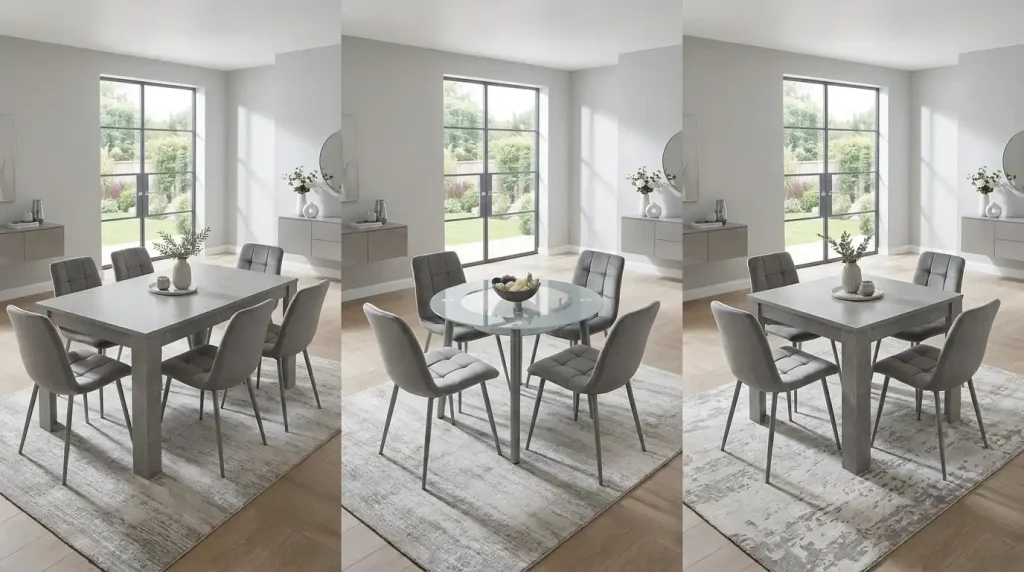
Once you know your target seat count, shape becomes the next real decision, and it affects how comfortably that number of seats actually fits.
Rectangular tables scale most predictably as seat count grows, and remain the most practical choice for anything above four seats in a typical UK dining space. Round tables suit four seats particularly well and work best in smaller or more square-shaped rooms, but scale poorly beyond six, since a round table wide enough for eight becomes difficult to reach across at the centre. Square tables suit four seats in a genuinely square room, but like round tables, do not scale gracefully to larger seat counts.
A Quick Reference: Typical Seat Counts by Household
As a general starting point, based on the household types covered earlier in this guide, here is a rough seat count reference before you move on to exact dimensions.
| Household type | Typical everyday seat count |
| Single person or couple | 2 to 4 |
| Small family (3 to 4 people) | 4 |
| Growing family, planning ahead | 4 to 6 |
| Larger or multi-generational household | 6 |
| Households hosting weekly or more | 6, or extendable |
Treat this as a starting point for your own household’s specific situation, not a fixed rule. Your own everyday headcount, worked out earlier in this guide, is the more reliable number to shop from.
Common Mistakes When Estimating Seating Needs
- Sizing the table around your biggest gathering of the year, rather than your genuine everyday headcount, results in a table that feels oversized most of the time.
- Forgetting to count daytime non-dining use, such as homework or working from home, when deciding how much seating and surface space you actually need.
- Underestimating how quickly a growing family’s seating needs change, leading to a table that is too small again within a couple of years.
- Assuming a round table will scale comfortably beyond six seats, when this shape generally works best for four, or six at most, in a typical UK dining space.
- Ignoring flexible overflow options and instead defaulting to the largest table that fits the room, even when the genuine daily need is considerably smaller.
- Not being honest about real hosting frequency, sizing a table for aspirational entertaining that happens only rarely in practice.
A Simple Worked Example
Consider a household of four: two adults and two children, one still young enough for a high chair. On a normal evening, three people sit at the table for dinner. A grandparent visits roughly once a fortnight, and the household hosts a larger family gathering of eight to ten people twice a year, at Christmas and one birthday.
Working through the framework in this guide: the everyday headcount is three, soon to be four once the youngest moves out of a high chair. The fortnightly grandparent visit points toward a genuine need for five seats fairly regularly, not just occasionally. The twice-yearly gathering of eight to ten is a clear case for an occasional overflow solution, not a permanently larger table.
The practical answer for this household is a 4-to-6-seater table, sized generously enough to comfortably cover the regular grandparent visits, paired with a couple of folding chairs stored away for the two annual larger gatherings. This avoids both an undersized table for regular use and an oversized table that would sit half empty most weeks of the year.
Quick Decision Framework
Work through these questions in order to land on your own genuine seat count.
- How many people eat together on a normal weekday? This is your baseline number.
- How often do regular guests join beyond your immediate household? Add one or two seats to your baseline if this happens weekly or fortnightly.
- Will your household grow within the next few years? If yes, consider one seat above your current strict headcount.
- How often do you host larger groups, honestly? A few times a year or less points toward overflow solutions rather than a permanently larger table.
- Does the table serve daytime purposes beyond meals? If so, lean toward the higher end of your calculated range.
Frequently Asked Questions
How many seats does a typical UK household actually need?
Based on the average UK household size, most households need a 2 to 4-seater table for genuine everyday use, though this varies with family size, regular guests and how often larger groups are hosted.
Should I buy a bigger table than I need for special occasions?
Generally, no, if those occasions happen only a few times a year. An extendable table, a bench, or a couple of folding chairs cover this need without the daily compromise of an oversized table.
How do I know if I need an extendable table rather than a fixed one?
If you host larger groups roughly once a month or more, an extendable table is usually worth the investment. For rarer occasions, a fixed table paired with flexible extra seating is generally the more practical choice.
Does a growing family need to plan ahead for seating?
Yes, to some extent. A child moving from a high chair to a full seat, or an expectation of more regular guests over time, is a reasonable reason to choose one seat more than your current strict headcount.
Is a round table a good choice for a larger household?
Round tables work best for four seats and can suit six in a larger room. Beyond that, a rectangular table generally scales more comfortably and remains easier to reach across for serving dishes.
What if my dining table also gets used for homework or work?
Count this as part of your seating and surface needs, not separately from mealtimes. A household using the table for both purposes regularly generally benefits from sizing toward the higher end of their calculated seat count.
Five Kosy Koala Sets Matched to Common Seating Needs
Using the household framework covered in this guide, here are five sets from our range, chosen for the seat count and everyday household situation each one suits best.
Round Glass Dining Table Set With 4 Black Chairs
Best for couples and small households. Seats: 4. Table: 90cm (L) x 90cm (W) x 75cm (H), tempered glass top.
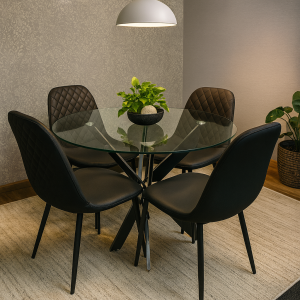
A genuine 4-seater footprint for a household whose everyday headcount sits at two to four, with enough room for the occasional guest without committing to a larger table. The compact 90cm diameter suits a smaller kitchen diner well, and the light glass top keeps the room feeling open rather than filled.
Shop: Round Glass Dining Table Set With 4 Black Chairs
Dining Table and 4 Grey Velvet Chairs, Live-Edge Wood
Best for small families wanting everyday comfort. Seats: 4. Table: 117cm (L) x 77cm (W) x 75cm (H).
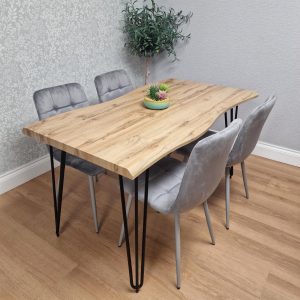
A slightly longer 4-seater, suited to a small family who eat together daily and occasionally welcome a grandparent or friend to the table. The cushioned velvet seats matter here, since this is a table built for longer, more relaxed everyday meals rather than quick sittings.
Shop: Dining Table and 4 Grey Velvet Chairs, Live-Edge Wood
Modern Dark Grey Dining Table With 4 Blue Velvet Chairs and Bench
Best for growing or larger households. Seats: up to 6 with the bench. Table: H75 x L140 x W80 cm. Bench: L90 x W30 x H45 cm.
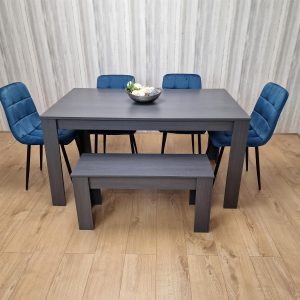
This is the set to reach for once your household’s everyday headcount pushes past four, or when regular guests are a genuine weekly or fortnightly occurrence rather than an exception. The bench adds flexible extra seating without a fixed sixth chair taking up space when it is not needed.
Shop: Modern Dark Grey Dining Table With 4 Blue Velvet Chairs and Bench
White and Black Dining Table With 4 Faux Leather Chairs
Best for households with daytime dual use. Seats: 4. Table: H75 x L140 x W80 cm.
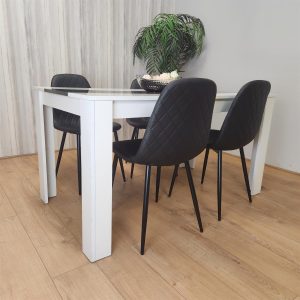
A practical choice if the table also earns its keep during the day, homework, craft projects, working from home, since the wipeable UV-painted surface and easy-clean faux leather chairs hold up to that kind of daily, non-mealtime use far better than a delicate finish would.
Shop: White and Black Dining Table With 4 Faux Leather Chairs
Space Saving Dining Table With 4 Velvet Chairs
Best for households prioritising everyday footprint over rare occasions. Seats: 4; chairs tuck fully under the table. Table: 100cm (L) x 100cm (W) x 75cm (H).
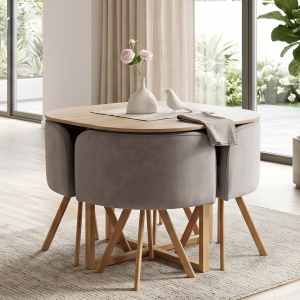
The right pick for a household that has deliberately chosen to size for everyday need rather than an occasional large gathering, then plans to cover rarer overflow with folding chairs or a borrowed seat, is exactly the strategy covered earlier in this guide. The fully tucking chairs free up genuine floor space between meals.
Shop: Space Saving Dining Table With 4 Velvet Chairs
Buying for the Table You Actually Use
The right seat count is rarely the number from your biggest, most memorable gathering. It is the number from an ordinary weekday evening, with a little honest allowance for regular guests and genuine household growth. Work through your own everyday headcount, be honest about how often you really host larger groups, and choose overflow solutions for the rest.
Once you know your target seat count, our complete dining table and chairs buying guide covers exact room measurements, shape and material in full depth. When you are ready to compare options built around real UK household needs, browse the full dining table and chairs range at Kosy Koala.
Recommended Supporting Articles
- Dining Table and Chairs Sets: The Complete UK Buying Guide
- Dining Table Dimensions Guide: How Much Space You Need Per Seat
- Dining Bench vs Dining Chairs: Which Should You Choose?
- How to Assemble a Flat-Pack Dining Table (Step by Step)
- Extendable vs Fixed Dining Tables: Which Suits Your Home?
About the author
This article was written by the Kosy Koala team. We design and source furniture for UK homes, with a focus on practical details that actually matter once a piece is in your room. Have a question about any product on this page? Get in touch through our About Us page.


 Dining Tables
 Dining Chairs

 Bed Frames
 Mattresses
 Bunk Beds
 Sofa & Sofa Beds


