

Blog
Dining Bench vs Dining Chairs: Which Should You Choose?

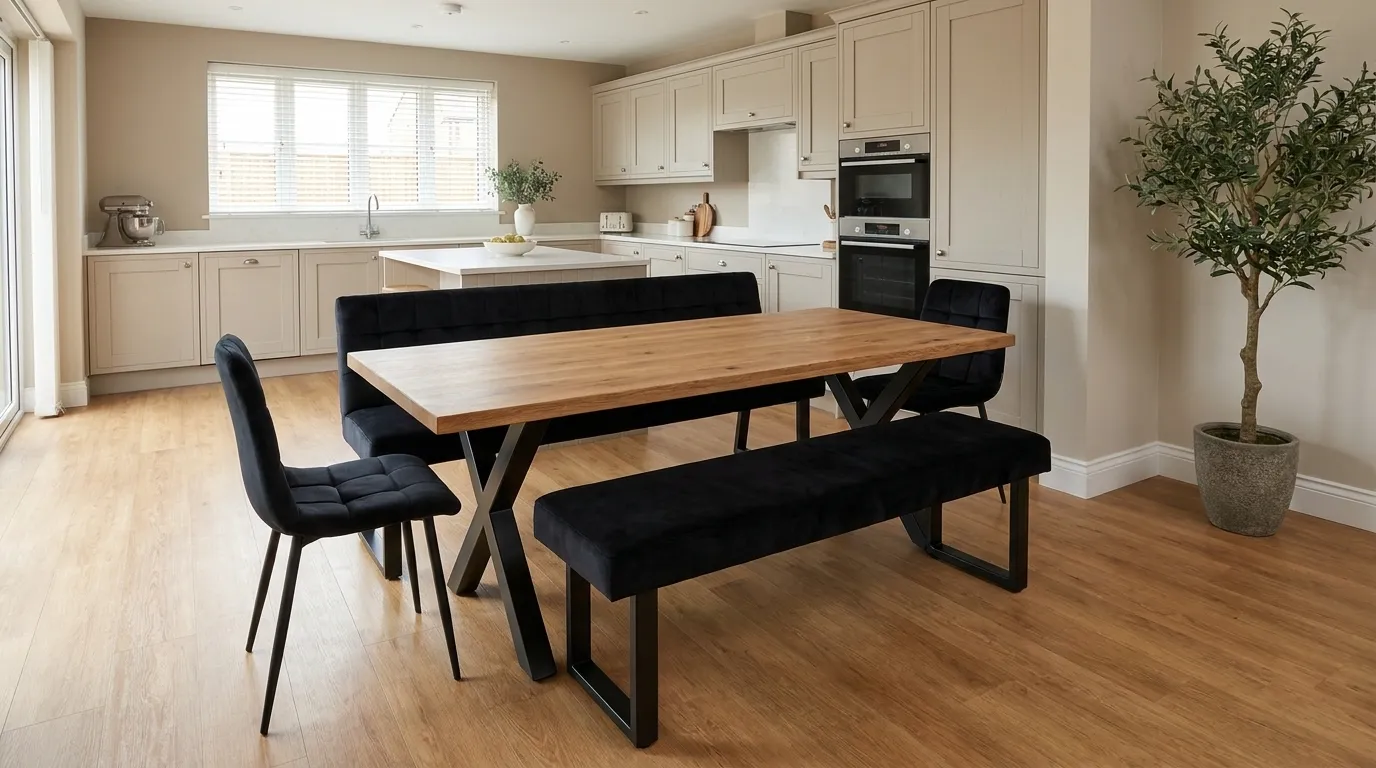
You are choosing a dining table, and now you need to decide on seating. A bench along one side. Chairs all around. Some mix of both. Every option looks fine in a photo, so the decision comes down to how you actually live, not how the room looks on day one.
This guide compares dining benches and dining chairs properly, with real numbers rather than vague impressions. If you have not yet settled on your table’s size or shape, our dining table dimensions guide covers that first. This article picks up from there, focusing specifically on what sits around the table.
Quick answer:
A bench saves genuine floor space, seats more people along the same length of table, and suits a household with children or a fluctuating guest count. Chairs give each person a defined seat and proper back support, which matters more for longer meals. For most households, the best answer is not to choose one exclusively. A bench on one side, paired with chairs on the other, gives you the space-saving benefit where you need it and the comfort of a proper seat where you want it.
What a Bench Actually Offers
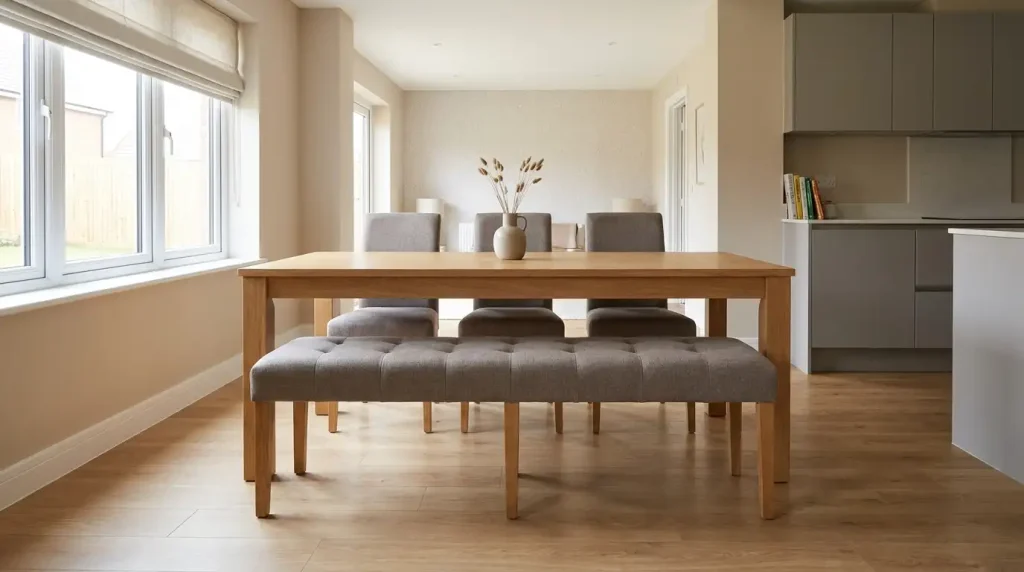
A bench is a single, continuous seat, usually placed along one side of a rectangular table. Its biggest practical advantage is flexibility. Nobody is confined to a fixed seat width. People shuffle along to make room, which matters far more than it sounds during a busy family meal or when an extra guest turns up unannounced.
Benches also tuck fully under the table when not in use, unlike a row of chairs, which always protrude into the room even when pushed in. This genuinely opens up floor space in a smaller kitchen diner, and it removes the visual clutter of several chair backs lined up against a wall.
Our black velvet padded dining bench shows the format well on its own, a 90cm long upholstered seat that works both as dedicated dining seating and as a flexible extra bench elsewhere in the home.
What Individual Chairs Actually Offer
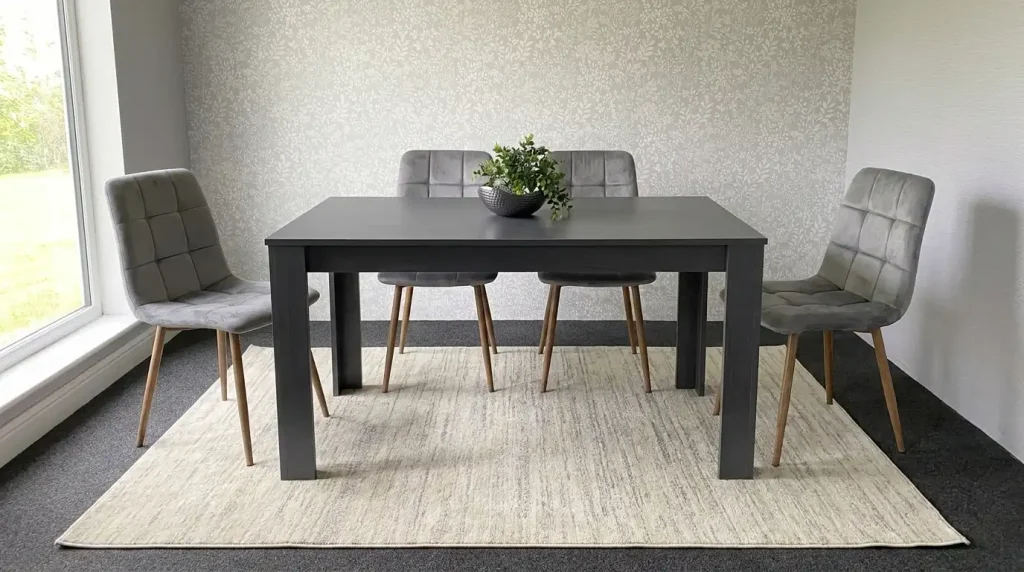
A chair gives each diner a fixed, defined seat with a proper backrest. This matters more than it might seem, particularly for anyone who spends longer than a quick meal at the table. According to Cambridge University Hospitals NHS Foundation Trust’s guidance on seating and ergonomics, a supportive backrest that maintains the spine’s natural curve reduces strain during seated activity, which is exactly what a bench, with no back support at all, cannot offer.
Chairs are also individually mobile. One can be pulled away from the table entirely, used elsewhere in the home, or replaced on its own if it gets damaged, without needing to source a whole matching set again. This flexibility does not exist with a bench, which is a single fixed unit.
Space: The Real Numbers, Not Just “Benches Save Space”
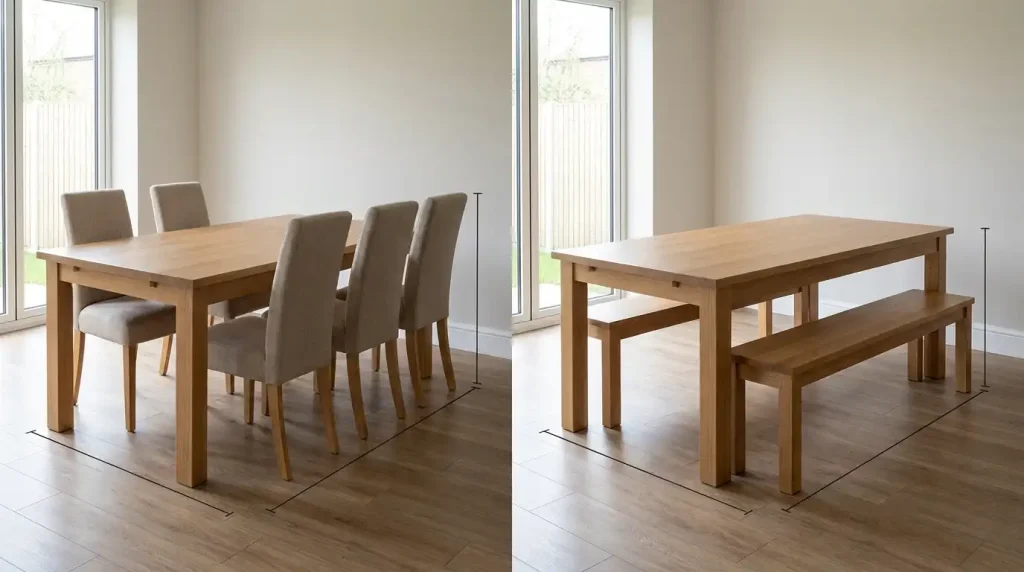
Most comparisons state that benches save space without explaining how much, so it helps to see the actual figures.
Individual chairs need roughly 60cm of table edge per person, following the standard per-seat spacing rule covered in our dimensions guide, and each chair adds its own frame width even when pushed fully under the table. A bench of the same length seats people more flexibly, since there is no fixed per-person division, individual chair legs, or armrests eating into the available width.
| Seating type | Space needed for 3 people |
| 3 individual chairs | Roughly 180cm of table length, allowing standard spacing |
| 1 bench (150cm) | Comfortably seats 3, sometimes a squeezed 4, in less overall length |
The real space-saving, though, comes from what happens when the seating is not in use. A bench that fully tucks under the table gives you back the full width of that side of the room. A row of chairs, even pushed in, still occupies roughly 40 to 50cm of depth from the table’s edge, since a chair cannot slide as far under the table as its own backrest allows.
Getting In and Out: A Detail Worth Real Thought
This is where the two options genuinely diverge, and it depends heavily on where the bench sits.
A bench against a wall is the easiest seating to use for anyone at either end, since there is no chair to pull out or push back in. The trade-off comes for anyone seated in the middle. They need everyone else on that side to shuffle out first before they can leave the table, which can be a genuine inconvenience for a household that eats at different paces or includes young children who regularly need to leave mid-meal.
A freestanding bench, not against a wall, solves this partially, since people can climb over or squeeze past more easily than with a fixed backrest in the way, though this is less comfortable than a proper chair to use for exactly this purpose.
Chairs avoid this problem entirely. Each person can stand up and leave independently, at any point during the meal, without disturbing anyone else at the table. This matters more than it might seem for a household with young children who eat quickly and want to leave the table early, or elderly relatives who need a steady, individual chair to push against when standing.
Comfort for Longer Meals
For a quick weekday breakfast, comfort differences between a bench and a chair barely register. For a long, relaxed Sunday lunch or an evening of conversation after the plates are cleared, the difference becomes real.
A chair with a proper backrest supports a seated position for much longer without discomfort, which is precisely why chairs remain the default choice for formal dining and any household that lingers at the table regularly. A bench, without back support, tends to suit shorter, more casual meals better and becomes noticeably less comfortable the longer people stay seated.
Key note: if your household regularly spends an hour or more at the table, particularly for weekend meals or when hosting, prioritise chairs on at least one side of the table, even if you choose a bench elsewhere for everyday flexibility.
Cleaning and Maintenance
A bench is genuinely easier to clean around. There is one continuous seat to wipe or vacuum, and no individual chair legs to move out of the way when cleaning the floor underneath. This matters more than it sounds in a household with children, where spills and crumbs under the dining table are a near-daily occurrence.
Chairs, by contrast, need to be moved individually for a proper clean underneath, which adds a small amount of extra effort to a routine task, particularly with a larger table seating six or more.
Material matters just as much as shape here. A faux leather or wipeable fabric bench or chair resists spills far better than a delicate fabric, regardless of which seating format you choose. If cleaning ease is the priority, focus on material first and treat benches versus chairs as a secondary decision.
Table Apron Clearance: The Detail Most Buyers Miss
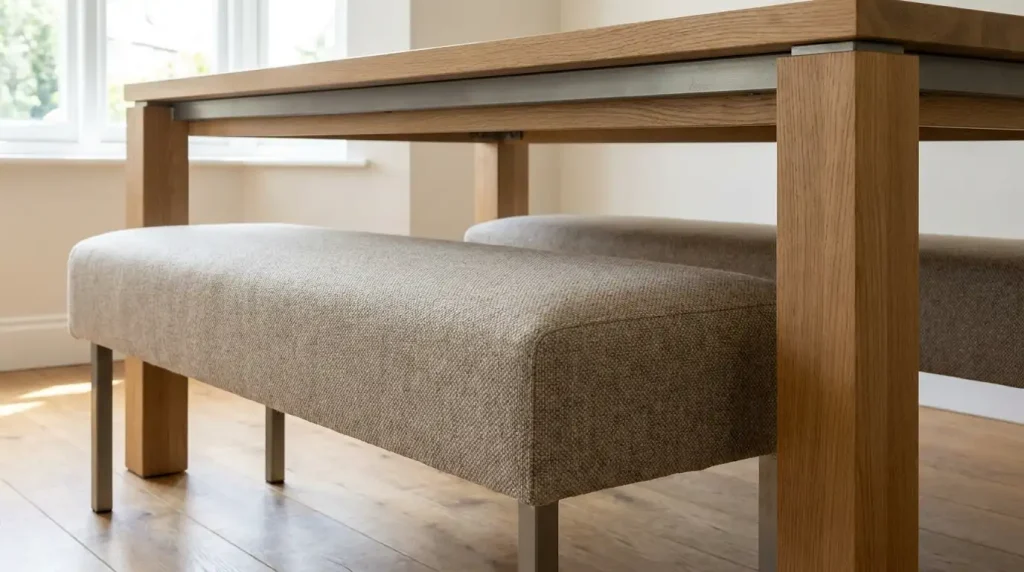
This is a genuinely common oversight, and it is worth checking carefully before you buy a bench to pair with an existing table.
A bench only saves space if it slides completely under the table when not in use. This depends on the table’s apron, the structural frame running under the tabletop, sitting high enough to clear the bench’s own height. If the apron sits too low, the bench either cannot tuck fully under the table or catches against the frame every time it is pushed in.
Key note: check the table’s apron height against your bench’s height before buying them separately. If you are unsure, a matched set, where the table and bench are designed together, removes this risk entirely. Our dark grey dining table set with a matching bench is built with exactly this coordination in mind, so the bench tucks away cleanly without any guesswork.
Stability and Safety of Freestanding Benches
A detail rarely covered elsewhere: a freestanding bench, not fixed to a wall, can tip if weight is placed unevenly near one end, particularly with nobody sitting on the opposite side to balance it. This is worth being aware of in a household with children who might climb onto a bench or stand on one end rather than sit centrally.
Choosing a bench with a wide, stable base and checking the weight distribution across its length reduces this risk considerably. If your household includes young children, it is also worth teaching them to sit centrally on a bench rather than perching at one end, much the same general caution most people already apply to any freestanding furniture in the home.
Cost Comparison
Benches are generally more cost-effective per seat than individual chairs, since you are buying one unit rather than three or four separate pieces, each with its own frame, legs and upholstery. This makes a bench a practical choice for a household stretching a furniture budget across a full dining set.
Chairs, bought individually rather than as a fixed matched set, offer more flexibility to spread the cost over time. A household can start with two chairs and add more as budget allows, something a bench, sold as a single fixed-length piece, does not really allow for.
Style and Visual Weight
A bench has a lower visual profile than a row of chairs, since there is no repeated pattern of chair backs and legs breaking up the space. This tends to make a room feel more open, particularly useful in a smaller kitchen diner or an open-plan space where visual clutter matters more than in a dedicated dining room.
Chairs, particularly a matched set with a consistent back height, bring a more structured, formal look to a room. This suits a traditional dining room or any household that wants a clearly defined, symmetrical table setting for entertaining.
Kids, Guests and Flexible Seating
This is where a bench earns its reputation as the family-friendly choice. Children can shuffle along a bench easily, without needing to manoeuvre a chair, and an unexpected extra guest can often be accommodated simply by everyone budging up slightly, something a fixed number of chairs cannot offer without physically finding another seat.
For households that host larger groups occasionally, this flexibility genuinely matters. A table with chairs on every side has a hard seating limit: the exact number of chairs you own. A table with a bench on one side has a softer limit, since the bench can typically accommodate one more person than its “official” seat count in a pinch.
The Hybrid Approach: Bench on One Side, Chairs on the Other
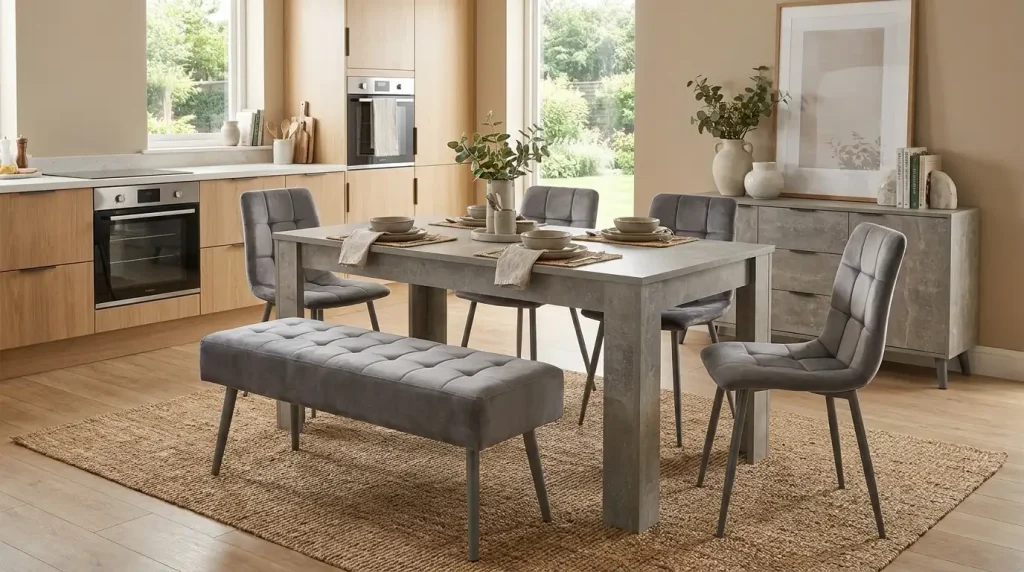
For most households, this is genuinely the best answer, not a compromise. A bench along one side, paired with individual chairs on the other and at either end, gives you the flexibility and space-saving benefit of a bench exactly where it helps most, alongside the comfort and individual seating of chairs where that matters more.
This arrangement suits a family particularly well. Children sit on the bench, where shuffling in and out is easy and spills are simple to wipe clean, while adults use chairs with proper back support for longer meals. Our dining table set with four chairs and a bench reflects exactly this balance, giving a household six seats total without committing fully to either format.
Which Table Shapes Work With a Bench
Not every table shape suits a bench equally well. This is worth checking before you commit to the format.
Rectangular tables are the natural pairing for a bench, since a straight side gives the bench a flush, stable edge to sit against, and the bench slides neatly under a straight tabletop edge when not in use. Round and square tables generally do not work well with a bench, since there is no long, straight side for the bench to sit flush against, and chairs remain the more practical choice for these shapes.
If you already know you want a bench, choosing a rectangular table from the outset avoids this mismatch entirely.
A Simple Decision Framework
Work through these questions to land on the right seating for your household.
- Does your household include young children or a fluctuating guest count? Lean toward a bench or the hybrid approach for genuine flexibility.
- Do you regularly spend an hour or more at the table? Prioritise chairs, at least on the side used most for longer meals.
- Is floor space genuinely tight in your dining area? A bench that tucks fully under the table offers real, measurable space-saving.
- Do you want to spread the cost of seating over time? Individual chairs, bought as budget allows, offer more flexibility than a single fixed bench purchase.
- What shape is your table? A bench suits a rectangular table well, but is a poor fit for round or square shapes.
Common Mistakes
- Buying a bench without checking the table’s apron height results in a bench that cannot tuck fully under the table as intended.
- Choosing a bench for a round or square table, where there is no straight edge for it to sit against properly.
- Assuming a bench will always be more comfortable for long meals, when the lack of a backrest genuinely limits comfort over time compared to a proper chair.
- Placing a freestanding bench without considering stability, particularly in a household with children who might stand at one end.
- Choosing chairs based on looks alone, without checking that they clear the table height correctly, is covered in more depth in our buying guide.
- Assuming a mixed bench and chair set always looks mismatched. A considered pairing, where finishes coordinate even if the shapes differ, generally looks entirely intentional rather than accidental.
Long-Term Wear: How Each Option Ages
Durability differs between the two formats in ways that only become obvious after a year or two of daily use, worth knowing before you commit either way.
A bench spreads wear more evenly along its length, since different people tend to sit in slightly different spots over time, rather than one fixed cushion bearing the same weight in the same place every single day. Chairs, by contrast, often show more concentrated wear, particularly if the same family members sit in the same seat at every meal, which can lead to one or two chairs showing more fading or cushion compression than the others in the set.
Frame joints matter just as much as upholstery. A bench has fewer structural joints overall than the equivalent number of individual chairs, which can mean fewer points of potential weakness over years of daily use, provided the bench itself is well built. Individual chairs, if one develops a fault, are easier to replace on their own without needing to source an entirely new matching set, which is a genuine advantage chairs hold over a bench that develops a structural issue.
Frequently Asked Questions
Is a dining bench more comfortable than chairs?
For short, casual meals, a bench works well. For longer meals, chairs are generally more comfortable, since a proper backrest supports the body in a way a bench cannot.
Does a bench really save floor space?
Yes, but only if it fully tucks under the table when not in use. Check the table’s apron height against the bench’s own height before buying them separately.
Can I mix a bench and chairs at the same table?
Yes, and for many households, this is the best solution. A bench on one side with chairs on the other and at the ends balances flexibility with individual comfort.
Are benches safe for households with young children?
Generally, yes, and children often find them easier to use than chairs. A freestanding bench, not against a wall, is worth choosing with a stable, wide base, and it is worth encouraging children to sit centrally rather than at one end.
Do benches work with round dining tables?
Not well. Benches need a straight edge to sit flush against, which makes them a poor fit for round or square tables. Chairs are the more practical choice for these shapes.
Is it cheaper to buy a bench or individual chairs?
A bench is usually more cost-effective per seat, since you are buying one unit rather than several. Chairs offer more flexibility to spread the cost over time, since they can be bought individually as budget allows.
Choosing Seating That Fits How You Actually Eat
There is no single correct answer in the bench versus chairs decision. A bench earns its place through flexibility, space-saving, and ease with children. Chairs earn their value through individual comfort and proper back support for longer meals. For most households, a hybrid approach, a bench where flexibility matters most and chairs where comfort matters most, gives you the practical benefit of both.
For the fuller picture on choosing your table’s shape, size and material alongside your seating, our complete dining table and chairs buying guide and our dining table dimensions guide both cover the wider decision in depth. When you are ready to compare seating options directly, browse the full dining table and chairs range at Kosy Koala.
Four Kosy Koala Picks for Bench and Chair Seating
A shortlist covering both approaches and the hybrid combination, from our own range.
Black Velvet Padded Dining Bench
Best standalone bench Size: 90cm (L) x 36cm (W) x 47cm (H).
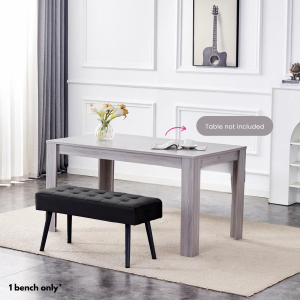
A freestanding bench that works both as dedicated dining seating and as a flexible extra seat elsewhere in the home. The tufted velvet seat and sturdy metal legs suit a household that wants the flexibility of a bench without committing to a full matching set.
Shop: Black Velvet Padded Dining Bench
Modern Dining Table Set With 4 Black Velvet Chairs
Best for households prioritising individual comfort. Table: H75 x L134 x W70 cm. Chairs: H87 x L59 x W44 cm, seat height 45cm.
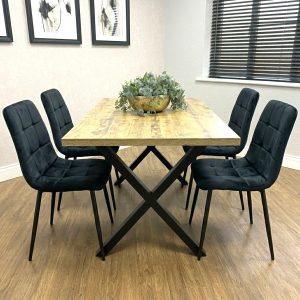
A genuine4-seaterr built entirely around individual chairs, with reinforced X-shaped legs on both the table and seating for real daily stability. The right choice for a household that regularly spends longer at the table and wants a proper backrest on every side.
Shop: Modern Dining Table Set With 4 Black Velvet Chairs
White and Black Dining Table With 4 Faux Leather Chairs
Best for Busy Households Table: H75 x L140 x W80 cm Chairs: H85 x L52 x W44cm, seat height 44cm Best for: families wanting an easy-clean set without compromising on style.
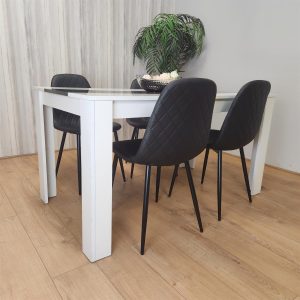
The UV-painted MDF surface is built for daily wipe-down cleaning, while the diamond-stitched faux leather chairs resist spills far better than fabric. A genuinely practical choice for a household eating together every day.
Shop: White and Black Dining Table With 4 Faux Leather Chairs
Dining Table and 4 Grey Velvet Chairs, Live-Edge Wood
Best for a dedicated chairs-only dining room Table: 117cm (L) x 77cm (W) x 75cm (H). Chairs: H87 x L59 x W44 cm, seat height 44cm.
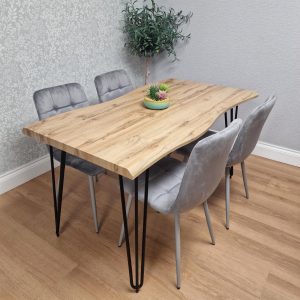
For a household that has decided chairs suit their routine best, this set pairs a characterful live-edge wooden top with genuinely comfortable tufted velvet chairs, built for a room used for longer, more relaxed meals rather than quick sittings.
Shop: Dining Table and 4 Grey Velvet Chairs, Live-Edge Wood
Browse the full range, including benches sold separately, at Kosykoala dining table sets.
Recommended Supporting Articles
- Dining Table and Chairs Sets: The Complete UK Buying Guide
- How Many Seats Do You Actually Need at Your Dining Table?
- Dining Table Dimensions Guide: How Much Space You Need Per Seat
- How to Assemble a Flat-Pack Dining Table (Step by Step)
- Extendable vs Fixed Dining Tables: Which Suits Your Home?
About the author
This article was written by the Kosy Koala team. We design and source furniture for UK homes, with a focus on practical details that actually matter once a piece is in your room. Have a question about any product on this page? Get in touch through our About Us page.


 Dining Tables
 Dining Chairs

 Bed Frames
 Mattresses
 Bunk Beds
 Sofa & Sofa Beds


