

Blog
Round vs Rectangular 4 Seater Dining Tables: Which Fits Better?

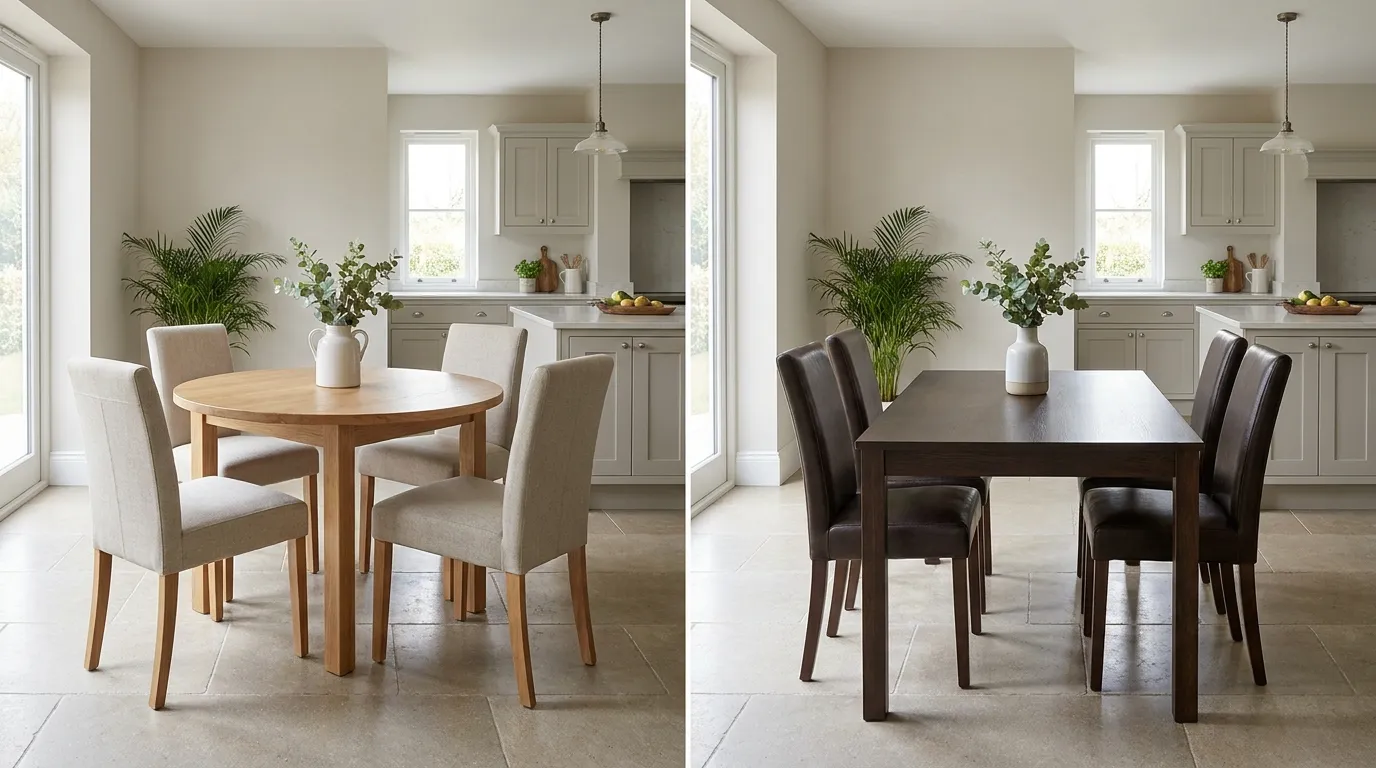
Same seat count. Same room. A completely different feeling. A round table and a rectangular table at four seats can occupy a similar footprint, yet live in a space in genuinely different ways. One softens a room. The other defines it.
This guide compares the two shapes properly, with real measurements rather than vague style opinions. If you have not yet settled on size, our 4 seater vs 6 seater comparison is worth reading first. This article assumes four seats, and focuses entirely on getting the shape right.
Quick answer: a round table generally suits a small or square room best, since it removes the corners that eat into circulation space and softens movement around a tight footprint. A rectangular table suits a long, narrow room, or a kitchen diner where pushing one side against a wall genuinely matters. Neither shape is universally better. Your room’s own proportions, not personal taste alone, should make this decision.
The Real Difference: Space Efficiency, With the Actual Maths
Most guides claim round tables “save space” without showing the numbers. Here is the actual comparison.
A round table at 90cm diameter has a footprint of roughly 0.64 square metres. A rectangular table at 120cm by 70cm, a common 4 seater size, has a footprint of roughly 0.84 square metres. On paper, the round table takes up less floor area for the same seat count, which is where the “round saves space” claim comes from.
But footprint alone does not tell the whole story. A round table has no corners, which means the clearance zone around it, the space a chair needs to pull out and be used, forms a smooth circle rather than a rectangle with unused space at each corner. In a genuinely square room, this circular clearance zone uses the room’s own shape efficiently. In a long, narrow room, that same circular clearance zone wastes space at the room’s own narrow ends, space a rectangular table’s straight sides would use far more effectively.
Key note: the winner on space efficiency depends entirely on your room’s shape, not the table’s footprint in isolation. A round table wins in a square room. A rectangular table wins in a long, narrow one.
Room Shape Decides More Than Room Size
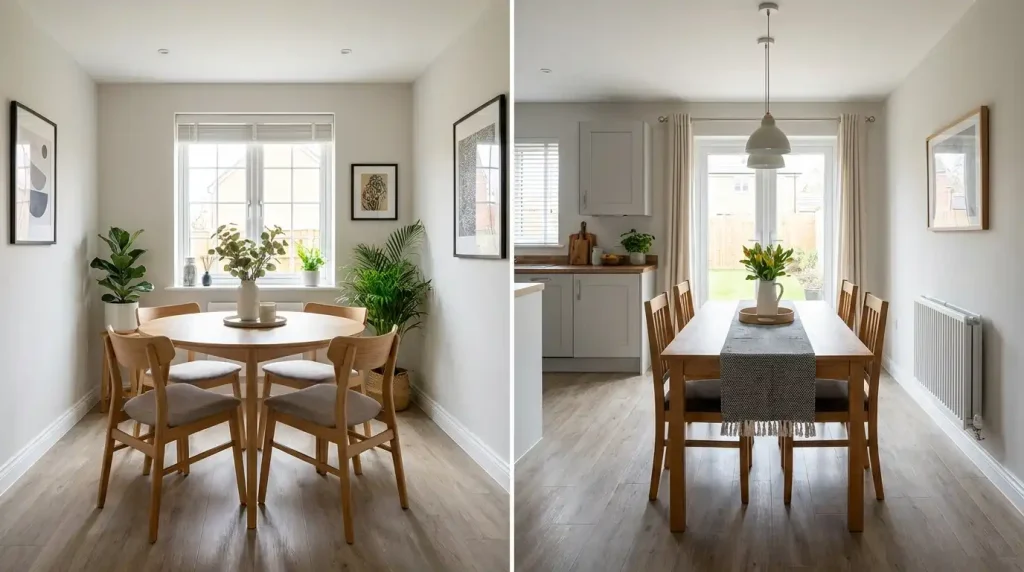
This is the principle worth internalising before anything else in this guide. Two rooms of an identical total area, one square and one long and narrow, need genuinely different table shapes to use that area well.
In a square room, a round table sits centred with even clearance on every side, using the room’s own proportions naturally. A rectangular table in the same square room often leaves awkward, unused space at two opposite ends, since the table’s own shape does not match the room’s. In a long, narrow room, the reverse applies. A rectangular table runs with the room’s length, using the full space efficiently, while a round table of a similar footprint leaves the narrow ends of the room comparatively empty and underused.
Our 4 seater dining table dimensions guide covers the exact clearance figures to check against your own room, whichever shape you are leaning toward.
Walking Around a Table: Why Corners Matter More Than You Think
A rectangular table’s corners do two things that a round table’s edge never has to deal with. They create a fixed pinch point that anyone walking past must navigate around, and they concentrate wear and bruised hips in exactly the same spot, meal after meal, year after year.
A round table removes this entirely. There is no single point where the table juts furthest into the room, which means movement around it feels more forgiving in a tight kitchen diner or a narrow route between the table and a nearby wall or unit. This is a genuine, physical reason round tables read as easier to live with in a compact space, not just a stylistic preference.
Conversation and Everyday Feel
Shape changes how a meal feels, not just how the table fits the room. Around a round table, everyone sits roughly equidistant from everyone else, with no natural head of the table and no one person structurally set apart from the group. This tends to suit everyday family meals and casual conversation well, since nobody is positioned as more central than anyone else.
A rectangular table creates a more defined structure, with a natural head position at each end and a slightly more formal feel along the two long sides. This suits a household that values a bit more structure to their dining setup, or entertains in a way where a clearer seating arrangement matters.
Neither feel objectively better. It is worth being honest with yourself about which everyday atmosphere actually suits how your household eats together most nights.
Safety: Corners and Households With Children
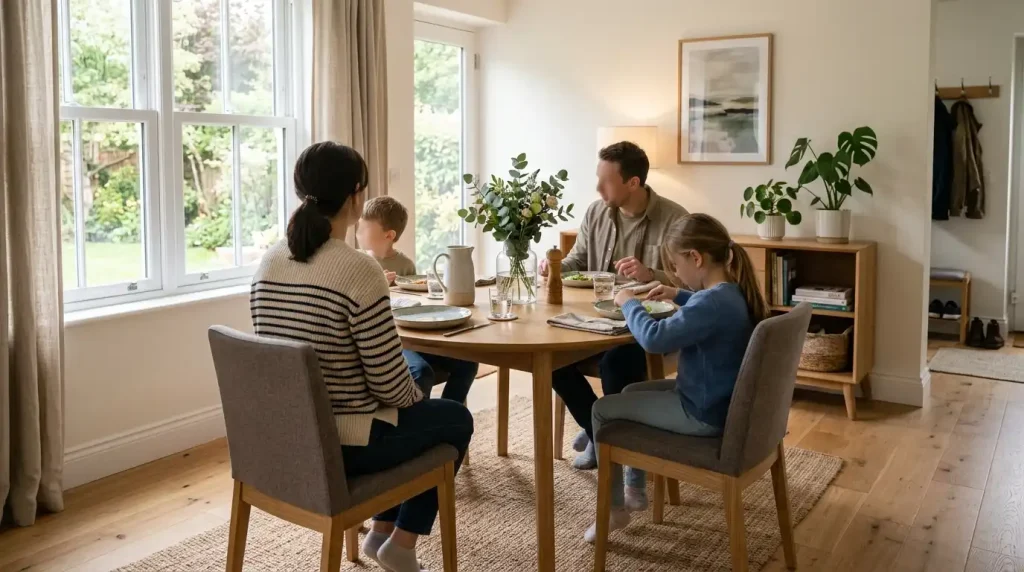
This is a genuine, practical consideration worth including plainly rather than treating as a minor detail. A rectangular table’s corners sit at a height that lines up with a young child’s head or face, and a bumped corner is one of the more common minor household injuries in a busy kitchen or dining area. A round table removes this specific risk entirely, since there is no hard corner at any point around its edge.
This does not mean a rectangular table is unsafe. It simply means a round table offers one less thing to think about in a household with toddlers or young children who are still learning to navigate furniture safely. If this is a genuine priority in your home, it is worth weighing alongside the room-shape principle covered earlier in this guide.
Chair Flexibility: Fixed Seats vs Flexible Spacing
A rectangular table generally has a fixed, expected chair arrangement, two per long side and often one at each end, following the standard 60cm per-seat spacing covered in our dining table dimensions guide. Adding an extra chair asymmetrically tends to look and feel obviously improvised.
A round table is more forgiving here. Chairs can be spaced slightly closer together around the rim to squeeze in one extra seat for an occasional guest, without the same visibly lopsided result a rectangular table gives when a fifth chair gets added to one side only. This is a small but genuine practical advantage for a household that occasionally needs one seat more than their standard four, without wanting to commit to a full 6-seater purchase.
Style and Visual Weight
Shape affects how a table reads in a room, separate from its actual footprint. A round table, particularly in glass, tends to feel lighter and less imposing, since there is no long, straight edge drawing the eye across the room. This suits a smaller space where you want the table to feel like a considered addition rather than the room’s dominant feature.
A rectangular table, especially a longer one, anchors a room more firmly and suits a space that benefits from a clear, defined dining zone, such as an open-plan kitchen diner where the table needs to visually separate the dining area from the cooking space. Our round glass dining table with four black chairs shows the lighter, softer read a round glass top gives a room, while our black marble effect rectangular table with four black velvet chairs shows how a rectangular shape can carry a bolder, more anchoring finish.
Which Suits a Kitchen Diner
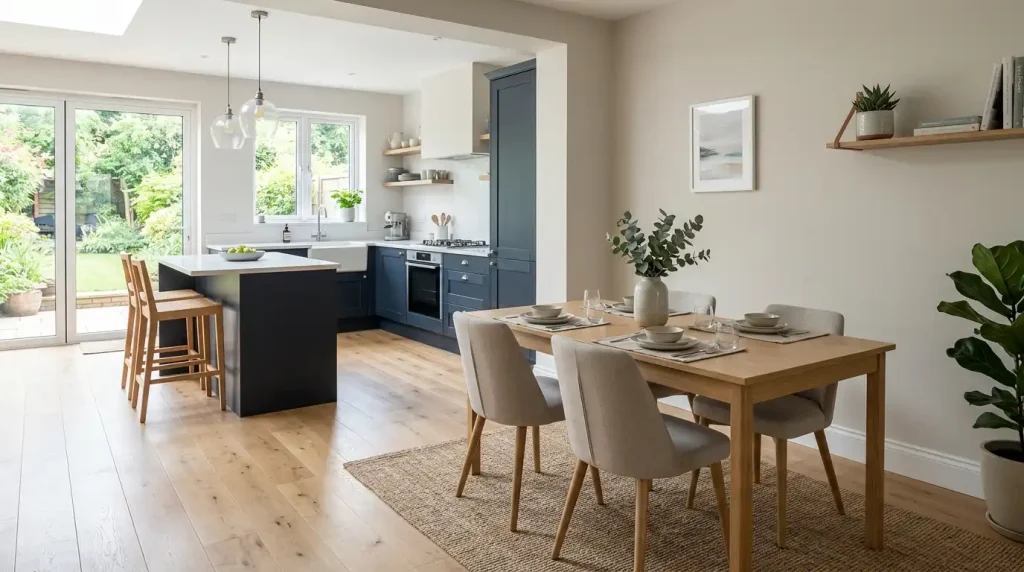
Kitchen diners deserve a specific mention here, since this is the room type where the shape decision matters most in daily life, not just in photographs. A round table suits a kitchen diner with limited floor space and no clean, spare wall to work with, since it can sit more centrally without corners catching against nearby units. A rectangular table suits a kitchen diner with a defined spare wall, since it can be pushed flush against that wall and used on three sides only, freeing up genuine floor space that a round table’s shape cannot replicate in the same way.
Our full guide to the best 4 seater dining set for a small kitchen diner covers this specific layout question in far more depth, including how to measure around kitchen units properly.
Extending Later: Which Shape Copes Better
If there is any chance you might want more seating down the line, shape affects your options considerably. Rectangular tables are, by a wide margin, the more common format for extendable mechanisms, since a butterfly or pull-out leaf naturally continues a straight edge. Round tables can extend too, typically becoming oval once a leaf is added, but the format is less common and generally offers a smaller range of choice in the UK market.
If growing into a larger table is a genuine possibility for your household, a rectangular shape keeps that option more open than a round one does. Our extendable versus fixed dining table comparison covers this decision in full, worth reading if flexibility matters as much to you as shape itself.
Materials and How They Interact With Shape
Material choice interacts with shape more than most buyers expect. Glass, in particular, behaves differently depending on whether it tops a round or rectangular frame.
A round glass table tends to read as the lightest option of all, since the curved edge has no long straight line to draw the eye across the room, and the material’s transparency does the rest of the work keeping the space feeling open. A rectangular glass table still keeps a room feeling airy, but the longer straight edges give it a slightly more defined, architectural presence than a round equivalent of the same material.
Solid wood and marble-effect finishes tend to suit rectangular tables particularly well, since the material’s own visual weight pairs naturally with the more structured, anchoring feel a rectangular shape already brings to a room. A heavier material on a round table can occasionally fight against the softness the shape is otherwise trying to achieve, though this is a matter of degree rather than a firm rule.
A Worked Example
Consider a household in a new-build flat with a genuinely square open-plan living and dining area, roughly 3.2 metres in both directions. A round table at 90cm diameter sits naturally in this space, with even clearance on every side and no awkward leftover floor area at any point around it. A rectangular table of a similar footprint, placed in the same square room, would likely leave two opposite ends of the room with noticeably more spare floor than the other two sides, since the room’s own proportions do not match the table’s shape.
Now consider a household in a Victorian terrace with a long, narrow kitchen diner, roughly 4.5 metres long but only 2.4 metres wide. Here, a rectangular table run lengthways with the room uses the available floor far more efficiently than a round table would, since a round table’s circular clearance zone would waste space at both narrow ends of the room while still needing the same width clearance a rectangular table needs only along its two long sides.
Neither household is choosing based on taste alone. In both cases, the room’s actual shape, not just its overall floor area, determines which table shape genuinely fits without waste.
Common Mistakes
- Choosing a shape based on style alone: without considering whether your room is actually square, long, or narrow.
- Assuming round always saves more space: It only does in a room shape that suits a circular footprint. A long, narrow room is usually better served by a rectangular table.
- Ignoring corners as a genuine safety factor: Particularly relevant for households with young children navigating a busy kitchen.
- Ordering a round table expecting to seat six later: Round tables scale poorly beyond four to six seats, since the diameter needed becomes impractical.
- Overlooking extension options if flexibility matters: Rectangular shapes offer far more choice if you might need extra seating down the line.
A Quick Decision Framework
- Is your room square or roughly equal in both directions? Lean toward round.
- Is your room long and narrow, or does it need to run alongside a spare wall? Lean toward rectangular.
- Do you have young children navigating the space regularly? Round removes a genuine, if minor, safety consideration.
- Might you need to extend to six seats in future? Rectangular gives you far more choice if this matters.
- What feel do you want at the table itself? Round suits equal, casual conversation. Rectangular suits a more structured, defined seating arrangement.
Frequently Asked Questions
Is a round or rectangular table better for a small room?
It depends on the room’s shape, not just its size. A round table suits a small square room well. A rectangular table suits a small but long, narrow room better, since it can use the full length efficiently.
Do round tables really save floor space?
Sometimes. A round table’s own footprint is often smaller than a rectangular equivalent at the same seat count, but the clearance space needed around it forms a circle, which can waste space in a room shaped differently to that circle.
Are round tables safer for households with children?
They remove hard corners entirely, which is a genuine, if modest, safety benefit in a busy kitchen or dining area with young children still learning to navigate furniture.
Can a round table be extended to seat more people?
Some can, typically becoming oval with an added leaf, but the format is less common in the UK market than rectangular extending tables, and generally offers less choice.
Which shape suits an open-plan kitchen diner better?
It depends on your layout. A round table suits a kitchen diner with limited spare wall space, while a rectangular table suits one with a defined wall to push against, using a three-side seating layout.
Does chair spacing work differently for round versus rectangular tables?
Yes. Rectangular tables generally have a fixed, expected arrangement per side. Round tables allow chairs to be spaced more flexibly around the rim, making it easier to squeeze in one extra seat occasionally.
Do round tables use materials differently to rectangular tables?
Glass tends to read as lighter on a round table, since there is no long straight edge to draw the eye across the room. Heavier materials such as marble-effect finishes generally suit rectangular tables, where the visual weight pairs naturally with the shape’s more structured feel.
Is one shape genuinely more expensive than the other?
Not consistently. Price differences between round and rectangular tables at the same seat count generally come down to material and finish rather than shape itself.
Choosing the Shape That Suits Your Room
There is no universally better shape between round and rectangular. The right choice comes down to your room’s actual proportions, whether children are navigating the space daily, and whether future flexibility matters to your household. Measure your room’s shape, not just its size, and the right table shape becomes considerably clearer than personal preference alone could make it.
For the exact dimensions to check once you have a shape in mind, our 4 seater dining table dimensions guide covers the full measuring process. For the style decision alongside shape, our 4 seater dining set styles guide is worth reading too. When you are ready to compare shapes directly, browse the full 4 seater dining set collection at Kosy Koala.
Five Kosy Koala Sets: Round vs Rectangular Compared
Three round options and two rectangular, so you can compare the shapes directly within our own range.
Round Black Glass Dining Table With 4 Black Chairs
Round, 90cm diameter.
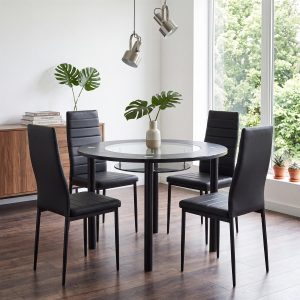
A compact, corner-free footprint suited to a small square room or a tight kitchen diner where movement space matters most.
Shop: Round Black Glass Dining Table With 4 Black Chairs
Round Glass Dining Table With 4 White and Black Chairs
Round, 90cm diameter.
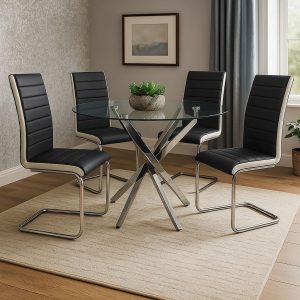
A lighter, contemporary take on the round format, well suited to a room that benefits from an open, less visually heavy tabletop.
Shop: Round Glass Dining Table With 4 White and Black Chairs
Round Glass Dining Table With 4 Velvet Chairs
Round, 90cm x 90cm.
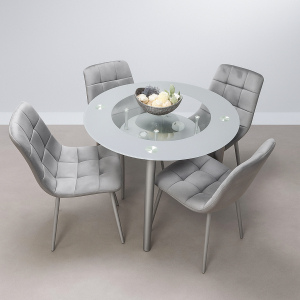
A softer, more upholstered round option, suited to a household that wants the space-saving benefit of a round shape without sacrificing seat comfort.
Shop: Round Glass Dining Table With 4 Velvet Chairs
Black Marble Effect Dining Table With 4 Black Velvet Chairs
Rectangular, 120cm x 70cm.
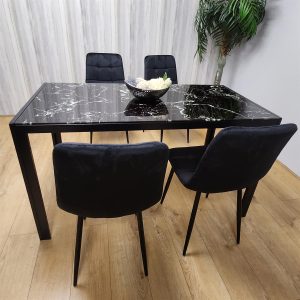
A bolder rectangular option that anchors a room and suits a defined dining zone, particularly effective pushed against a spare wall in a kitchen diner.
Shop: Black Marble Effect Dining Table With 4 Black Velvet Chairs
Modern Rectangle Glass Dining Table With 4 Mustard Gem Pattern Chairs
Rectangular, 120cm x 70cm.
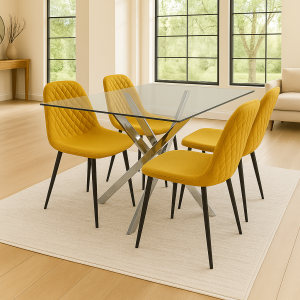
A rectangular option with a distinctive chair finish, suited to a longer, narrower room that benefits from a table running with the space rather than against it.
Shop: Modern Rectangle Glass Dining Table With 4 Mustard Gem Pattern Chairs
Browse the full range at kosykoala 4-seater dining set
About the author
This article was written by the Kosy Koala team. We design and source furniture for UK homes, with a focus on practical details that actually matter once a piece is in your room. Have a question about any product on this page? Get in touch through our About Us page.


 Dining Tables
 Dining Chairs

 Bed Frames
 Mattresses
 Bunk Beds
 Sofa & Sofa Beds


