

Blog
4 Seater vs 6 Seater Dining Table: Which Size Do You Need?

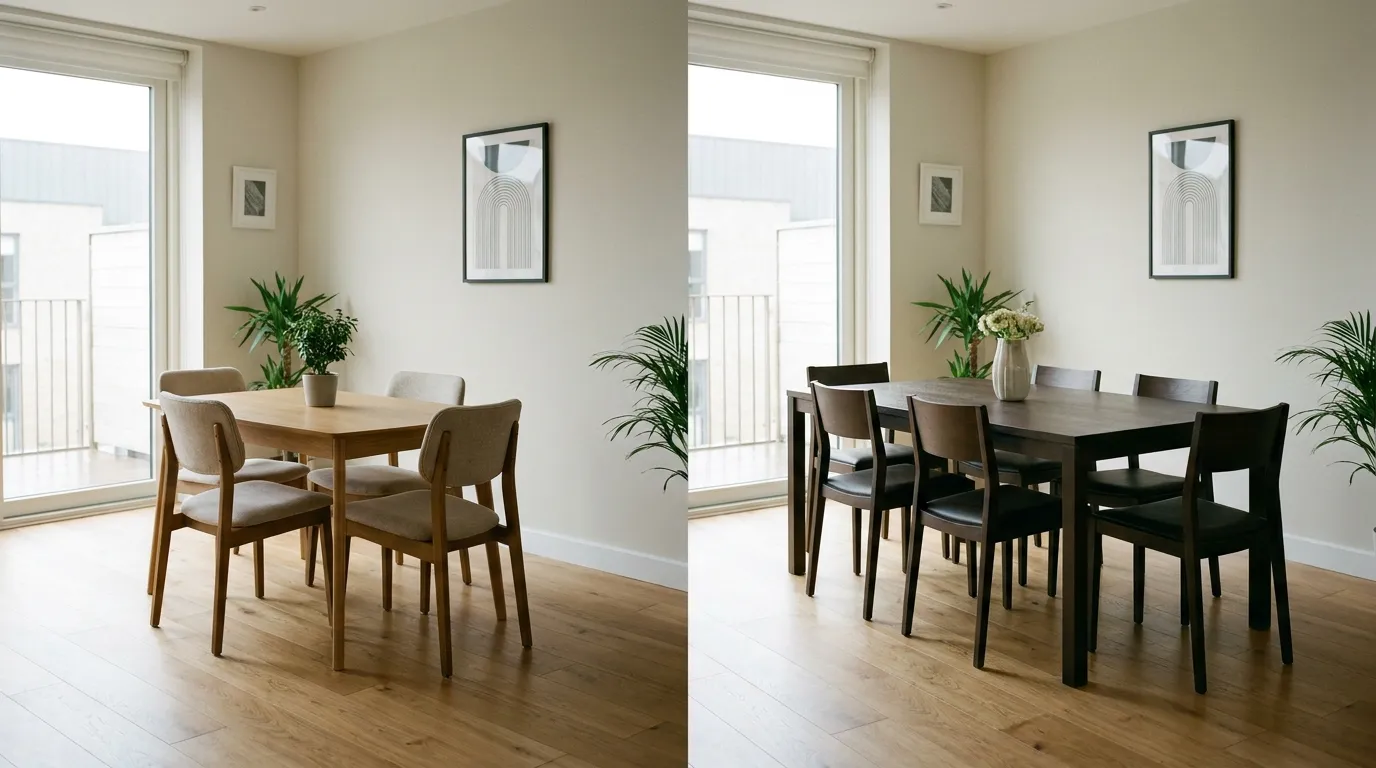
Two numbers separate these tables, but they change everything else. Floor space. Price. Hosting habits. Even how a room feels day to day. Getting this one decision right matters more than the finish, the shape, or the colour.
This guide compares 4-seater and 6-seater dining tables directly, with real measurements and a genuine decision framework. If you want the fuller picture on style once you have settled on size, our 4-seater dining set styles guide covers that separately. This article focuses purely on the size decision itself.
Quick answer:
Choose a 4-seater if your household regularly seats two to four people and your room is under roughly 3 metres in one direction. Choose a 6-seater if your household regularly seats five or six, or if you host larger groups more than a handful of times a year and have a dedicated dining zone or open-plan kitchen diner to fit it in. If you are genuinely torn between the two, our wider guide to how many seats you actually need walks through the household-by-household framework in more depth.
The Real Difference at a Glance
|
4 Seater |
6 Seater | |
| Typical table length | 90 to 120cm | 134 to 160cm |
| Minimum room length needed | Around 280cm | Around 340 to 400cm |
| Typical UK price | £160 to £250 | £220 to £300 |
| Best suited to | Couples, small families, flats | Larger families, regular hosts |
| Everyday feel | Intimate, conversational |
Spacious, sociable |
These figures are general ranges rather than fixed rules, but they hold true across most of the UK dining sets on the market, including our own range.
Room Size: What Each Size Actually Needs
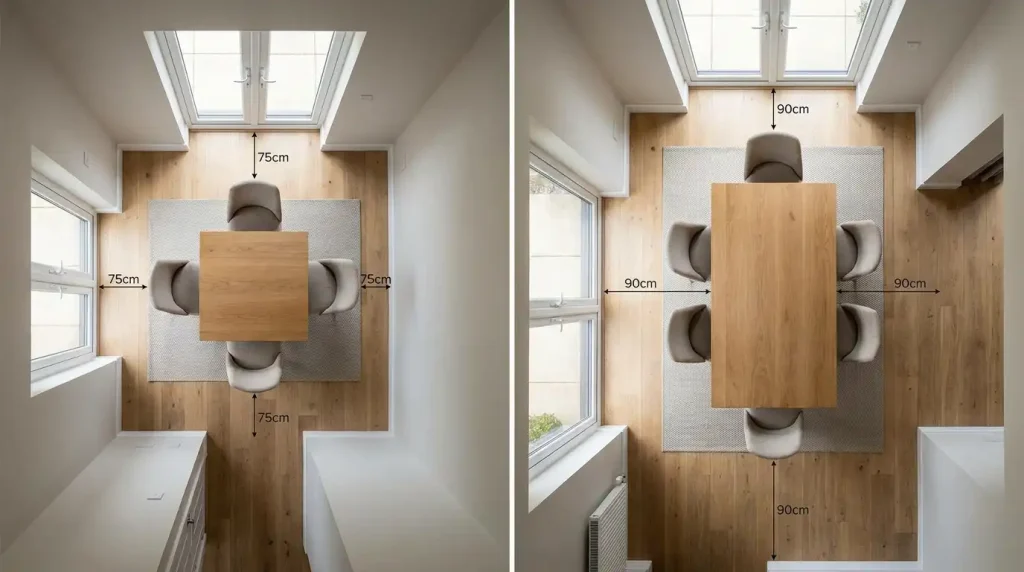
This is where the decision usually gets made, whether buyers realise it or not. The table itself is only half the measurement. Chairs need room to pull out, and people need room to walk past a seated guest.
A 4-seater table, typically 90 to 120cm long, needs a room of roughly 280cm in the direction the table sits, once you account for the table’s footprint plus clearance on each side. A 6 seater, typically 134 to 160cm long, needs closer to 340 to 400cm in the same direction. That difference, often a full metre or more, is usually the single biggest factor in which size actually works in your home.
Our 4-seater dining set dimensions guide covers the exact measuring process for the smaller size in full detail, including how to check your own room before you order rather than after.
Key note: measure your room before you fall in love with a specific table. A 6 seater that looks perfect in a product photo can feel genuinely cramped in a room that was only ever going to comfortably fit four.
Household Fit: Who Should Choose Which
Size should follow household, not the other way around. Here is how the two sizes map onto real UK households.
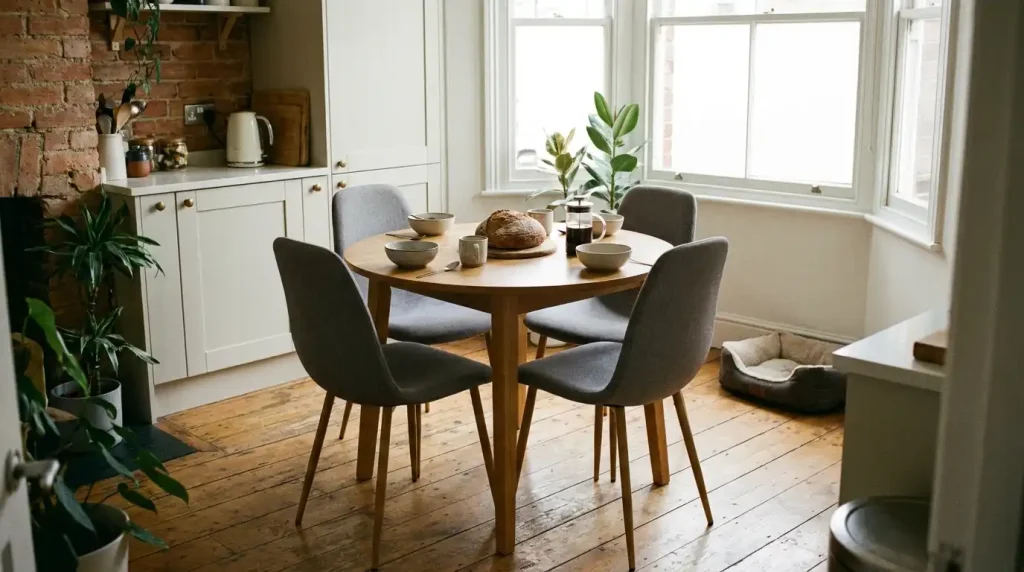
A 4-seater suits a couple, a small family of three or four, or anyone in a flat or a compact kitchen diner. It keeps the room feeling calm and conversational, since four people around one table tend to share a single conversation rather than splitting into separate pairs.
A 6-seater suits a family of five or six, or a smaller household that hosts regularly enough that extra seats get genuine daily-adjacent use, not just an annual outing. It gives a household room to grow into, and it removes the recurring hunt for extra chairs that a 4-seater household faces every time guests turn up.
Hosting Habits: The Question That Settles It
If room size and household headcount still leave you torn, hosting frequency is usually the deciding factor. Ask yourself two questions. How many people eat at your table on a normal evening? How many people do you host at your biggest gathering of a typical year?
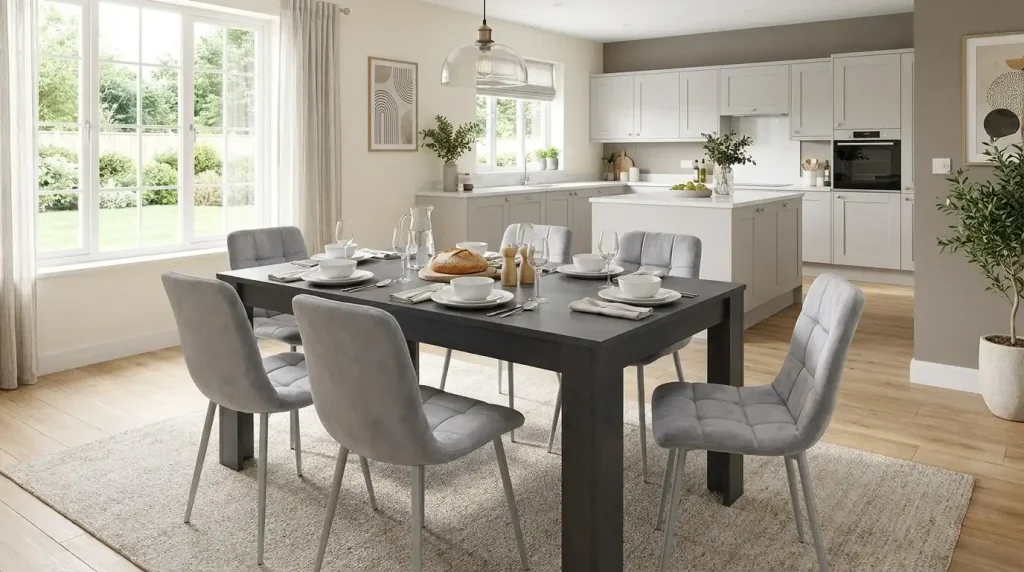
If those two numbers sit close together, a 4-seater almost always makes more sense, since a 6-seater would sit mostly underused for the rest of the year. If the gap is wide, and your peak number of five or six shows up more than a few times a year, a 6-seater earns its extra floor space through genuine, repeated use rather than a single occasion.
Our dining table seating guide covers this everyday-versus-peak framework in far more depth, including how to handle a genuinely rare gap without buying a permanently larger table.
Price Difference: What You Are Actually Paying For
A 6-seater set typically costs £40 to £60 more than an equivalent 4 seater in the same style and material, reflecting two extra chairs and a longer, sturdier table frame rather than a proportional jump in price. This is worth knowing if budget matters as much as size, since the difference is usually smaller than buyers expect before checking real prices.
Our Modern Rectangle Grey Glass Dining Table Set With 4 Grey Velvet Chairs and its six seat counterpart, the Modern Rectangle Grey Glass Dining Table Set With 6 Grey Velvet Chairs, show this well. Same finish, same chair style, with the price difference reflecting the two additional chairs and a longer table rather than a different tier of quality altogether.
Shape Considerations for Each Size
Shape and size interact more than most buyers expect. A round table works well as a 4-seater, since a round shape at 90 to 100cm diameter keeps a compact footprint with no corners to work around. Round tables scale poorly beyond four seats, since the diameter needed for six quickly becomes difficult to reach across.
A rectangular table suits both sizes comfortably, but it is the only practical shape for a genuine 6-seater in most UK rooms. If shape is still an open question for you, our dedicated guide to round vs rectangular dining tables covers exactly how each shape performs at different seat counts.
The “In-Between” Household: A Concrete Rule
Many households genuinely sit between the two sizes, four people most days, five or six a couple of times a month. Rather than defaulting to whichever size feels safer, use this rule: if your fifth and sixth seats would be used more than twice a month, buy the 6-seater. If they would be used less often than that, a 4-seater paired with a couple of stored folding chairs almost always works out better in daily life, since the room stays open the rest of the time.
This rule matters because the cost of getting it wrong is not symmetrical. A 6-seater that is too big for daily life sits underused every single day. A 4-seater that is occasionally one seat short is solved in minutes with a spare chair pulled from another room.
Buying 4 Now, Adding Chairs Later: Does It Work?
This is a genuine question worth answering honestly, since it comes up often. In most cases, no, not cleanly. A 4-seater table is generally sized specifically for four place settings, following the standard 60cm per seat spacing covered in our wider dining table dimensions guide. Adding two more chairs to a table built for four usually results in cramped seating rather than a genuine sixth and seventh place.
If you suspect your household might grow into needing six seats within a couple of years, it is generally better to buy the 6-seater from the outset, even if it feels slightly generous at first, rather than buying twice.
Flexibility Options If You Are Torn
If you are still undecided, a few options bridge the gap without committing fully to either size.
A bench on one side of a 4-seater table can absorb one or two extra people in a pinch, without permanently taking up the floor space a full 6-seater would need every day. An extendable table, covered in our dining cluster’s extendable versus fixed comparison, gives you a genuinely flexible middle ground, staying compact for daily use and growing for the occasions that need it. A couple of inexpensive folding chairs, stored away and brought out only when needed, is often the simplest and cheapest solution of all for a household whose extra seating need is genuinely rare.
How Chair Style Changes Between Sizes
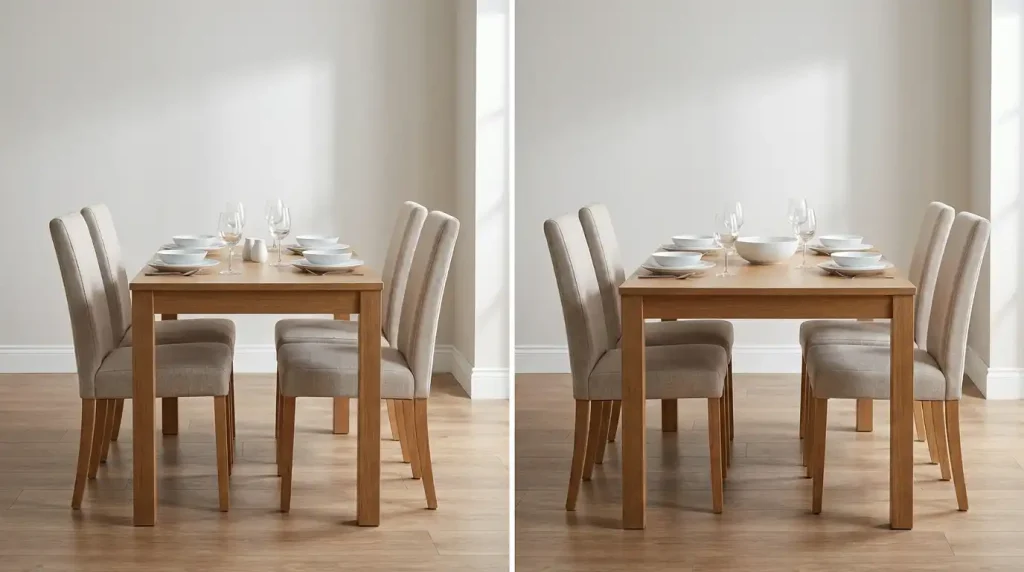
It is easy to assume the chairs stay identical between a 4-seater and 6-seater version of the same set, but it is worth checking rather than assuming. In most matched pairs, the chair design itself carries across unchanged; only the quantity and the table length differ. This matters because it means you can genuinely judge comfort and finish from the 4-seater version alone, without needing to see the larger set in person first, provided the listing confirms the chairs are identical across both sizes.
Occasionally, a 6-seater set introduces a slightly different chair to manage cost at the larger size, such as a simpler frame or a different upholstery grade. It is worth checking the chair dimensions and material specifically on both listings if you are comparing a matched pair, rather than assuming they are identical by default.
Two Worked Examples
Consider a couple living in a two-bedroom flat with an open-plan kitchen diner measuring roughly 3 metres across the dining area. They eat together most evenings and host one or two friends for dinner every few weeks. Their room comfortably fits a 4 seater table with proper clearance on every side, and their hosting pattern, occasional rather than frequent, means a 6-seater would sit oversized for the vast majority of their meals. A 4-seater, such as the grey glass set featured in this guide, suits them well.
Now consider a family of five in a three-bedroom semi-detached house, with a dedicated dining room measuring roughly 4 metres in length. They eat together as a household of five most evenings, and grandparents join for Sunday lunch most weeks. Their everyday headcount alone justifies a 6-seater, and their weekly hosting pattern means the extra capacity gets used far more than twice a month, comfortably clearing the rule covered earlier in this guide. A 6-seater, matched in style to whichever finish suits their existing room, is the clear choice here.
Neither household is choosing based on preference alone. In both cases, the room’s real measurements and the household’s actual weekly pattern point clearly toward one size over the other, which is exactly the process worth following in your own home before you buy.
Common Mistakes
- Choosing size based on the biggest gathering of the year: rather than genuine everyday use, resulting in a table that sits oversized most of the time.
- Not measuring the room before falling for a specific table: then discovering a 6-seater simply does not fit the available space.
- Assuming a round table can comfortably scale to six seats: It generally cannot without an impractically large diameter.
- Buying a 4-seater and hoping to add chairs later: when the table’s spacing was never designed for more than four in the first place.
- Underestimating the price gap correctly: The difference between sizes is usually smaller than buyers assume, which can make the 6-seater worth considering even on a moderate budget.
A Quick Decision Framework
- Measure your room first: Confirm which size genuinely fits before comparing anything else.
- Write down your everyday headcount and your peak headcount: A small gap points toward 4 seats. A wide, regular gap points toward 6.
- Check hosting frequency honestly: If extra seats would be used more than twice a month, size up.
- Consider shape alongside size: Round suits four. Rectangular suits both, and is the only practical choice for six.
- If still torn, consider a bench, an extendable table, or folding chairs: rather than defaulting to the larger fixed size.
Longevity: Which Size Ages Better With Your Household
Household size rarely stays fixed for the life of a dining table, which is worth a moment’s thought before committing to either size.
A 4-seater bought for a couple tends to serve well right up until children arrive and grow old enough to need their own proper seat rather than a highchair, at which point the household often outgrows it. A 6-seater bought slightly ahead of genuine need holds its usefulness longer, since it comfortably absorbs a growing family without a second purchase. This is not a reason to always buy larger than you currently need, but it is worth weighing against the room-size and hosting-frequency rules covered earlier if your household is likely to grow within the next few years.
Frequently Asked Questions
What size room do I need for a 6-seater dining table?
Around 340 to 400cm in the direction the table sits, once you account for the table’s own footprint plus clearance for chairs on each side. Our dimensions guide covers the exact measuring method in full.
Is a 6-seater dining table much more expensive than a 4-seater?
Not usually. The typical difference is £40 to £60 for an equivalent style, reflecting two extra chairs and a longer table rather than a different quality tier.
Can a round table seat six people comfortably?
Generally not without becoming impractically large. Round tables work best for four seats, where the diameter stays manageable, and the centre remains within easy reach.
Should I buy a 6-seater if I only host a few times a year?
Usually not. If your peak headcount only comes up a handful of times a year, a 4-seater paired with folding chairs for those rare occasions is usually the more practical, better-used choice.
Can I add two extra chairs to a 4-seater table later?
Generally no, since 4-seater tables are sized specifically for four place settings. If you expect to need six seats within a couple of years, it is usually better to buy the 6-seater from the start.
What is a good compromise if I cannot decide between the two sizes?
A 4-seater table with a bench on one side, or an extendable table, both give you a smaller everyday footprint with genuine flexibility for occasional larger gatherings.
Choosing the Size That Actually Fits Your Life
There is no universally better size between four and six seats. The right choice comes down to your room’s real measurements, your household’s genuine everyday headcount, and how often extra guests actually show up. Measure first, be honest about your hosting habits, and the right size becomes considerably clearer than any single product photo could make it.
For the style decision once size is settled, our 4-seater dining set styles guide covers finish and chair choice in depth. When you are ready to compare sizes directly, browse the full 4-seater and 6-seater collections at Kosy Koala.
Five Kosy Koala Sets: 4 Seater and 6 Seater Compared
Two matched pairs and one budget-friendly alternative, so you can see exactly how the same style scales between sizes.
Modern Black Glass Dining Table With 4 Black Velvet Chairs
4 Seater Table: H75 x L120 x W70cm. Chairs: H87 x L59 x W44cm, seat height 45cm.
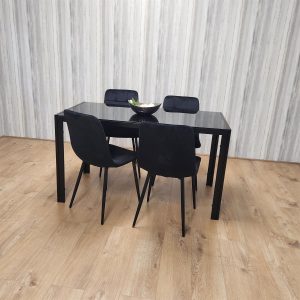
A compact monochrome set that suits a couple or small family, with a footprint that fits comfortably into most UK kitchen diners.
Shop: Modern Black Glass Dining Table With 4 Black Velvet Chairs
Black Clear Glass Dining Table With 6 Black Velvet Chairs
6 Seater Table: H75 x L140 x W80cm. Chairs: H87 x L59 x W44cm, seat height 45cm.
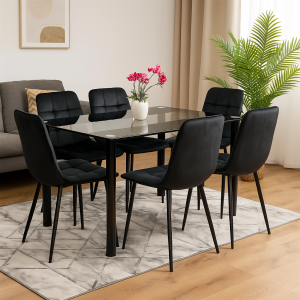
The six seat version of the same monochrome look, sized for a larger household or anyone who hosts regularly enough to want six proper seats as standard.
Shop: Black Clear Glass Dining Table With 6 Black Velvet Chairs
Modern Rectangle Grey Glass Dining Table Set With 4 Grey Velvet Chairs
4 Seater Table: H75 x L120 x W70cm. Chairs: H87 x L59 x W44cm, seat height 45cm.
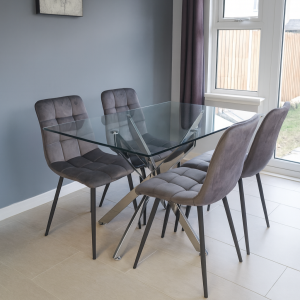
A softer, lighter finish than the monochrome pair above, well suited to a smaller room that benefits from a brighter tone.
Shop: Modern Rectangle Grey Glass Dining Table Set With 4 Grey Velvet Chairs
Modern Rectangle Grey Glass Dining Table Set With 6 Grey Velvet Chairs
6 Seater Table: H75 x L134 x W70cm. Chairs: grey tufted velvet.
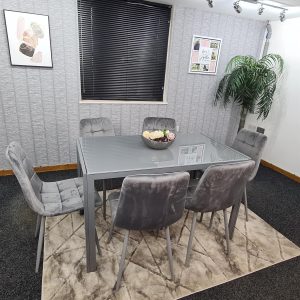
The direct six seat match to the grey set above, ideal for comparing exactly how the same style and finish scale once two more seats are added.
Shop: Modern Rectangle Grey Glass Dining Table Set With 6 Grey Velvet Chairs
Modern Dining Table Set With 4 Black Velvet Chairs, X-Shaped Legs
4 Seater Table: H75 x L134 x W70cm. Chairs: H87 x L59 x W44cm, seat height 45cm.
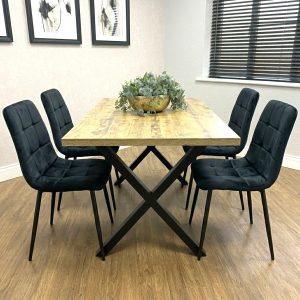
A sturdier wood-effect alternative to the glass options above, with reinforced X-shaped legs, worth considering if a solid, family-proof frame matters more than a glass finish.
Shop: Modern Dining Table Set With 4 Black Velvet Chairs, X-Shaped Legs
Browse the full range at kosykoala dining table-sets
About The Author
This article was written by the Kosy Koala team. We design and source furniture for UK homes, with a focus on practical details that actually matter once a piece is in your room. Have a question about any product on this page? Get in touch through our About Us page.


 Dining Tables
 Dining Chairs

 Bed Frames
 Mattresses
 Bunk Beds
 Sofa & Sofa Beds


